21 October 1805, morning
The approach
At dawn on 21 October the British fleet is about 34 km north-west of Cape Trafalgar, with the combined fleet between it and the cape. At 6 a.m. Nelson orders his ships to prepare for battle. They form two columns, the weather column under Nelson in HMS Victory to the north and the lee column under Collingwood in HMS Royal Sovereign to the south. With the wind behind them they set every sail, but in the light breeze the approach takes hours.
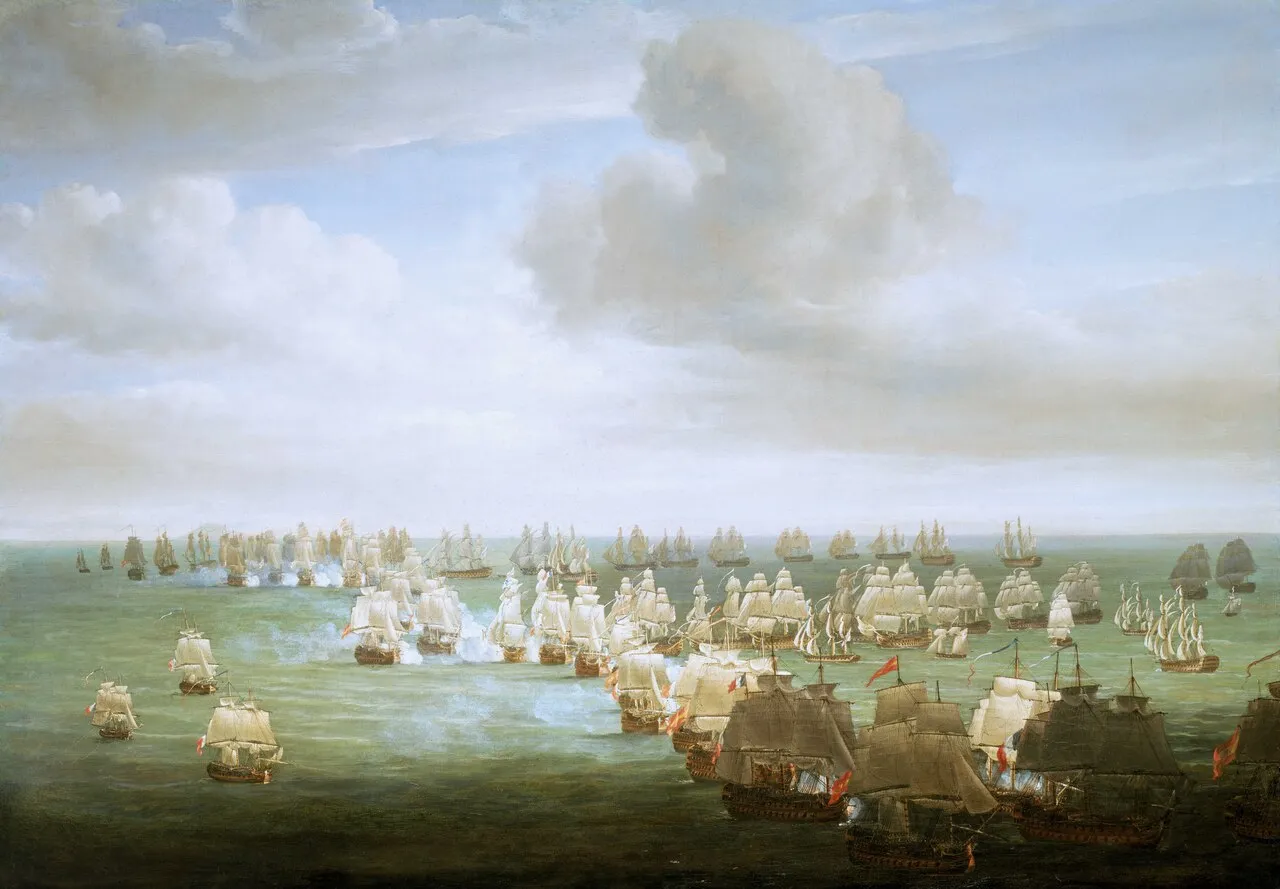 The beginning of the action at Trafalgar, painting by Nicholas Pocock, about 1808Wikimedia Commons, Nicholas Pocock, Public domain (The Battle of Trafalgar, 21 October 1805- Beginning of the Action RMG BHC0548.tiff)
At 8 a.m. Villeneuve orders the fleet to wear together and head back for Cádiz. The turn reverses his line, so that Dumanoir’s rear division now leads, and in the light, shifting wind it takes the inexperienced crews nearly an hour and a half. The combined fleet ends up in an uneven crescent about 8 km long, heading north, with the slower ships to leeward, nearer the shore.
Nelson has 27 ships of the line with about 17,000 men and 2,148 guns. Villeneuve has 33, 18 French and 15 Spanish, with some 30,000 men and about 2,600 guns, among them the Santísima Trinidad of 130 guns. At 11:45 Victory hoists Nelson’s signal “England expects that every man will do his duty”.
Sources
- Mark Adkin, The Trafalgar Companion (2005).
- Tim Clayton and Phil Craig, Trafalgar: The Men, the Battle, the Storm (2004).
- Roy Adkins, Trafalgar: The Biography of a Battle (2004).
Prev: The combined fleetNext: Breaking the line