June to July 1807
Tilsit
After Friedland the Russian army falls back across the Niemen, and on 19 June Alexander I sends an envoy to ask for an armistice. Napoleon tells him that the Vistula is the natural border between French and Russian influence in Europe. On 25 June the two emperors meet on a raft moored in the Niemen at Tilsit, and King Frederick William III agrees to a truce the same day.
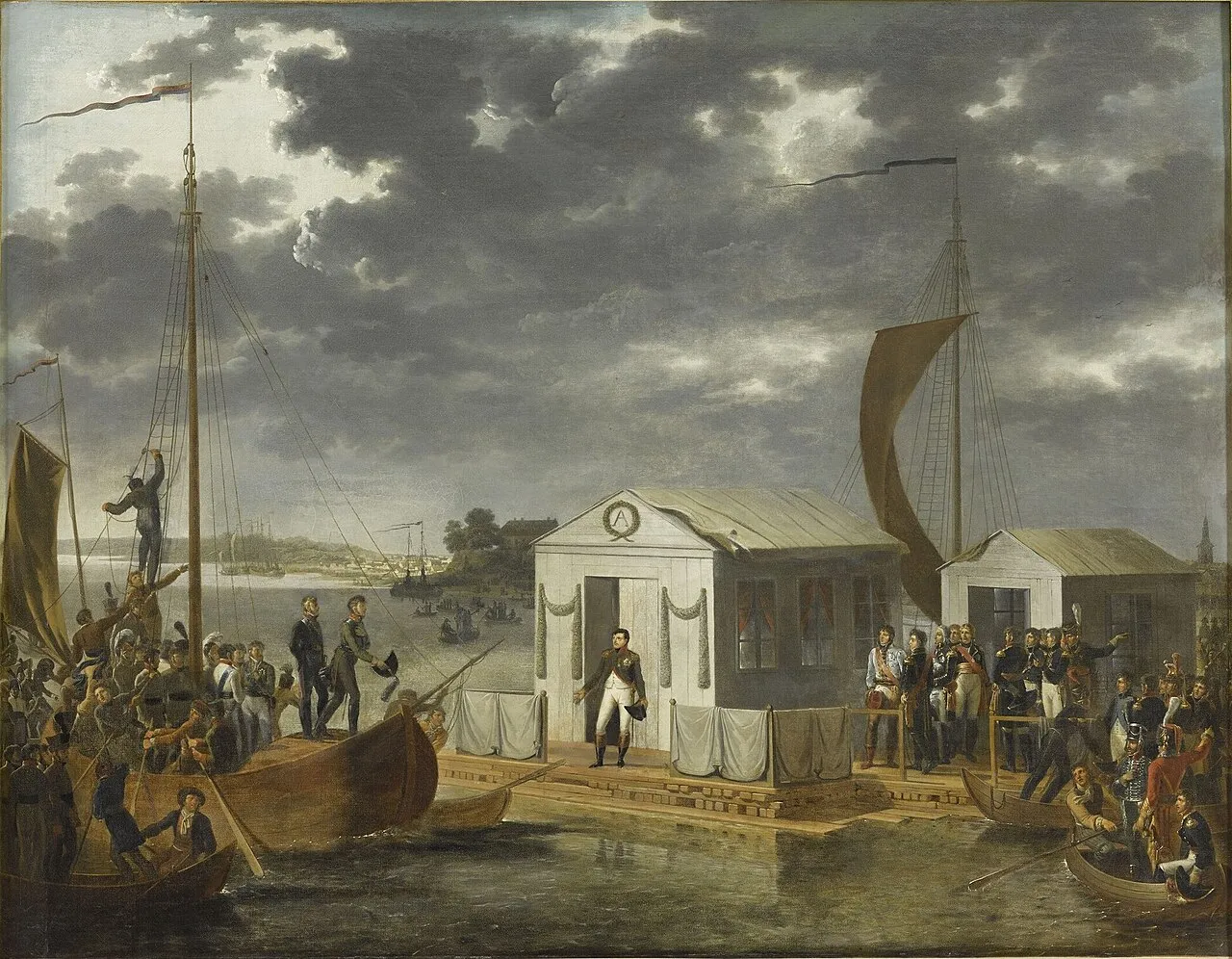 The meeting of Napoleon and Alexander I on the raft at Tilsit, painting by Adolphe Roehn, 1808Wikimedia Commons, Adolphe Roehn, Public domain (Tilsitz 1807.JPG)
The negotiations take two weeks, with reviews of both armies and a banquet for the French and Russian Guards. By the treaty with Russia, signed on 7 July, Alexander joins the Continental System against Britain, agrees to evacuate Wallachia and Moldavia and hands the Ionian Islands and Cattaro to France. In secret the two empires become allies, and France promises Russia its help against the Ottoman Empire.
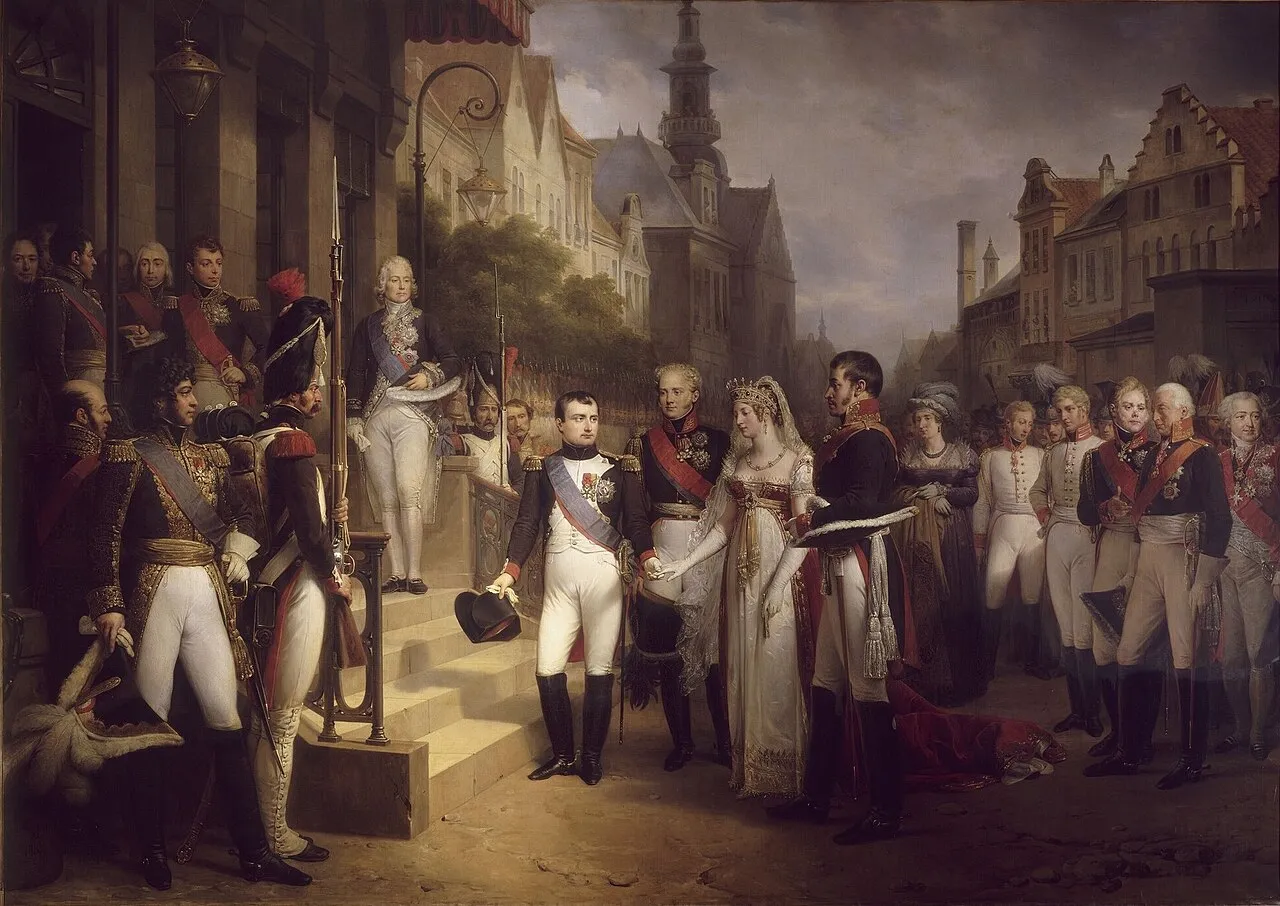 Napoleon receives Queen Louise of Prussia at Tilsit on 6 July 1807, painting by Nicolas Gosse, 1837Wikimedia Commons, Nicolas Gosse, Public domain (Treaty of Tilsit.jpg)
On 6 July Queen Louise meets Napoleon to plead for milder terms, without success. The treaty with Prussia, signed on 9 July, takes about half of its territory and more than half of its people, leaving 4.5 million of 9.75 million. The lands west of the Elbe go to the new Kingdom of Westphalia under Napoleon’s brother Jérôme, most of the Polish lands of the last two partitions become the Duchy of Warsaw under the King of Saxony, Danzig becomes a free city, Białystok goes to Russia and Cottbus to Saxony. Prussia must cut its army to 43,000 men and pay a war contribution, fixed in 1808 at 154.5 million francs and later lowered to 120 million.
Britain and Sweden are the only members of the coalition still at war with France. Napoleon returns to Paris, which he has not seen for more than 300 days.
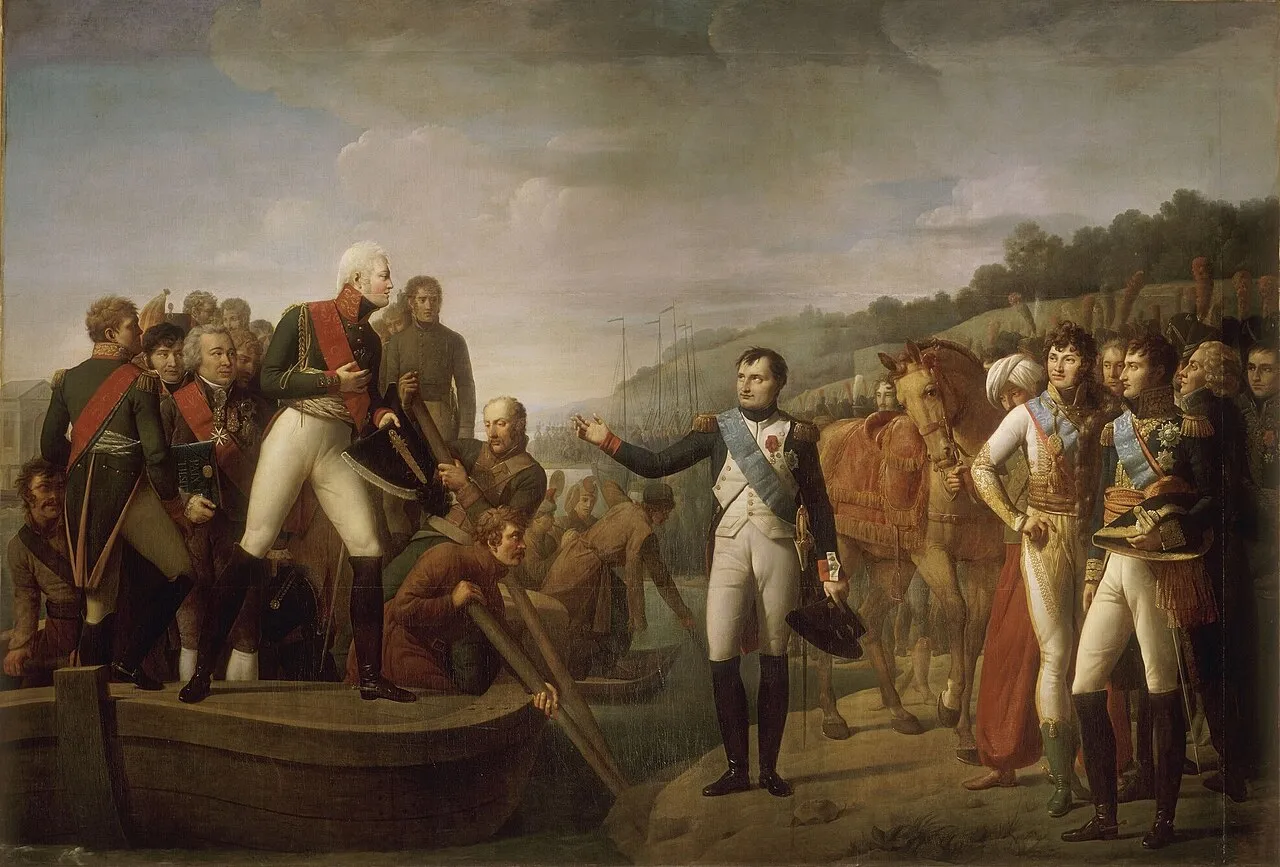 The farewell of Napoleon and Alexander I after the peace of Tilsit, 9 July 1807, painting by Gioacchino Giuseppe Serangeli, 1810Wikimedia Commons, Gioacchino Giuseppe Serangeli, Public domain (Serangeli - Adieux de Napoléon et d'Alexandre après la paix de Tilsitt (9 juillet 1807).jpg)
Sources
- Dominic Lieven, Russia Against Napoleon (2009).
- Georges Lefebvre, Napoleon: From 18 Brumaire to Tilsit, 1799–1807 (1969).
- David G. Chandler, The Campaigns of Napoleon (1966).
Prev: Driven into the AlleNext: Portugal and Spain