October 1807 to June 1808
Portugal and Spain
After Tilsit Napoleon demands that Portugal close its ports to British ships, declare war on Britain and seize British goods. The Prince Regent John closes the ports but will not arrest the British merchants, and on 12 October 1807 General Jean-Andoche Junot’s corps of about 25,000 men crosses the Bidasoa into Spain at Irun. By the secret Treaty of Fontainebleau, signed days later, France and Spain agree to divide Portugal into three parts, and three Spanish columns of 25,500 men in all are to join the invasion.
Junot reaches Salamanca on 12 November and, ordered to hurry, takes the short road over the hills to Alcántara and down the valley of the Tagus. In continual rain half of his horses die and all but six guns are left behind. On 29 November the Prince Regent sails for Brazil with his family, the court and the treasury, 15 warships and more than 20 transports. The next day 1,500 French soldiers march into Lisbon without meeting any resistance.
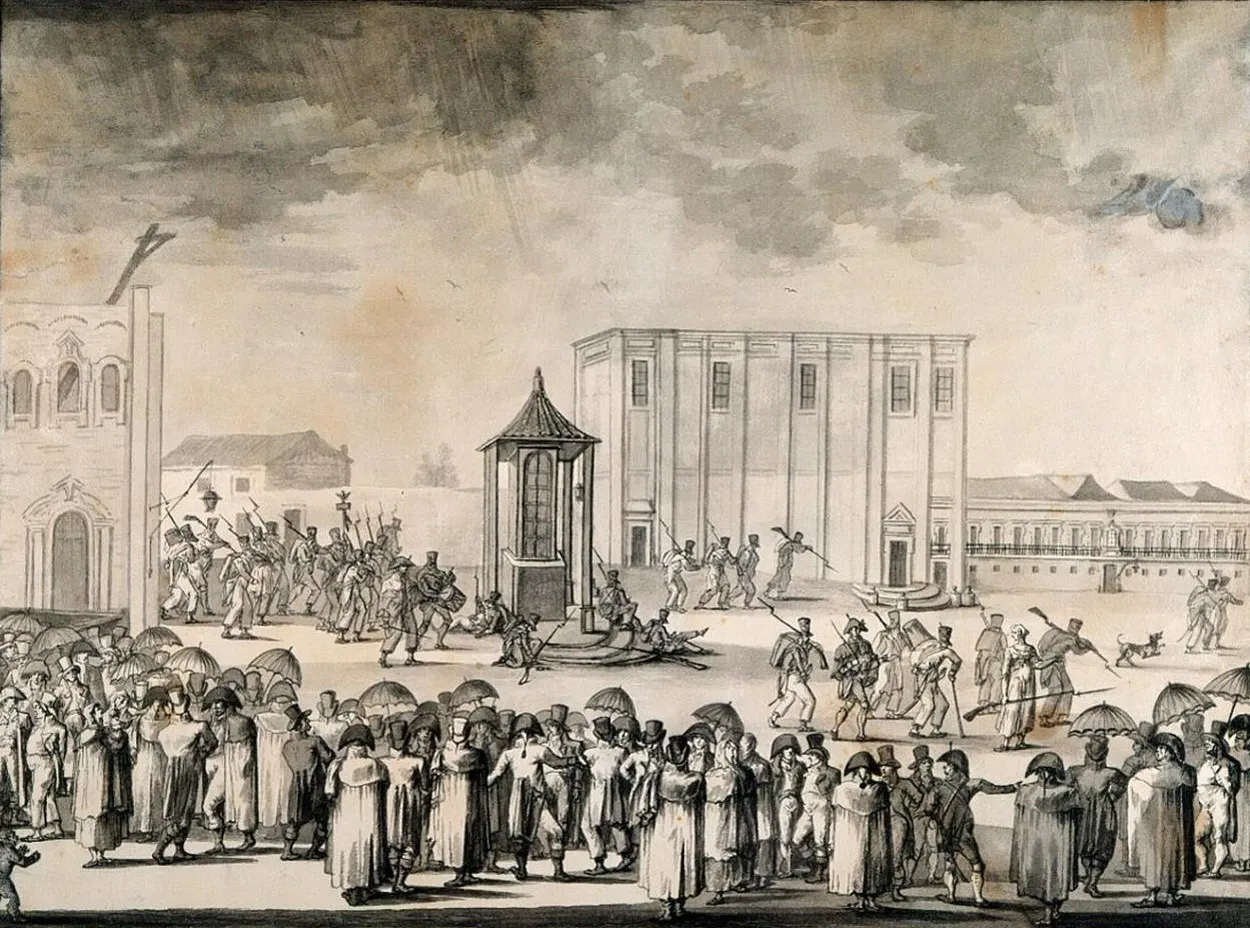 French troops entering Lisbon on 30 November 1807, print by Luís António Xavier, about 1807Wikimedia Commons, Luís António Xavier, Public domain (La veritable entrée des protecteurs en Lisbonne le 30 de Novembre 1807.jpg)
In February 1808 French divisions cross the Pyrenees and occupy Navarre and Catalonia with the citadels of Pamplona and Barcelona. Joachim Murat takes command of all French troops in Spain, 60,000 to 100,000 men. On 17 March a crowd at Aranjuez storms the house of the chief minister Manuel Godoy, and two days later King Charles IV abdicates in favour of his son Ferdinand VII. Murat enters Madrid on 23 March.
Napoleon summons both kings to Bayonne. On 2 May a crowd in Madrid tries to stop the removal of the king’s youngest son to France, and Murat’s troops, the Imperial Guard and its Mamluks among them, put down the rising in street fighting. Hundreds of prisoners are shot the next day. At Bayonne between 5 and 7 May Charles and Ferdinand both renounce the crown to Napoleon, who gives it to his brother Joseph, until then King of Naples, on 6 June.
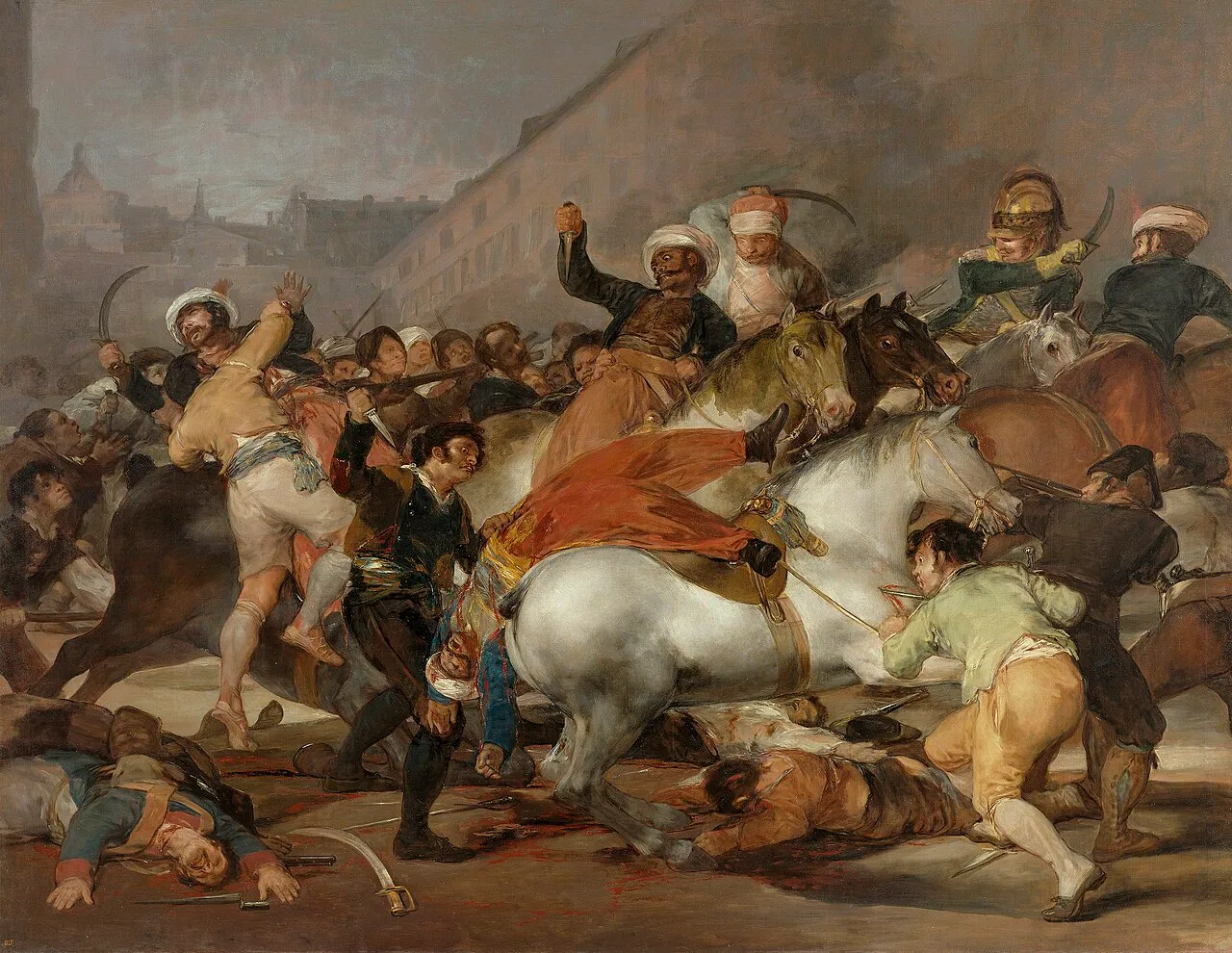 The Second of May 1808 in Madrid, the Mamluks of the Guard charging the crowd, painting by Francisco Goya, 1814Wikimedia Commons, Francisco Goya, Public domain (El dos de mayo de 1808 en Madrid.jpg)
Cartagena and Valencia rise on 23 May, Zaragoza and Murcia on 24 May, and Asturias declares war on Napoleon on 25 May. Within weeks every Spanish province has rebelled, and in June Portugal follows. About 80,000 French troops hold a strip of central Spain from Pamplona and San Sebastián to Madrid and Toledo, and Junot’s corps in Portugal is cut off.
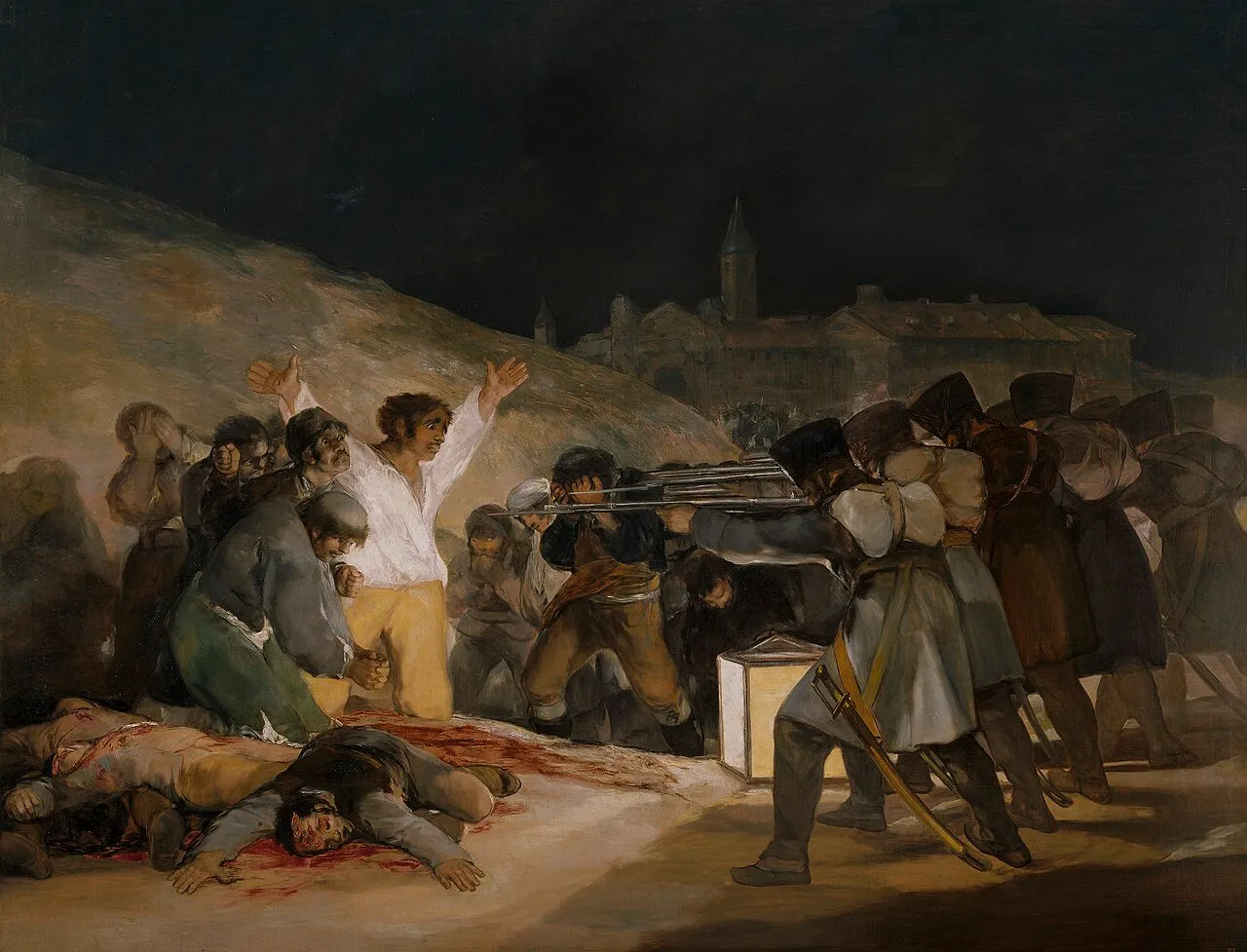 The Third of May 1808 in Madrid, French soldiers shooting prisoners, painting by Francisco Goya, 1814Wikimedia Commons, Francisco Goya, Public domain (El tres de mayo de 1808 en Madrid.jpg)
Sources
- David G. Chandler, The Campaigns of Napoleon (1966).
- Charles Oman, A History of the Peninsular War, vol. I (1902).
- Charles J. Esdaile, The Peninsular War: A New History (2003).
Prev: TilsitNext: Dupont in Andalusia