August 1812
Smolensk
At Vitebsk Napoleon rests his army and waits for stragglers. Detachments, garrisons, hunger and disease have reduced his main strike force from 375,000 men to 185,000. Barclay and Bagration unite their armies at Smolensk, and under pressure from the tsar and the army Barclay agrees on 6 August to attack. Platov’s Cossacks defeat Horace Sébastiani’s cavalry at Inkovo on 7 August, but the offensive stalls in marches and countermarches.
Napoleon answers with a move around the Russian left. On the night of 13 to 14 August General Jean Baptiste Eblé’s engineers build four pontoon bridges over the Dnieper near Rosasna, and about 175,000 men advance east along the south bank towards Smolensk. On 14 August Murat and Ney attack Dmitry Neverovsky’s 27th Division at Krasnoi, which falls back into Smolensk. Nikolay Raevsky’s VII Corps reaches the city on 15 August, and Napoleon halts his advance for a day.
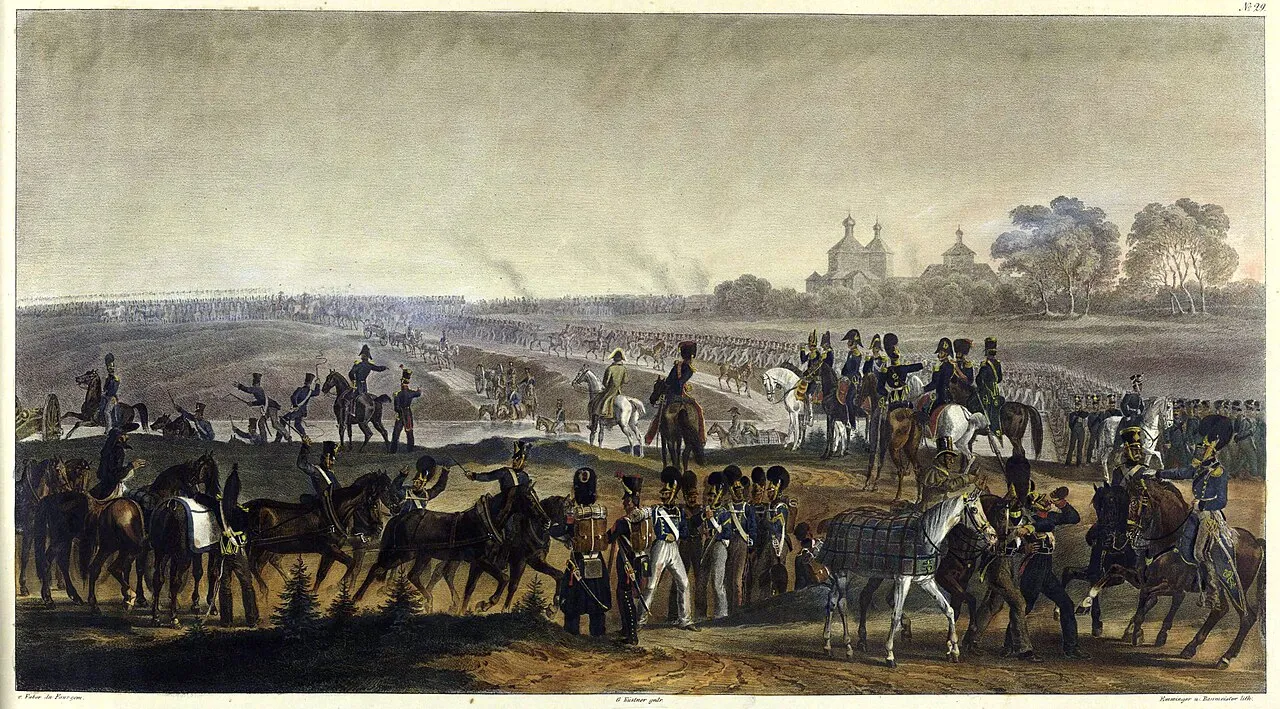 The crossing of the Dnieper on 14 August 1812, by Christian Wilhelm von Faber du FaurWikimedia Commons, Christian Wilhelm von Faber du Faur, Public domain (Dniapro. Дняпро (C. Faber du Faur, 14.08.1812) (2).jpg)
On 16 August the French close up to the walled city on the south bank, where Barclay’s army joins Bagration’s. Napoleon orders a general assault by three corps supported by 200 guns, and the bombardment sets the city on fire. Barclay leaves a rearguard, destroys the bridges and stores, and withdraws his army, and around dawn on 17 August Poniatowski’s Poles break through the walls. The Russians hold the north bank until the night of 18 August.
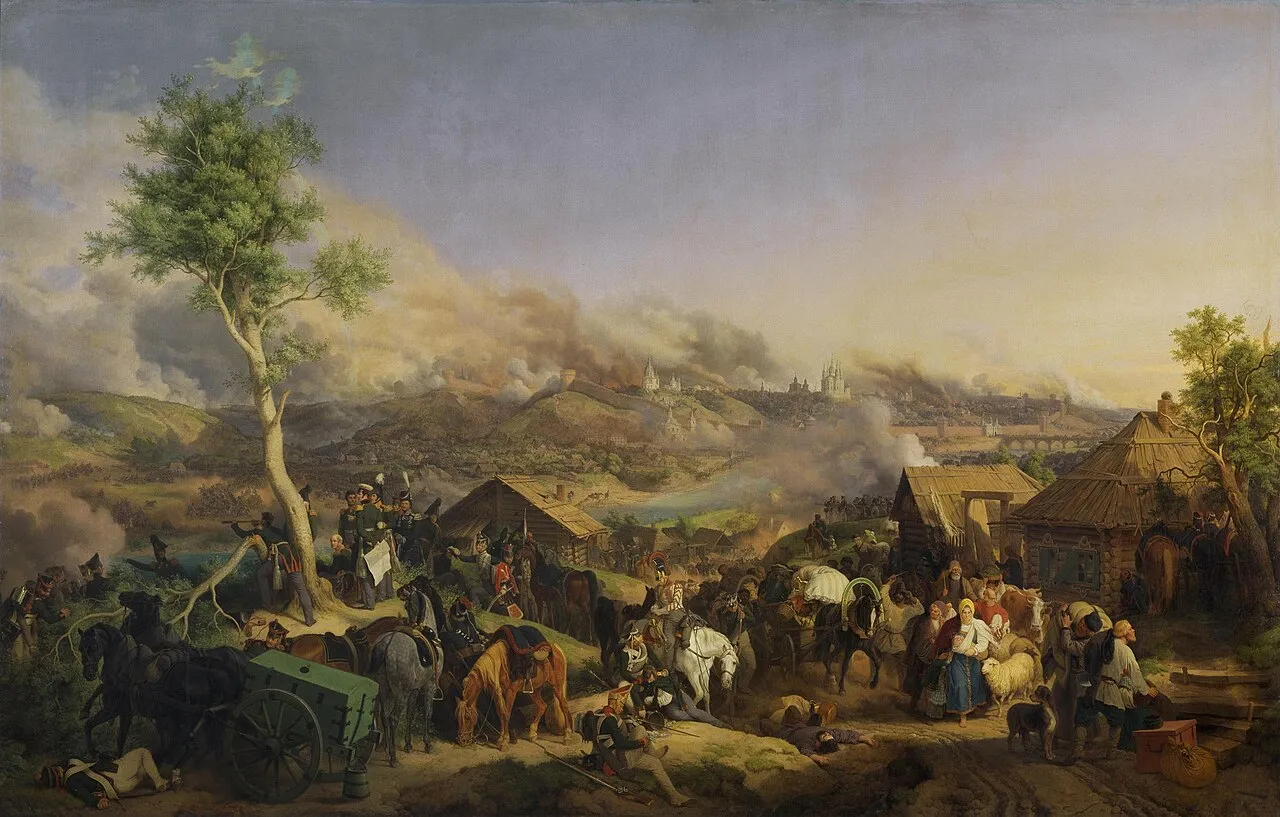 The battle of Smolensk, painting by Peter von Hess, 1846Wikimedia Commons, Peter von Hess, Public domain (Smolensk by hess.jpg)
Russian losses are estimated at between 4,000 and 14,000, French losses at about 10,000, while Napoleon admits 700 killed and 3,100 wounded. Of the city’s 2,250 buildings 84 per cent are destroyed. On 19 August Ney and Junot fail to cut off the Russian rearguard at Valutino, and the next day the tsar appoints Mikhail Kutuzov commander-in-chief in place of Barclay.
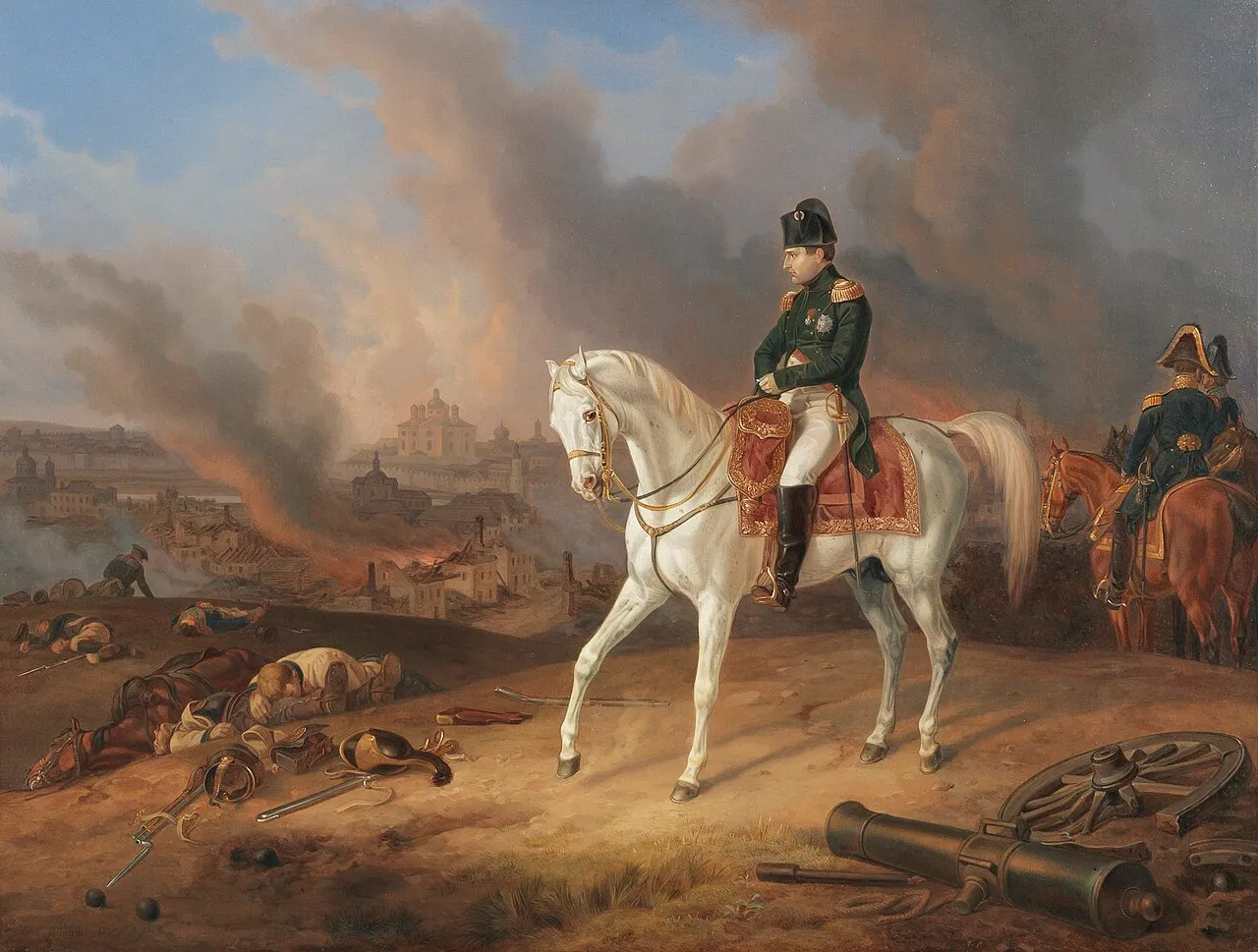 Napoleon before burning Smolensk, painting by Albrecht Adam, 1836Wikimedia Commons, Albrecht Adam, Public domain (Albrecht Adam Napoleon vor dem brennenden Smolensk.jpg)
Sources
- David G. Chandler, The Campaigns of Napoleon (1966).
- Adam Zamoyski, Moscow 1812: Napoleon’s Fatal March (2004).
- Richard K. Riehn, 1812: Napoleon’s Russian Campaign (1990).
Prev: Crossing the NiemenNext: The road to Moscow