July 1809 to 1811
Schönbrunn and the Empire at its height
After Wagram Charles retreats north towards Znaim in Moravia. Marmont attacks the Austrian army there on 10 July, Napoleon arrives with reinforcements, and on 12 July Charles signs the Armistice of Znaim on his own responsibility. In the Netherlands a British army of 39,000 under the Earl of Chatham lands on Walcheren on 30 July to attack Antwerp. It takes Flushing on 16 August, but loses about 4,000 men to fever against 106 killed in action and its last troops leave in December.
The Treaty of Schönbrunn is signed on 14 October 1809. Austria cedes Salzburg to Bavaria, West Galicia to the Duchy of Warsaw and the district of Tarnopol to Russia. Carniola, Trieste, Gorizia, Istria, western Carinthia and the Croatian lands south of the Sava go to France as the Illyrian Provinces, which cuts Austria off from the sea. Austria loses over three million subjects, about a fifth of its population, pays an indemnity of about 85 million francs and joins the Continental System.
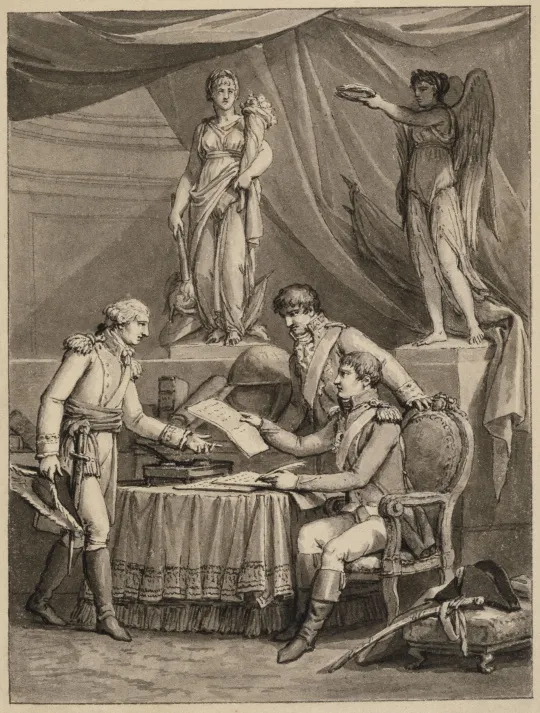 The signing of the Treaty of Schönbrunn, drawing by Charles MonnetWikimedia Commons, Charles Monnet, Public domain (Traité de paix conclu à Vienne le 14 octobre 1809.jpg)
Two days before the signing, Friedrich Staps, the son of a Lutheran pastor from Naumburg, tries to approach Napoleon with a knife at a parade at Schönbrunn and is arrested by General Rapp. In the Tyrol, Bavarian, French and Italian troops, 45,000 men in all, put down Andreas Hofer’s rising by early November. Hofer is betrayed in January 1810 and executed by the French.
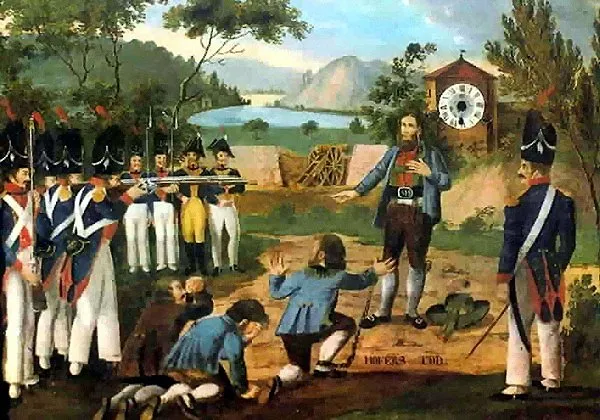 The execution of Andreas Hofer at Mantua on 20 February 1810, print of about 1810Wikimedia Commons, anonymous, Public domain (20 02 1810-die-erschiessung-von-andreas-hofer-in-mantua 1.jpg)
Napoleon’s marriage to Joséphine, who has given him no heir, is annulled on 10 January 1810. On 11 March Archduchess Marie Louise, daughter of Francis I, is married to him by proxy in Vienna, with Archduke Charles standing in for the groom. The civil wedding follows on 1 April and the religious wedding in the Louvre on 2 April, and on 20 March 1811 Marie Louise gives birth to a son, who receives the title King of Rome.
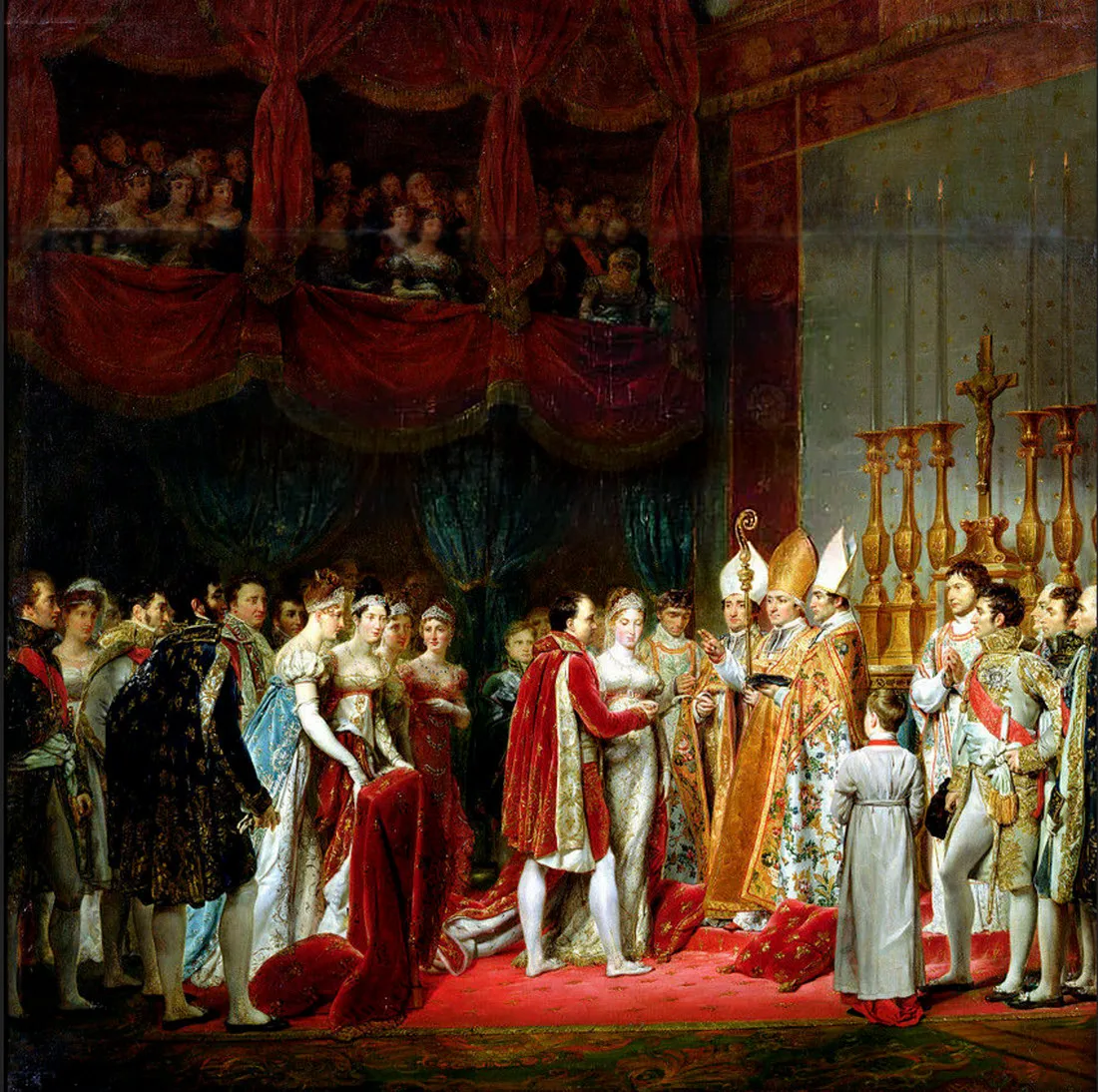 The religious wedding of Napoleon and Marie Louise in the Louvre, painting by Georges Rouget, 1810Wikimedia Commons, Georges Rouget, Public domain (Napoleon Marie Louise Marriage1.jpeg)
The Papal States are annexed and Pope Pius VII is held at Savona. Louis Bonaparte abdicates as King of Holland on 1 July 1810, and Holland is annexed to France. On 21 August 1810 the Swedish estates elect Marshal Bernadotte crown prince of Sweden. At its height in 1812 the French Empire has 130 departments and over 44 million inhabitants, while Russia reopens its trade with Britain in 1810.
Sources
- David G. Chandler, The Campaigns of Napoleon (1966).
- John H. Gill, The Battle of Znaim (2020).
- Alexander Mikaberidze, The Napoleonic Wars: A Global History (2020).
Prev: MacDonald’s columnNext: Crossing the Niemen