22 July 1812, dusk
Ferey’s rearguard
Clauzel orders Ferey to hold off the allies at all costs. Ferey forms seven battalions in a line three deep along the curve of a hillside, a battalion in square on each flank and his guns in close support, and Clinton’s 6th Division attacks it in the dusk. The slope is so steep that the French third rank fires over the heads of the first two, and Hulse’s brigade loses heavily, the 1/11th Foot 340 men out of 516 and the 1/61st 366 out of 546.
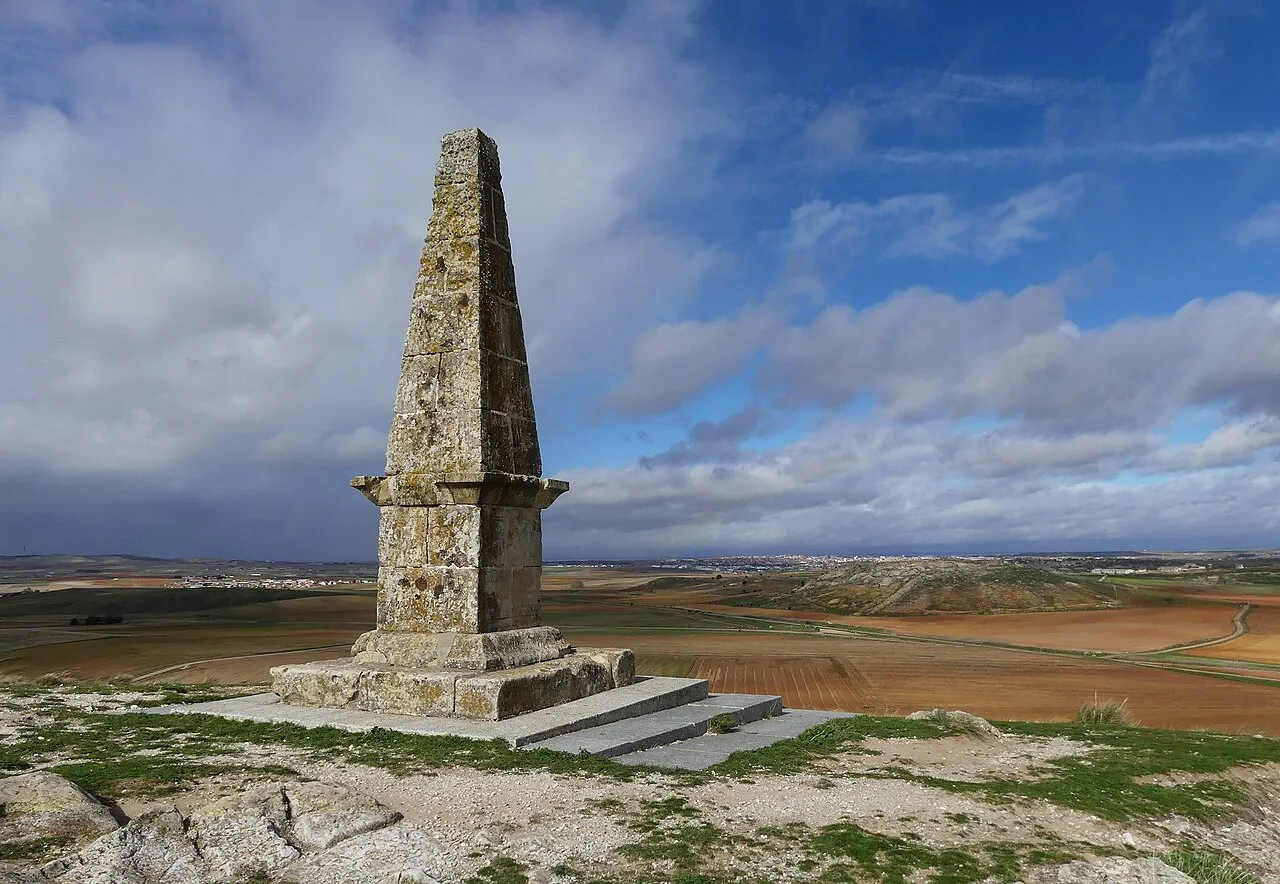 Monument to the battle on the Greater Arapile, photographed in 2019Wikimedia Commons, Alta Falisa, CC BY-SA 4.0 (Los Arapiles 22 July 1812.jpg)
Ferey is killed by a round shot. Rezende’s Portuguese brigade attacks next and loses 487 men, and when the 5th Division presses on the French left, Ferey’s line gives way into the forest, having lost over 1,100 men. Foy’s division covers the retreat to the bridge at Alba de Tormes, which the French cross because the Spanish battalion in its castle has been withdrawn without Wellington’s knowledge.
The French lose 7,000 to 10,000 killed and wounded, 7,000 prisoners and two Eagles, and the allies 3,129 British, 2,038 Portuguese and 6 Spanish killed and wounded. The next day the dragoons of the King’s German Legion break two French squares at García Hernández. King Joseph leaves Madrid, and Wellington enters it on 12 August.
Sources
- Rory Muir, Salamanca, 1812 (2001).
- Ian Fletcher, Salamanca 1812: Wellington Crushes Marmont (1997).
Prev: Clauzel’s counterattackNext: Burgos and the advance of 1813