January 1797
The fourth relief of Mantua
For the fourth relief of Mantua Alvinczi gathers 28,000 men in the north, to come down the Adige and through the mountains east of Lake Garda in five columns. Two smaller forces advance from the east: Bajalics with 6,200 men from Bassano towards Verona, and Provera with 9,000 men and a bridging train from Padua, to cross the Adige near Legnago and march on Mantua.
Bonaparte has Joubert’s division of 10,300 men near Rivoli, Masséna’s 9,000 at Verona, Augereau’s 9,000 behind the Adige near Legnago, Rey’s 4,000 west of Lake Garda and Sérurier’s 10,000 blockading Mantua. Victor’s brigade of 2,000 and three small cavalry brigades are in reserve. Provera sets out on 7 January 1797 and Bajalics on the next day, and by 10 January they threaten Legnago and Verona.
Alvinczi attacks Joubert on 12 January, and Joubert holds him off. On the afternoon of 13 January Bonaparte sees that the main attack is coming from the north and orders Masséna, Rey and Victor to march to Rivoli. He reaches the plateau himself at 2 am on 14 January, where Joubert, joined by Berthier, holds a line on the Trambasore heights north of the village. That night Provera crosses the Adige at Angiari, above Legnago, and marches for Mantua.
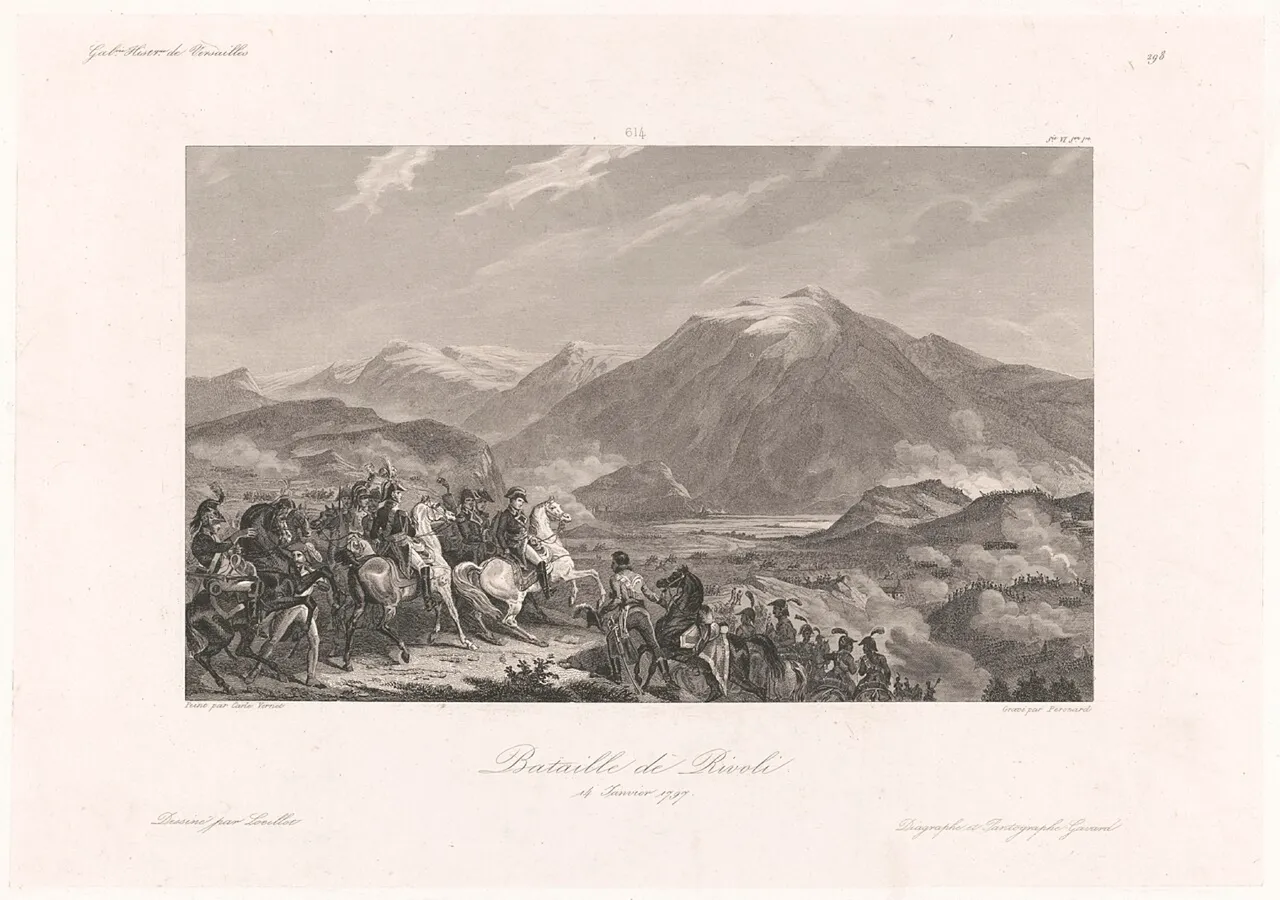 The Battle of Rivoli, engraving for the Galerie historique de Versailles, 19th centuryWikimedia Commons, Peronard, Public domain (Bataille de Rivoli LCCN2003677129.jpg)
Sources
- David G. Chandler, The Campaigns of Napoleon (1966).
- Martin Boycott-Brown, The Road to Rivoli: Napoleon’s First Campaign (2001).
- Phillip R. Cuccia, Napoleon in Italy: The Sieges of Mantua, 1796–1799 (2014).
Prev: Arcole fallsNext: Joubert holds the heights