February to May 1815
The return from Elba
On Elba Napoleon forms a small army and navy, works the iron mines and builds roads, but his wife and son do not join him, the allowance promised at Fontainebleau is not paid, and there are rumours that he is to be moved to a remote island in the Atlantic. In France Louis XVIII is unpopular, and the powers at the Congress of Vienna are divided over Poland and Saxony.
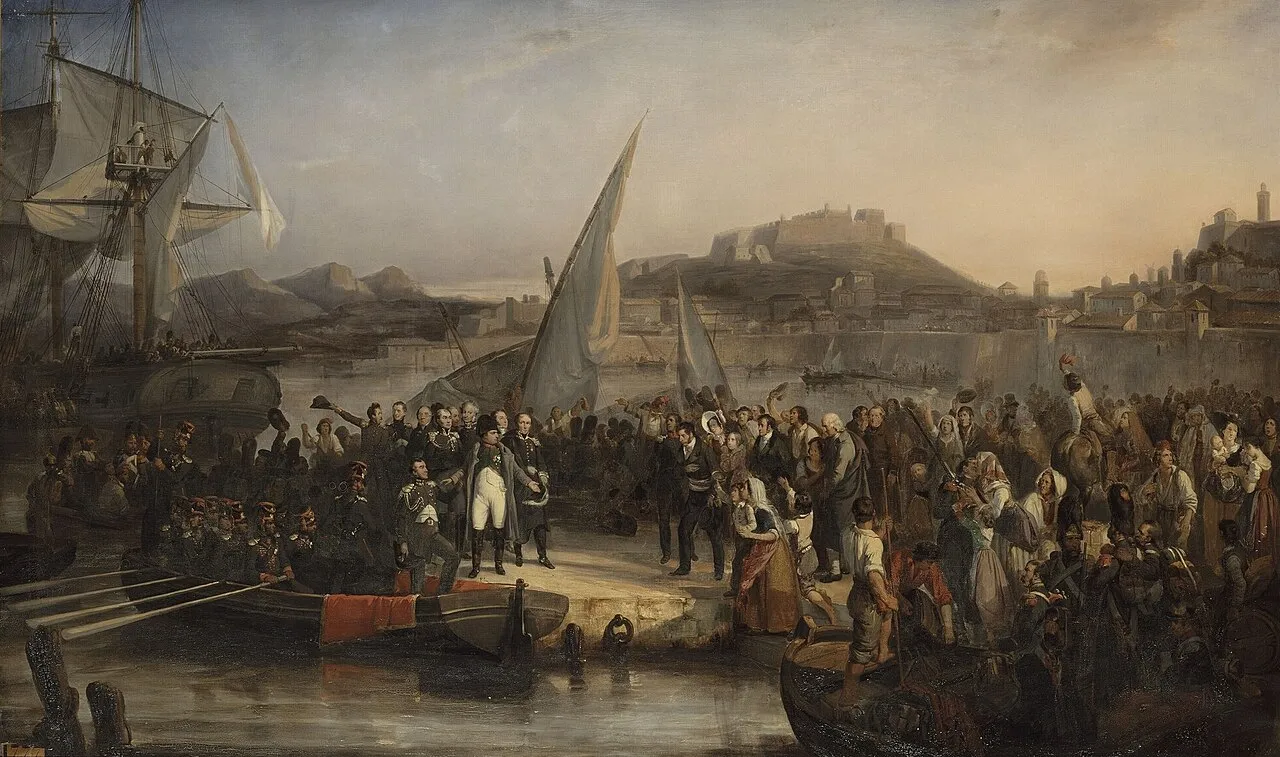 Napoleon leaves Elba, painting by Joseph Beaume, 1836Wikimedia Commons, Joseph Beaume, Public domain (Beaume - Napoléon Ier quittant l'île d'Elbe - 1836.jpg)
On 26 February 1815, while the British and French guard ships are away, Napoleon leaves Portoferraio with about 1,000 men in the brig Inconstant, four small transports and two feluccas. He lands at Golfe-Juan, between Cannes and Antibes, on 1 March. To avoid royalist Provence he marches north through the Alps, on the road now called the Route Napoléon.
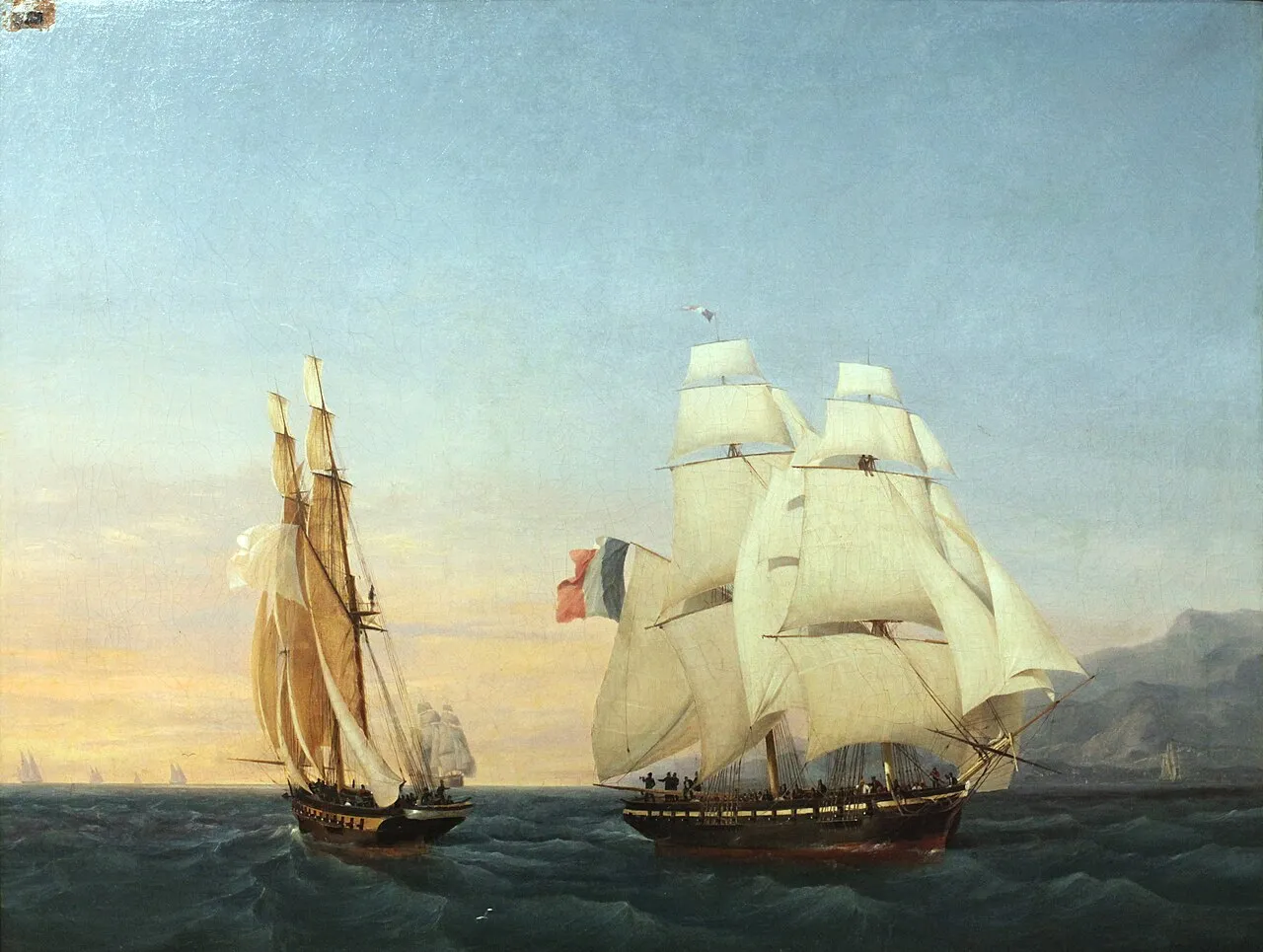 The brig Inconstant, carrying Napoleon to France, crosses the path of the brig Zéphir, painting by Ambroise Louis GarnerayWikimedia Commons, Ambroise Louis Garneray, Public domain (Retour de lIle dElbe-Garneray-IMG 2247.jpg)
At Laffrey, south of Grenoble, the 5th Infantry Regiment is sent to stop him. He walks up to the soldiers alone and offers to let them shoot their emperor, and they go over to him, followed by the 7th Regiment under Charles de La Bédoyère.
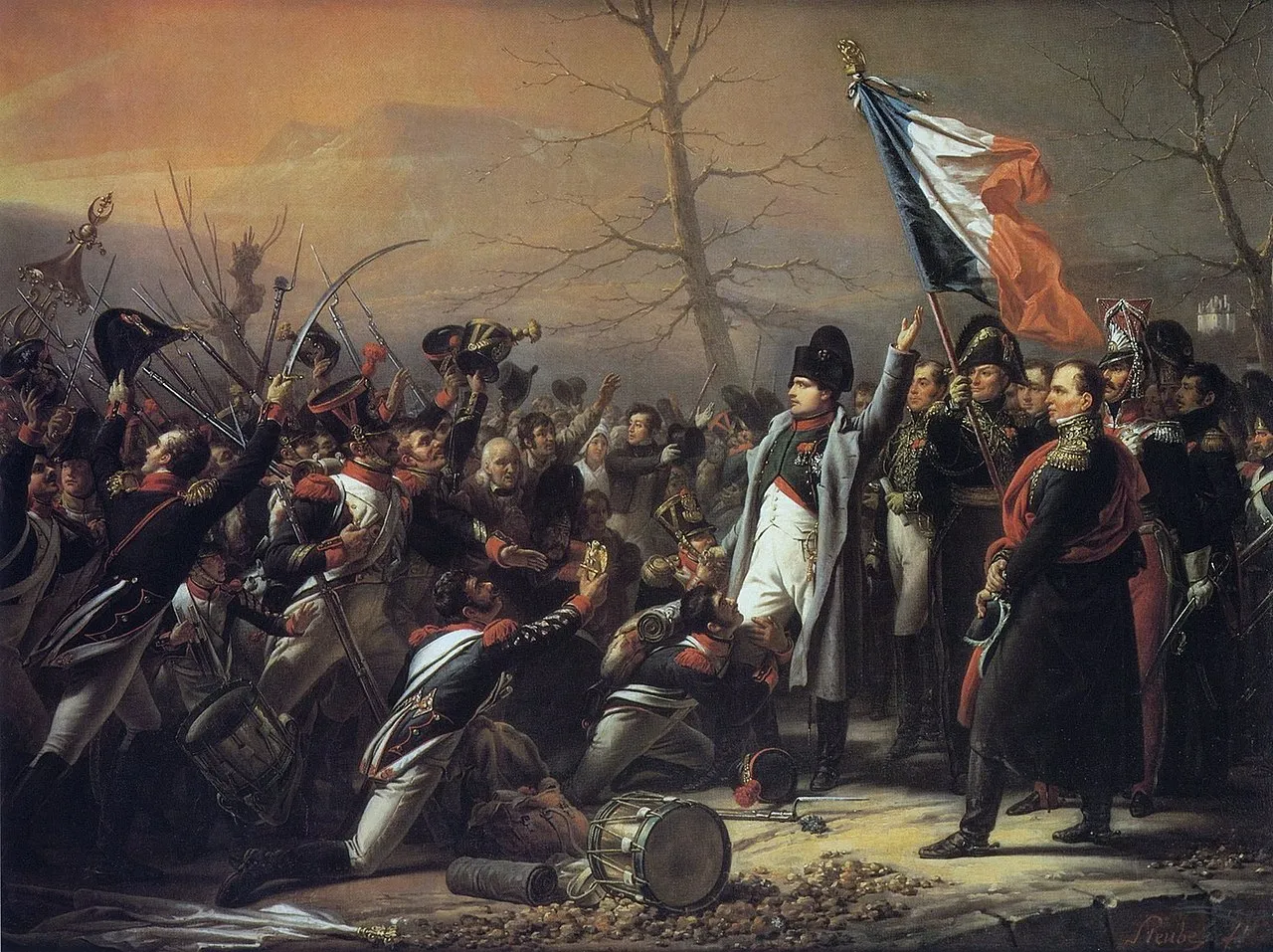 Napoleon’s return from Elba, painting by Charles de Steuben, 1818Wikimedia Commons, Charles de Steuben, Public domain (Retour de Napoleon d' Isle d'Elbe, by Charles de Steuben.jpg)
At Lyon on 13 March Napoleon dissolves the royal chambers and calls a national assembly. The same day the powers in Vienna declare him an outlaw, and on 25 March Austria, Prussia, Russia and Britain each bind themselves to put 150,000 men into the field against him. On 14 March at Lons-le-Saunier Marshal Ney, who has said that Napoleon should be brought to Paris in an iron cage, goes over to him with 6,000 men. Louis XVIII leaves Paris for Belgium in the early hours of 20 March, and Napoleon enters the city that evening without a shot fired.
Napoleon forms a government and has a revised constitution approved by plebiscite in May, with 1,532,527 votes cast. The law does not allow conscription, and he raises about 300,000 men, many of them recruits and National Guards. In Italy Joachim Murat, King of Naples, declares war on Austria on 15 March, is defeated at Tolentino and loses his throne.
Sources
- David G. Chandler, The Campaigns of Napoleon (1966).
- David Chandler, Waterloo: The Hundred Days (1981).
Prev: Paris and the abdicationNext: The armies in Belgium