15 – 16 June 1815
Ney at Quatre Bras
Ney's orders are to take the crossroads of Quatre Bras, where the road from Charleroi to Brussels meets the road from Nivelles to Namur, and to be ready to turn east and help Napoleon against the Prussians. If the French hold it, Wellington cannot move along the Namur road to join Blücher. On the evening of 15 June the Nassauers of Saxe-Weimar turn back the Guard lancers at Frasnes, and Ney camps for the night rather than attack with his infantry strung out along the road.
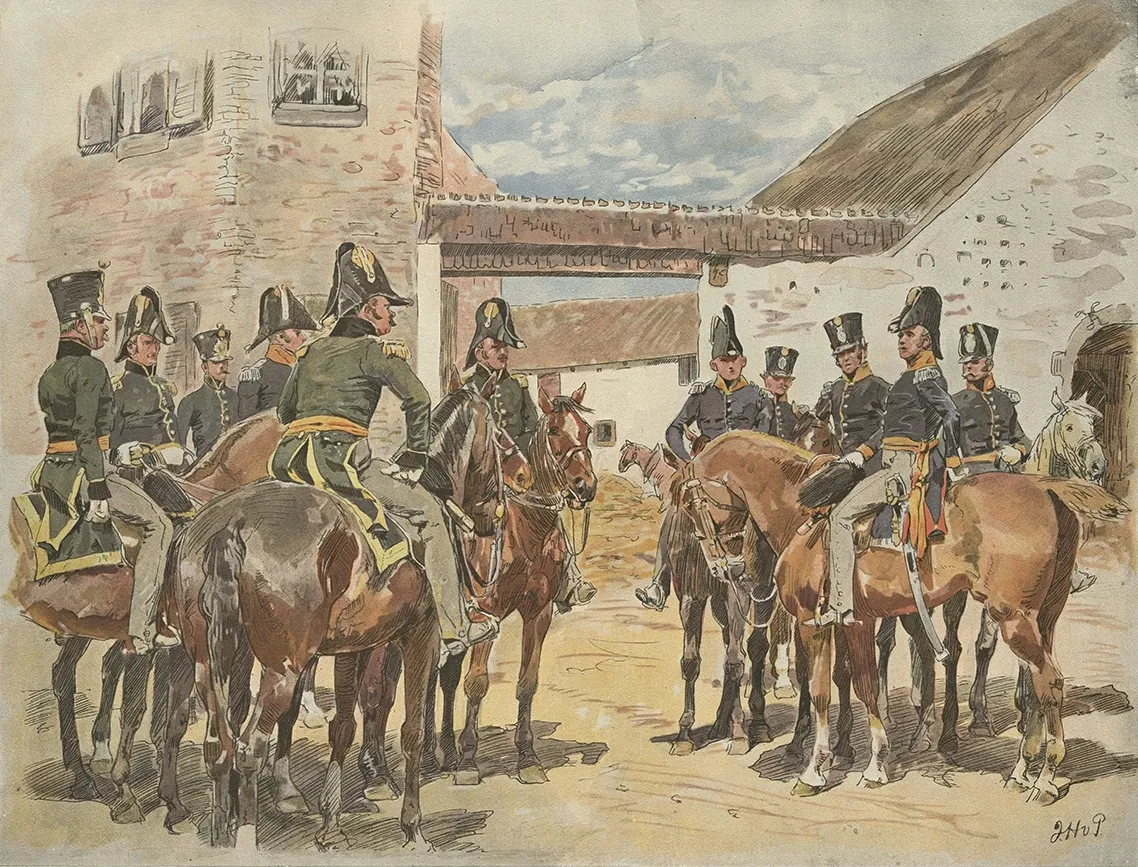 Prince Bernhard of Saxe-Weimar and the officers of his brigade at Quatre Bras, by Jan Hoynck van PapendrechtWikimedia Commons, Jan Hoynck van Papendrecht, Public domain (Saxe-Weimar and other officers at Quatre Bras (cropped).jpg)
Ney spends the morning of 16 June gathering his I and II Corps and Kellermann's III Cavalry Corps and reconnoitring, and makes no serious attempt on the crossroads before noon. At the start of the battle he has about 18,000 men at hand, with 2,000 cavalry and 32 guns, against 8,000 infantry with 16 guns under the Prince of Orange: Perponcher's 2nd Netherlands Division, the brigades of Bylandt and Saxe-Weimar.
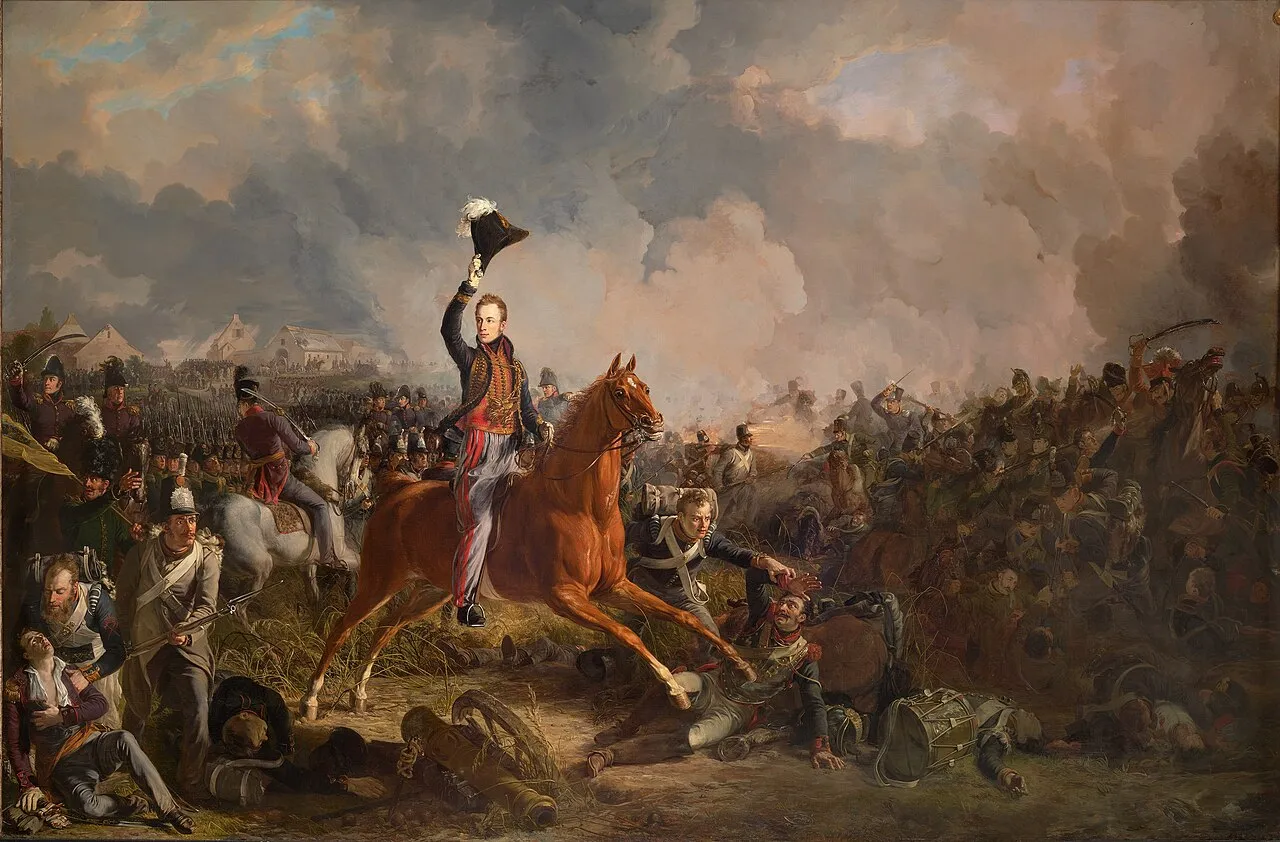 The Prince of Orange at Quatre Bras, painting by Jan Willem Pieneman, 1818Wikimedia Commons, Jan Willem Pieneman, Public domain (The Prince of Orange at Quatre Bras.jpg)
South of the crossroads the Brussels road passes the farm of Gemioncourt. To the west lie the Bossu wood and the farm of Pierrepont, and to the east the hamlet of Piraumont. Wellington's divisions are on the march from Brussels and Nivelles, and they reach the field one after another through the afternoon.
Sources
- William Siborne, The Waterloo Campaign, 1815 (1848).
- Peter Hofschröer, Waterloo 1815: Quatre Bras and Ligny (2005).
- Bernard Cornwell, Waterloo: The History of Four Days, Three Armies and Three Battles (2015).
Prev: Ligny: the Guard breaks the centreNext: Quatre Bras: Ney attacks