2 to 20 July 1798
The march on Cairo
Bonaparte leaves Kléber as governor of Alexandria and sends Dugua’s division along the coast to Rosetta, at the western mouth of the Nile. From there a flotilla of about 65 river boats under Jean-Baptiste Perrée, 25 of them armed, is to carry supplies up the river. To reach Cairo before the Nile flood, the main army marches from 6 July through the desert by Damanhur to Rahmaniya on the Nile, which its head reaches on 10 July. Bedouin have filled in the wells, and many soldiers suffer from thirst, dysentery and inflamed eyes.
Murad Bey comes north with about 3,000 Mamluk horsemen, their attendants and a force of infantry, while Ibrahim Bey gathers a second army near Cairo. On 13 July the armies meet at Shubra Khit. The French form each division into a large rectangle, and the Mamluk charges break on their musketry and grapeshot, while on the river Perrée’s flotilla fights off Murad’s gunboats. Murad withdraws towards Cairo.
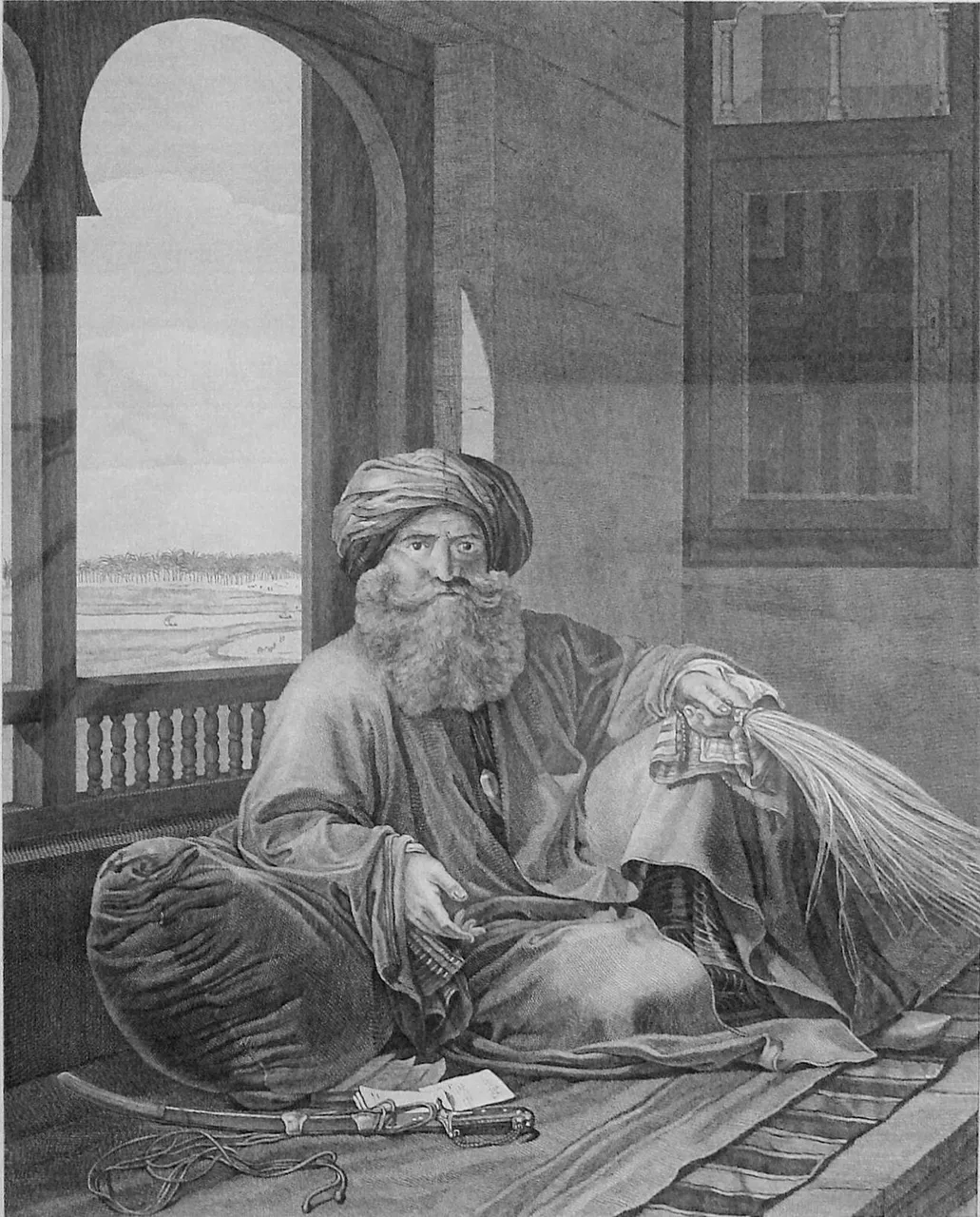 Murad Bey, drawing by Dutertre in the Description de l’Égypte, 1809Wikimedia Commons, Dutertre, Public domain (Murad Bey by Dutertre in Description de l Egypte 1809.jpg)
The French follow the west bank of the Nile south. On 20 July they reach Umm Dinar, 29 km north of Cairo, and learn that Murad Bey has fortified the village of Embabeh on the west bank, while Ibrahim Bey holds the east bank opposite. After marching through the night, the army comes in sight of Embabeh on 21 July, about 14 km from the pyramids of Giza.
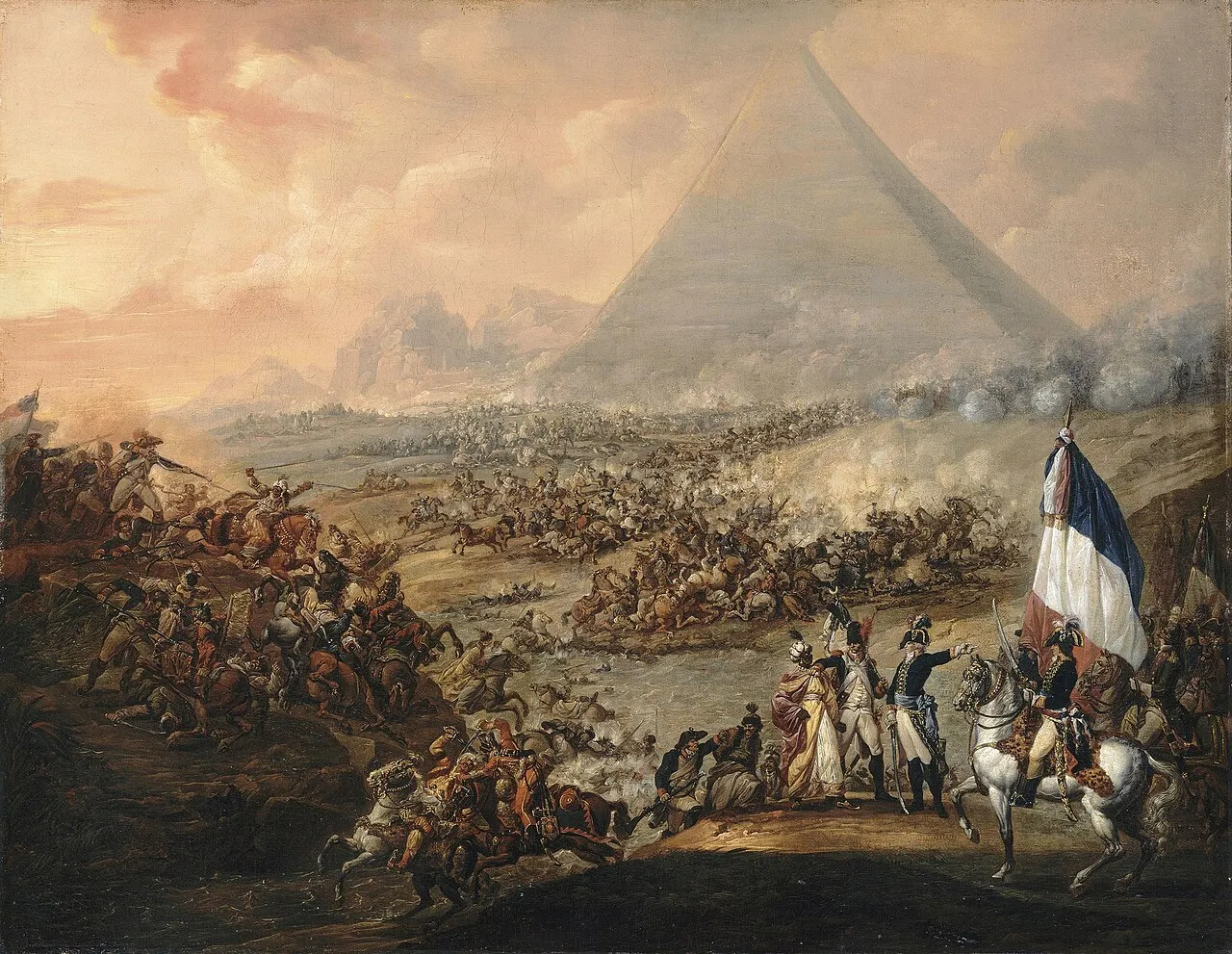 The Battle of the Pyramids, painting by François-Louis-Joseph Watteau, 1798 to 1799Wikimedia Commons, François-Louis-Joseph Watteau, Public domain (Francois-Louis-Joseph Watteau 001.jpg)
Sources
- David G. Chandler, The Campaigns of Napoleon (1966).
- Paul Strathern, Napoleon in Egypt (2008).
- Juan Cole, Napoleon’s Egypt: Invading the Middle East (2007).
Prev: The expedition to EgyptNext: The squares and the Mamluk charge