August to 10 October 1806
Prussia goes to war
In July 1806 Napoleon founds the Confederation of the Rhine, a league of German states under his protection, and Emperor Francis II dissolves the Holy Roman Empire. In peace talks with Britain Napoleon offers to give back Hanover, which he had promised to Prussia months before. The war party at the Prussian court, led by Queen Louise, gains the upper hand, and on 7 August King Frederick William III decides on war. His only German ally is Saxony, and the Russian army is still far to the east.
 Queen Louise of Prussia, portrait by Josef Grassi, 1802Wikimedia Commons, Josef Grassi, Public domain (Grassi, Josef Mathias - Luise von Mecklenburg-Strelitz.jpg)
Prussia mobilises 171,000 men, 20,000 of them Saxons, in three armies under the Duke of Brunswick, Prince Hohenlohe, and Ernst von Rüchel with Gebhard von Blücher. Brunswick’s orders must be confirmed by the king, and councils of war debate several plans for weeks. On 5 October, when a reconnaissance finds the French moving north from Bayreuth, they decide to gather Hohenlohe’s army at Rudolstadt, Brunswick’s at Erfurt and Rüchel’s at Gotha. An ultimatum demands that the French withdraw west of the Rhine by 8 October, and on 9 October Prussia declares war.
Napoleon calls up 50,000 conscripts on 5 September and gathers the Grande Armée, about 180,000 men, along the southern border of Saxony. On 8 October it crosses the Franconian Forest in three columns close enough to support each other, an order of march he calls the bataillon carré. Soult’s and Ney’s corps march by Hof on the right, Bernadotte’s and Davout’s with Murat’s cavalry and the Guard by Schleiz in the centre, and Lannes’s and Augereau’s by Saalfeld on the left. By Petre’s count the French advance on a front of 60 km, while the Prussian and Saxon army is spread over 145 km.
On 9 October Drouet’s division of Bernadotte’s corps and Murat’s cavalry drive Bogislav von Tauentzien’s Prussians and Saxons out of Schleiz, and Tauentzien falls back to Auma with a loss of 566 men. The next day at Saalfeld, Lannes with 12,800 men meets the 8,300 Prussians and Saxons of Prince Louis Ferdinand, the advance guard of Hohenlohe’s army. While the 17th Light Infantry holds the front, Suchet’s division marches through the woods around the open Prussian right.
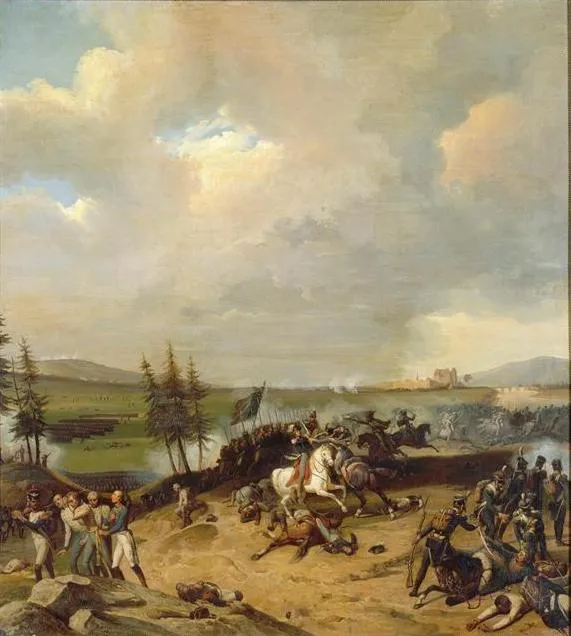 Lannes’s victory over the Prussians at Saalfeld, painting by François Desmoulins, 1837Wikimedia Commons, François-Barthélémy-Augustin Desmoulins, Public domain (Desmoulins - Victoire du maréchal Lannes sur les troupes prussiennes à Saalfeld sur la Saale en Thuringe.jpg)
At 11 a.m. an order from Hohenlohe tells the prince to stay at Rudolstadt, and he tries to break off the fight. Just before 1 p.m. Lannes attacks along the whole line. The prince leads his cavalry against the French hussars and chasseurs and is overwhelmed, and near Wöhlsdorf he refuses to surrender and is cut down by Quartermaster Guindet of the 10th Hussars. His force loses about 900 killed and wounded, 1,800 prisoners and 33 guns, the French 172 to 200 men.
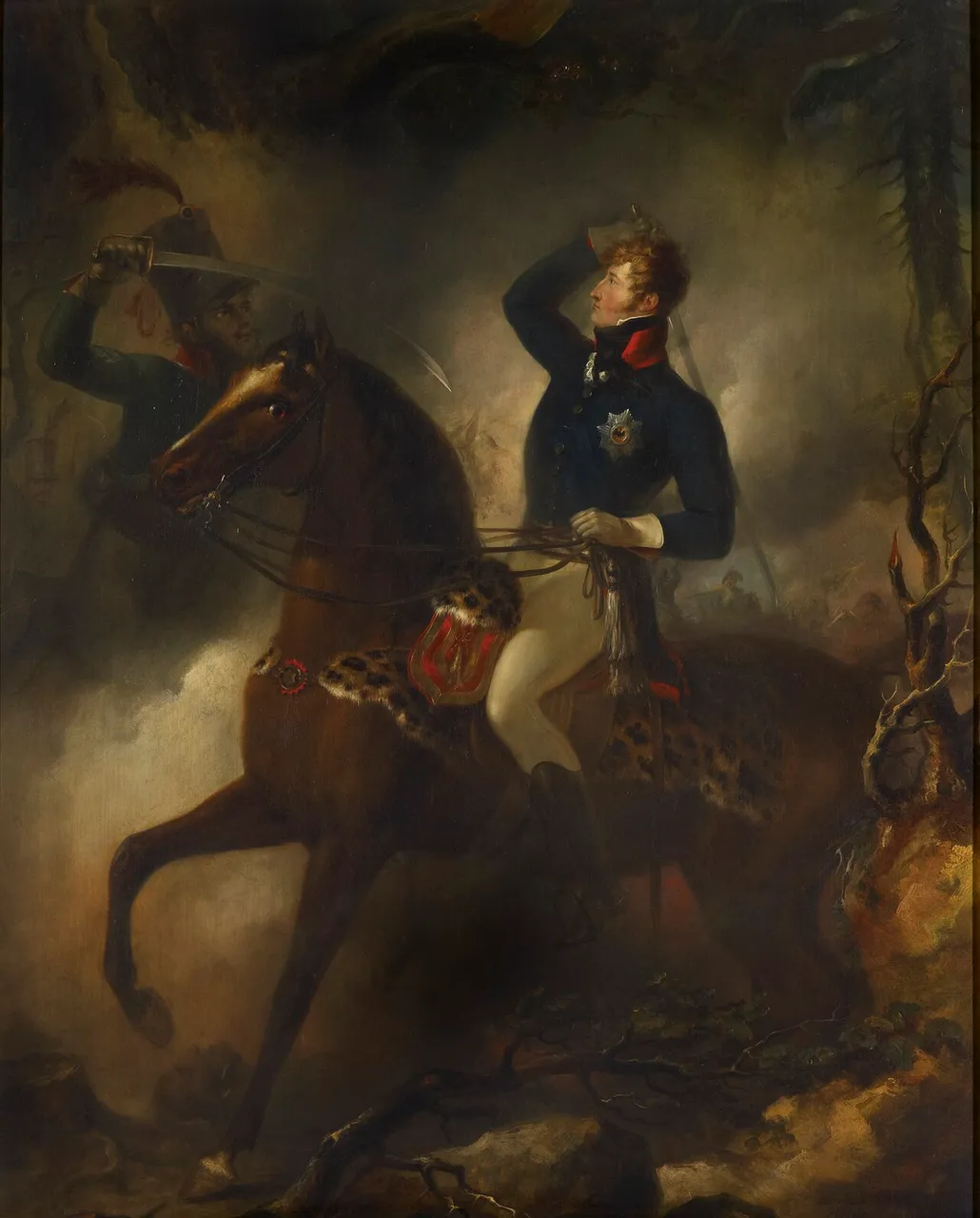 The death of Prince Louis Ferdinand at Saalfeld, painting by Peter Edward Stroehling, between about 1806 and 1816Wikimedia Commons, Peter Edward Stroehling, Public domain (Peter Edward Stroehling (1768-c. 1826) - The Death of Prince Louis Ferdinand of Prussia (1772-1806) - RCIN 405839 - Royal Collection.jpg)
Sources
- F. Loraine Petre, Napoleon’s Conquest of Prussia 1806 (1907).
- David G. Chandler, The Campaigns of Napoleon (1966).
- Digby Smith, The Napoleonic Wars Data Book (1998).
Prev: Pressburg and the Confederation of the RhineNext: The armies meet on the Saale