December 1805 to August 1806
Pressburg and the Confederation of the Rhine
On 4 December 1805 France and Austria agree a truce, and the Russian army is allowed to march home. On 26 December Talleyrand, and for Austria Prince Johann of Liechtenstein and Count Ignác Gyulay, sign the Peace of Pressburg. Austria leaves the coalition and confirms the treaties of Campo Formio and Lunéville. It cedes Venetia, Istria and Dalmatia to the Kingdom of Italy, Tyrol, Vorarlberg and Augsburg to Bavaria and its Swabian lands to Württemberg and Baden, recognises the Electors of Bavaria and Württemberg as kings and pays 40 million francs, while it receives Salzburg.
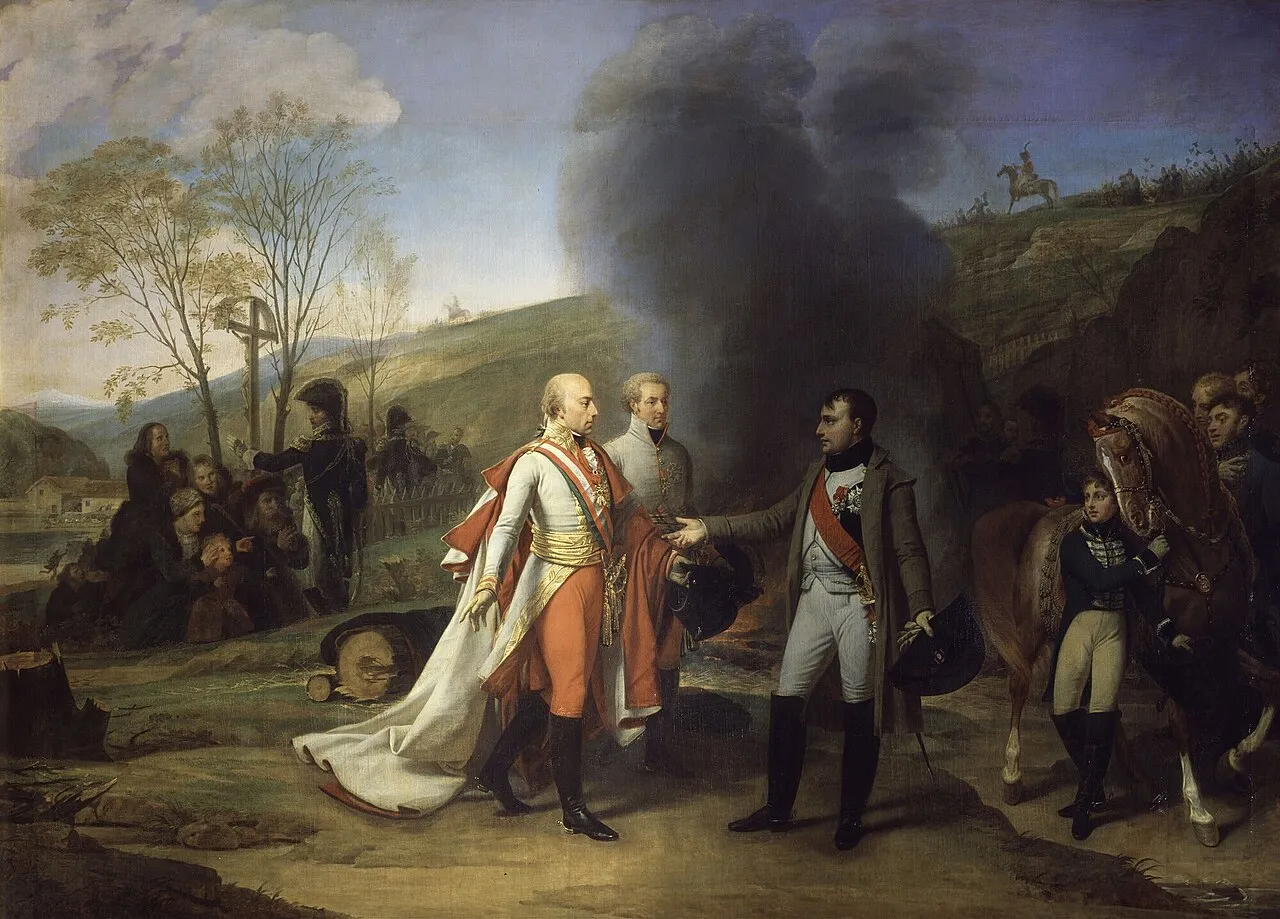 Napoleon and Francis II meet after Austerlitz, painting by Antoine-Jean Gros, 1812Wikimedia Commons, Antoine-Jean Gros, Public domain (Gros - Entrevue - 1812.jpg)
In Britain William Pitt dies on 23 January 1806. In southern Italy the Russians withdraw after Austerlitz and the British evacuate the mainland for Sicily. On 9 February Masséna invades the Kingdom of Naples with the army of Napoleon’s brother Joseph, King Ferdinand IV flees to Sicily under the protection of the British fleet, and Masséna takes Naples on 14 February. In March Napoleon declares Joseph King of Naples, while the fortress of Gaeta holds out until 18 July and a rising in Calabria against the French lasts into 1807.
On 5 June 1806 Napoleon’s brother Louis becomes King of Holland in place of the Batavian Republic. On 12 July the envoys of 16 German princes in Paris are made to sign the treaty of the Confederation of the Rhine, with Napoleon as its Protector. Bavaria and Württemberg are kingdoms, Baden, Hesse-Darmstadt and Berg, under Murat, grand duchies, and the members pledge an army of 63,000 men to France.
On 1 August the members of the Confederation leave the Holy Roman Empire. On 6 August, after an ultimatum from Napoleon, Francis II declares the Empire dissolved and keeps the title of Emperor of Austria, which he has held since 1804. Prussia sees these changes as an affront to its standing as the main power of central Europe.
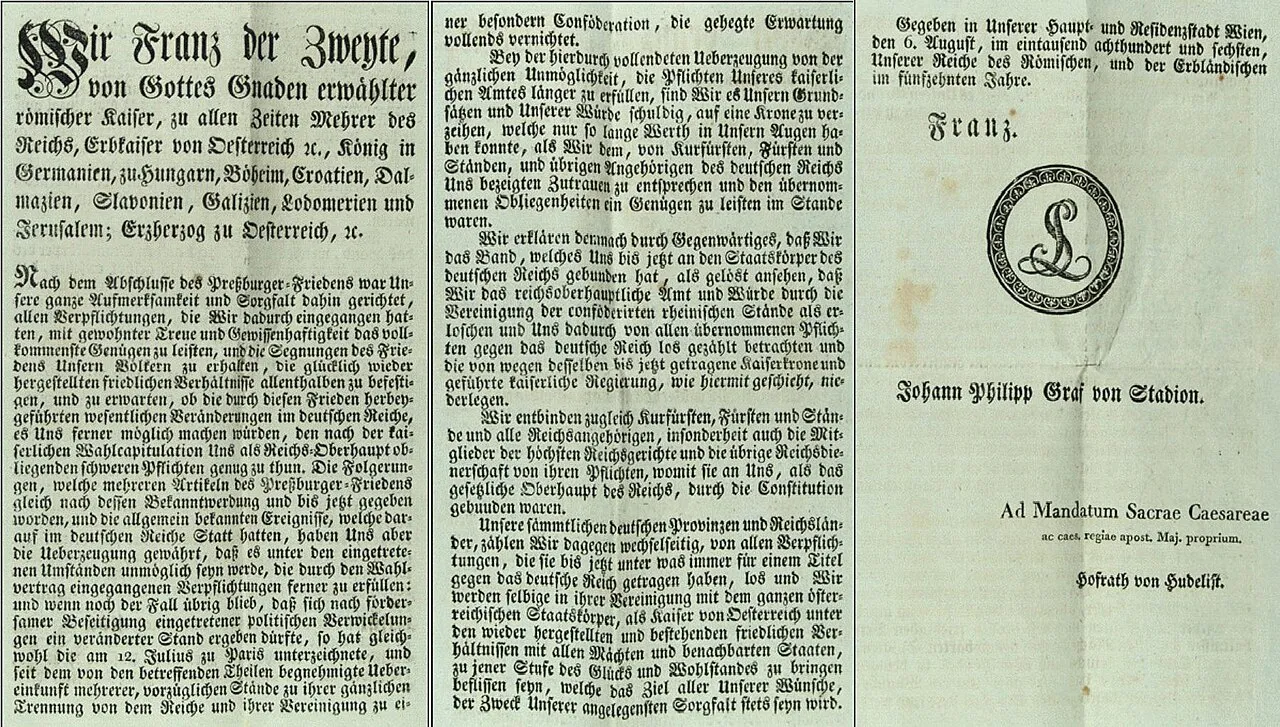 The printed declaration of Francis II laying down the crown of the Holy Roman Empire, 6 August 1806Wikimedia Commons, Francis II, Public domain (Printed version of the abdication of Francis II (1806).jpg)
Sources
- David G. Chandler, The Campaigns of Napoleon (1966).
- Joachim Whaley, Germany and the Holy Roman Empire, vol. II (2012).
- Frederick C. Schneid, Napoleon’s Conquest of Europe: The War of the Third Coalition (2005).
Prev: The allied left breaksNext: Prussia goes to war