June to July 1812
Crossing the Niemen
On 31 December 1810 Tsar Alexander I leaves the Continental System and opens Russian ports to neutral shipping, after Napoleon has annexed the Duchy of Oldenburg, whose duke is the tsar’s uncle. Napoleon begins to plan an invasion in late 1811. Prussia has to provide 20,000 troops under a treaty of February 1812, and Austria agrees in March to provide 30,000. In April Alexander demands the withdrawal of French troops from Prussia and the Duchy of Warsaw.
On 24 June 1812 the Grande Armée crosses the Niemen on pontoon bridges near Kaunas. Estimates of its strength range from 400,000 to 600,000, half of them from outside France, with more than 1,100 guns. Napoleon leads the centre with the Imperial Guard, Murat’s cavalry and the corps of Davout, Oudinot and Ney, Eugène de Beauharnais crosses upstream at Piliuona, and Jérôme Bonaparte crosses at Grodno on 1 July. Macdonald’s X Corps, half of it Prussian, crosses at Tilsit and moves on Riga, and Schwarzenberg’s 34,000 Austrians cross the Bug on 2 July.
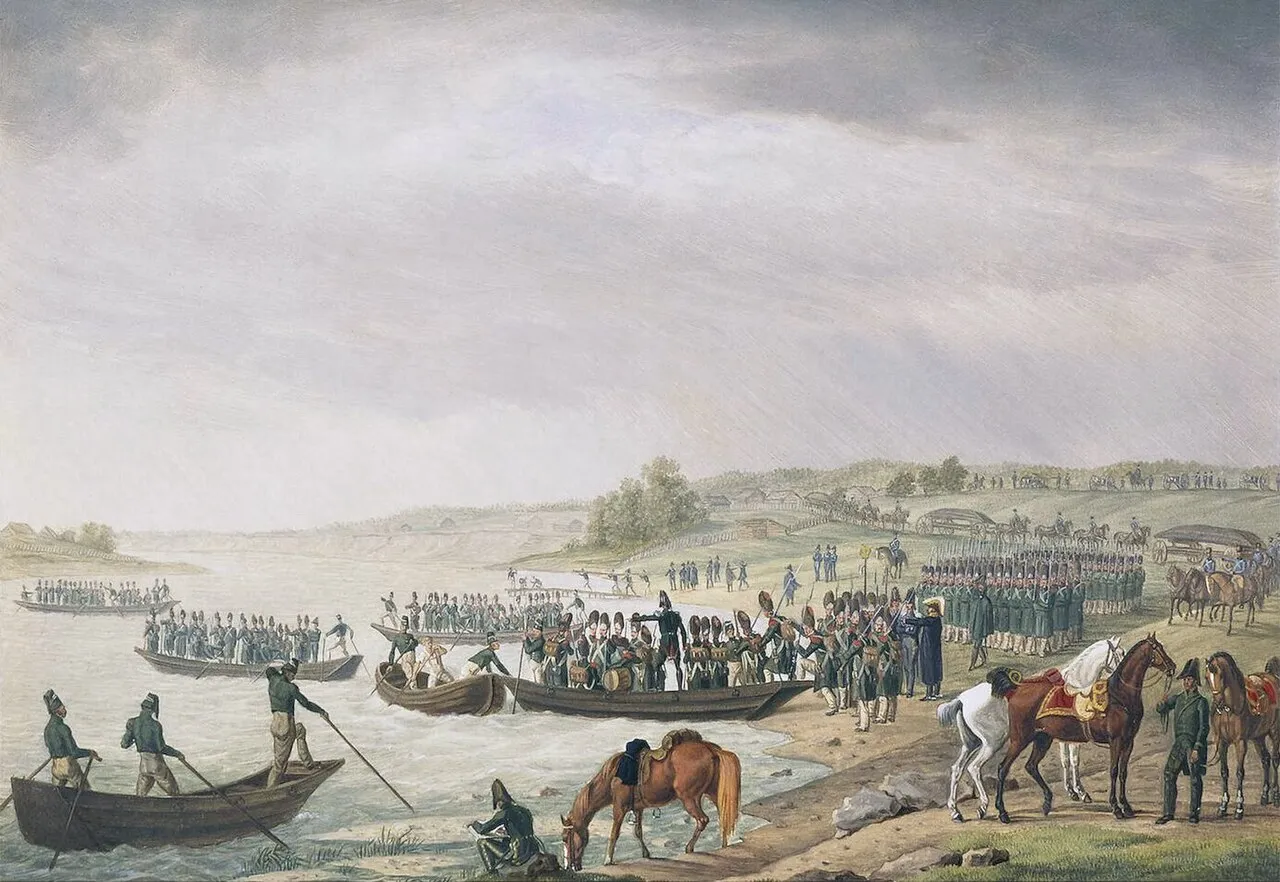 Eugène de Beauharnais’s IV Corps crossing the Niemen on 30 June 1812, painting by Albrecht Adam, 1815Wikimedia Commons, Albrecht Adam, Public domain (Eugene Beauharnais Crossing Niemen 1812.jpg)
The Russians have about 180,000 to 220,000 men in two armies, Barclay de Tolly’s 1st Western Army around Vilnius and Pyotr Bagration’s 2nd Western Army further south. Barclay withdraws without battle to the fortified camp at Drissa on the Dvina. Napoleon enters Vilnius on 28 June, leaving more than 5,000 dead horses along the road. Heat, storms, typhus and desertion cost the Grande Armée about 100,000 men in the first two weeks of July.
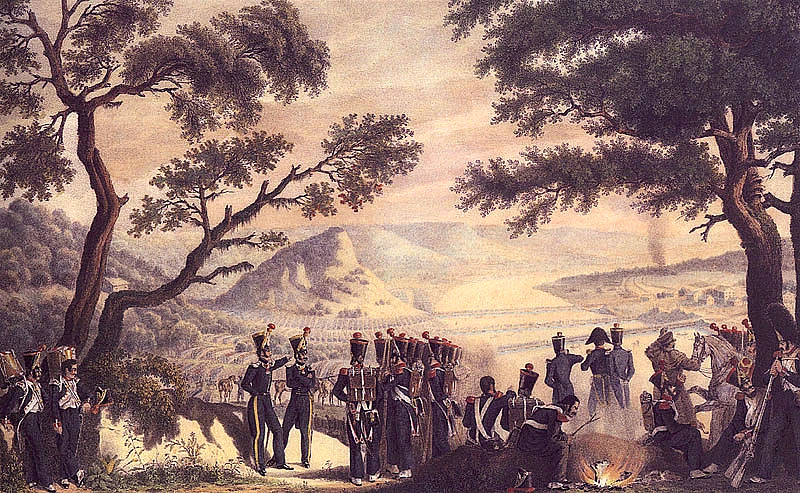 French troops on the bank of the Niemen in 1812, by Christian Wilhelm von Faber du FaurWikimedia Commons, Christian Wilhelm von Faber du Faur, Public domain (On the border of Nieman 1812.PNG)
Napoleon tries to catch Bagration between Davout and Jérôme. Davout takes Minsk on 8 July, but Bagration escapes south-east, his Cossacks under Matvei Platov beating the Polish cavalry at Mir on 9 and 10 July, and fights Davout at Mogilev on 23 July before turning towards Smolensk. Barclay leaves Drissa, fights a rearguard action at Ostrovno on 25 July and slips away from Vitebsk on 27 July, where Napoleon halts until 12 August.
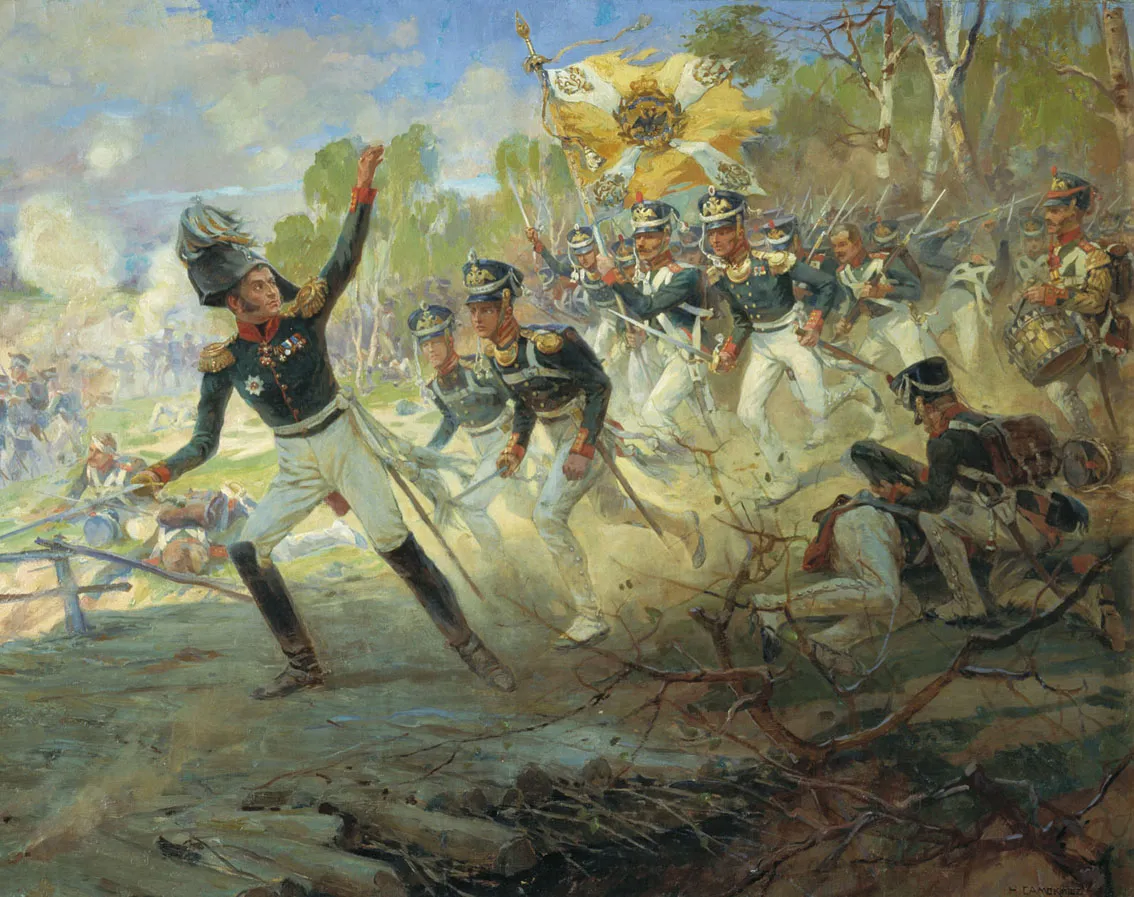 Raevsky leading his men at Saltanovka near Mogilev, painting by Nikolai Samokish, 1912Wikimedia Commons, Nikolai Samokysh, Public domain (Raevsky saltanovka.jpg)
Sources
- Adam Zamoyski, Moscow 1812: Napoleon’s Fatal March (2004).
- Dominic Lieven, Russia Against Napoleon (2010).
- Richard K. Riehn, 1812: Napoleon’s Russian Campaign (1990).
Prev: Schönbrunn and the Empire at its heightNext: Smolensk