September to November 1812
Moscow and the retreat
On 8 September the Russian army retreats past Mozhaysk towards Moscow. At a council of war at Fili on 13 September Kutuzov decides to give up the city without a battle in order to keep the army, and most of its 270,000 inhabitants leave. Napoleon enters Moscow on 14 September with about 100,000 men and receives no delegation. A fire, attributed to the military governor Fyodor Rostopchin, burns from 14 to 18 September and destroys three quarters of the city.
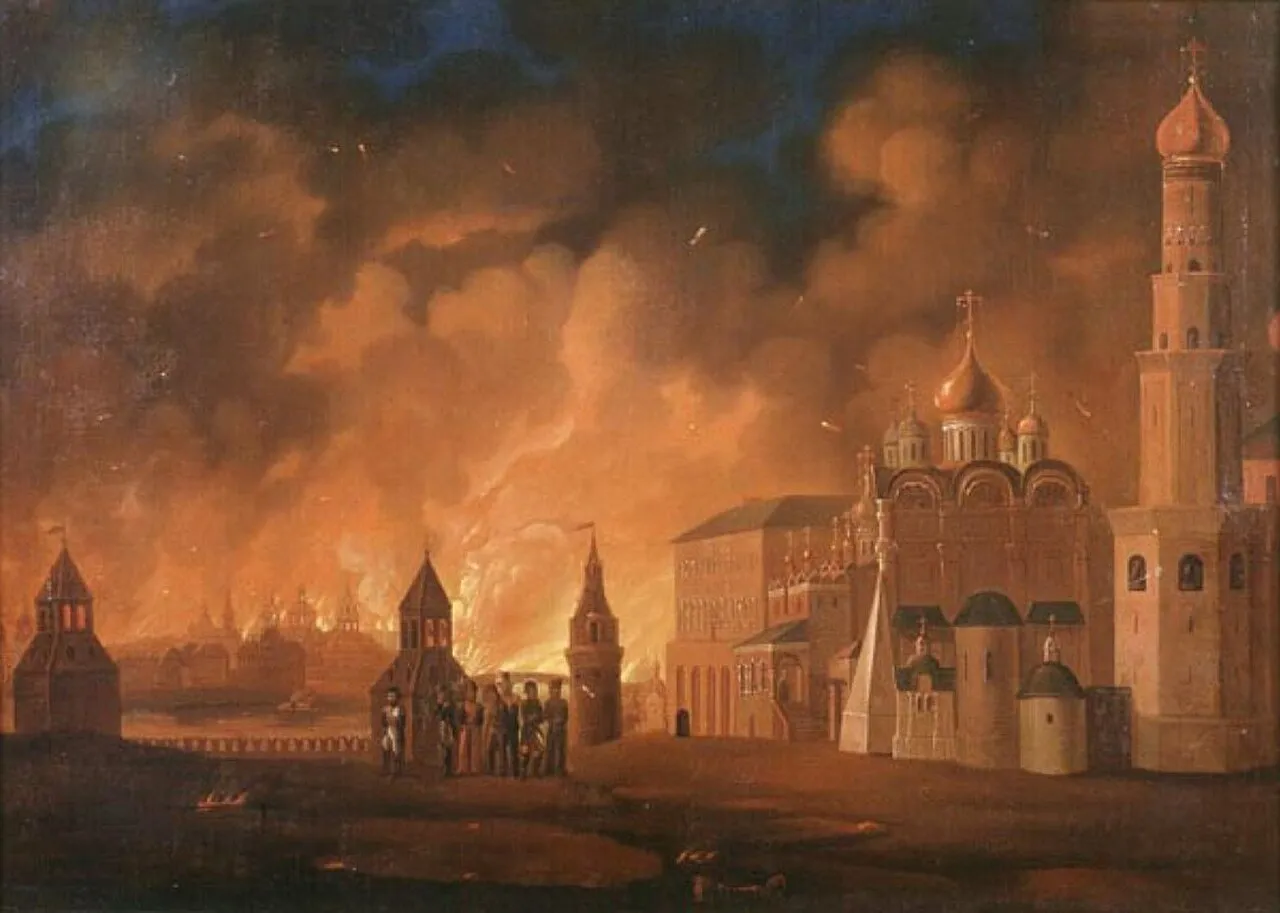 The fire of Moscow from 15 to 18 September 1812, painting by A. Smirnov, 1813Wikimedia Commons, A. Smirnov (Смирнов А.Ф.), Public domain (Fire of Moscow 1812.jpg)
Kutuzov first retreats south-east on the Ryazan road, then turns west and on 3 October camps at Tarutino, where he covers Kaluga and the arms works of Tula and receives food and recruits from the south. Napoleon waits five weeks for a peace offer, and on 5 October sends Jacques Lauriston to Kutuzov’s headquarters, but Alexander does not reply. On 18 October Levin von Bennigsen surprises Murat’s advance guard at Tarutino.
On 19 October the French leave Moscow, about 108,000 men with little cavalry left, and march south-west on the Old Kaluga road to avoid the region they had stripped on the way in. On 24 October Alexis Delzons’s division of Eugène’s corps meets Dmitry Dokhturov’s corps at Maloyaroslavets on the Luzha. The town changes hands eight times, Delzons is killed, and the French lose 6,000 to 8,000 men and the Russians about 8,000. The French hold the town, but Kutuzov blocks the road to Kaluga, and on 26 October Napoleon turns north to Mozhaysk and the road by which he came.
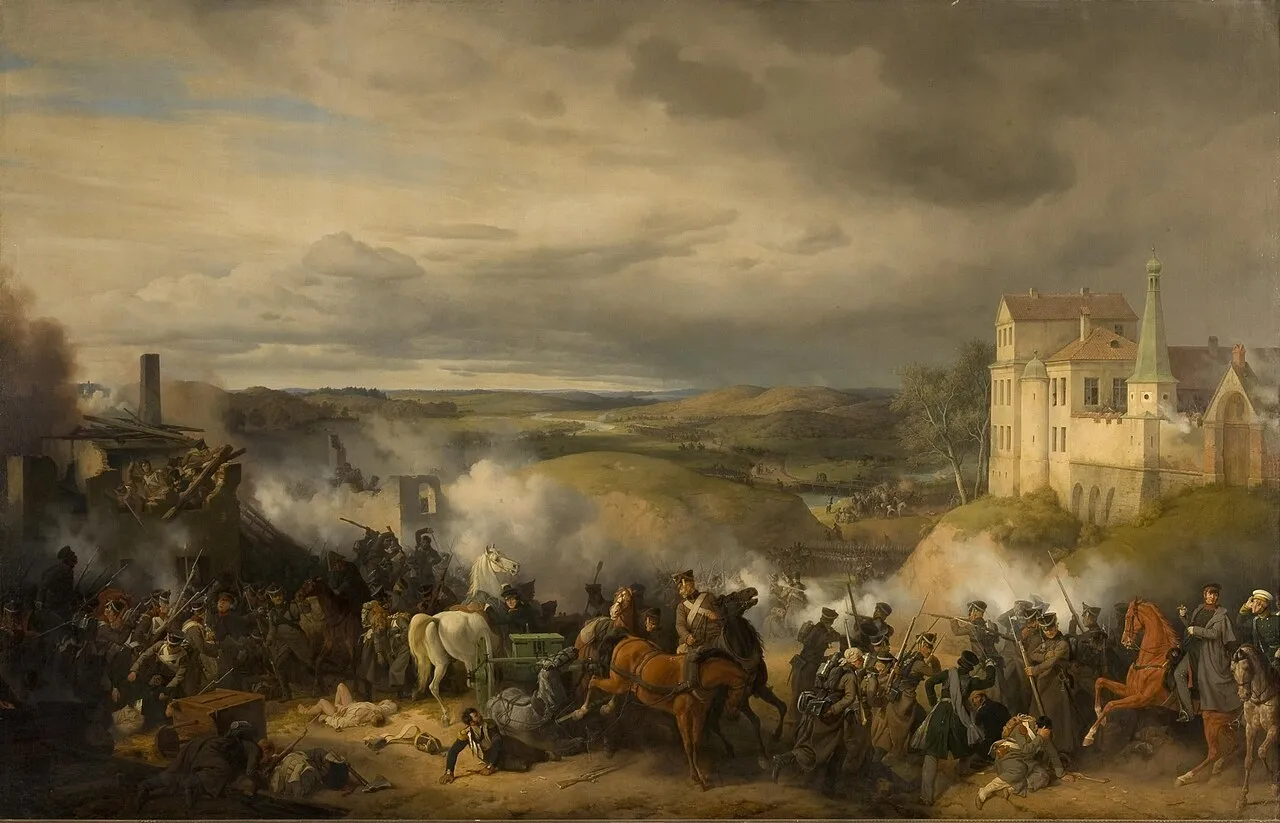 The battle of Maloyaroslavets, painting by Peter von HessWikimedia Commons, Peter von Hess, Public domain (Hess maloyaroslavets.jpg)
The army marches west through Vyazma, where Mikhail Miloradovich attacks Davout’s rearguard on 3 November, and through country stripped of food. Cossacks under Platov, Vasily Orlov-Denisov and Denis Davydov fall on stragglers and foragers, and Kutuzov follows on roads further south. Snow and frost begin with a blizzard on 6 November, and about 40,000 to 50,000 men reach Smolensk on 9 November.
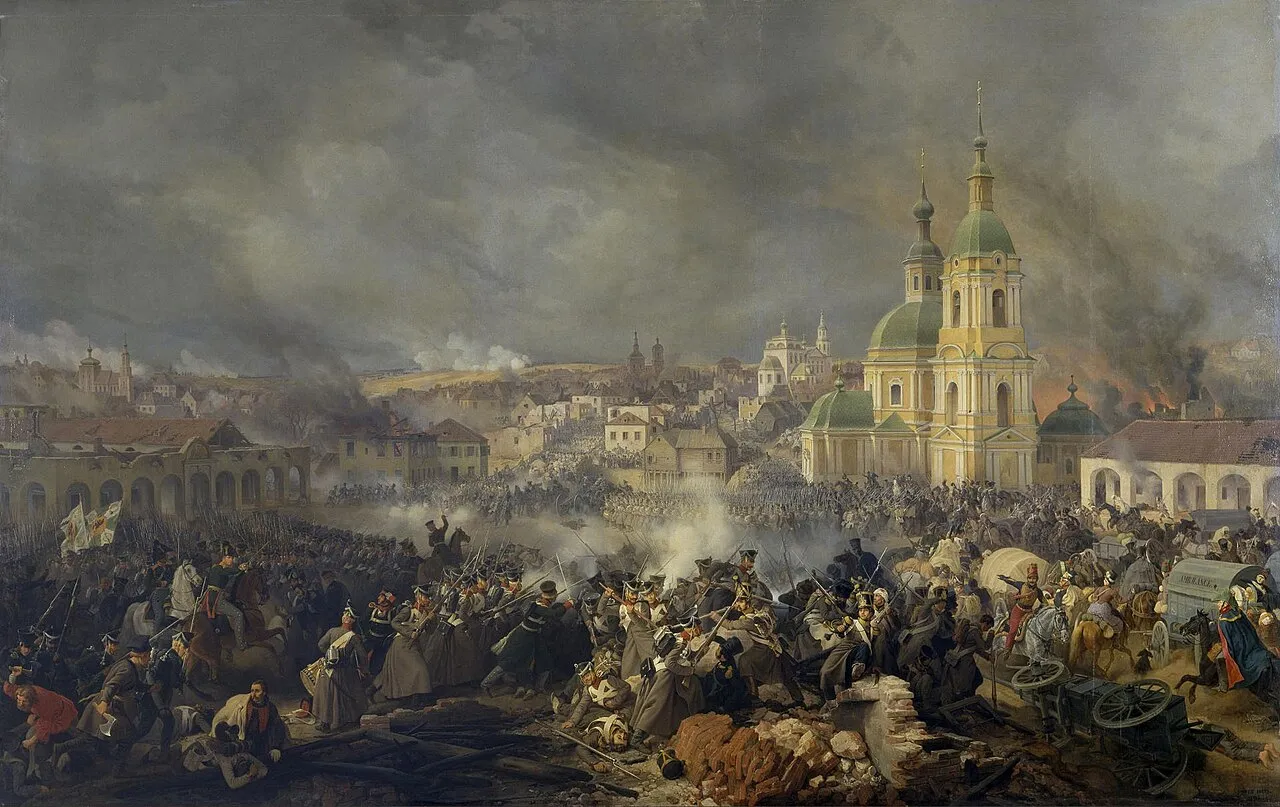 The battle of Vyazma on 3 November 1812, painting by Peter von HessWikimedia Commons, Peter von Hess, Public domain (Battle vyazma.jpg)
Sources
- Adam Zamoyski, Moscow 1812: Napoleon’s Fatal March (2004).
- Dominic Lieven, Russia Against Napoleon (2010).
- David G. Chandler, The Campaigns of Napoleon (1966).
Prev: The fall of the great redoubtNext: Krasnoi and the Berezina