April to 13 June 1800
Across the Great St Bernard
On 25 January 1800 Bonaparte orders Berthier to assemble a Reserve Army of 60,000 men at Dijon, while Moreau is to attack in Germany. In Italy the Austrian commander Michael von Melas advances against the Army of Italy in April and splits it in two. From 19 April he shuts Masséna with 12,000 men in Genoa, besieged on land by 24,000 Austrians under Peter Karl Ott and at sea by a British squadron under Lord Keith.
Instead of marching to Genoa along the coast, Bonaparte leads the Reserve Army over the Alps into the Austrian rear. From 15 May about 40,000 men cross the Great St Bernard from Martigny to Aosta, carrying their equipment in packs and dragging the guns over the snow in hollowed tree trunks, while about 20,000 more cross by other passes. In the Aosta valley the Austrian fort at Bard holds out for two weeks, and the army files past it out of range of its guns.
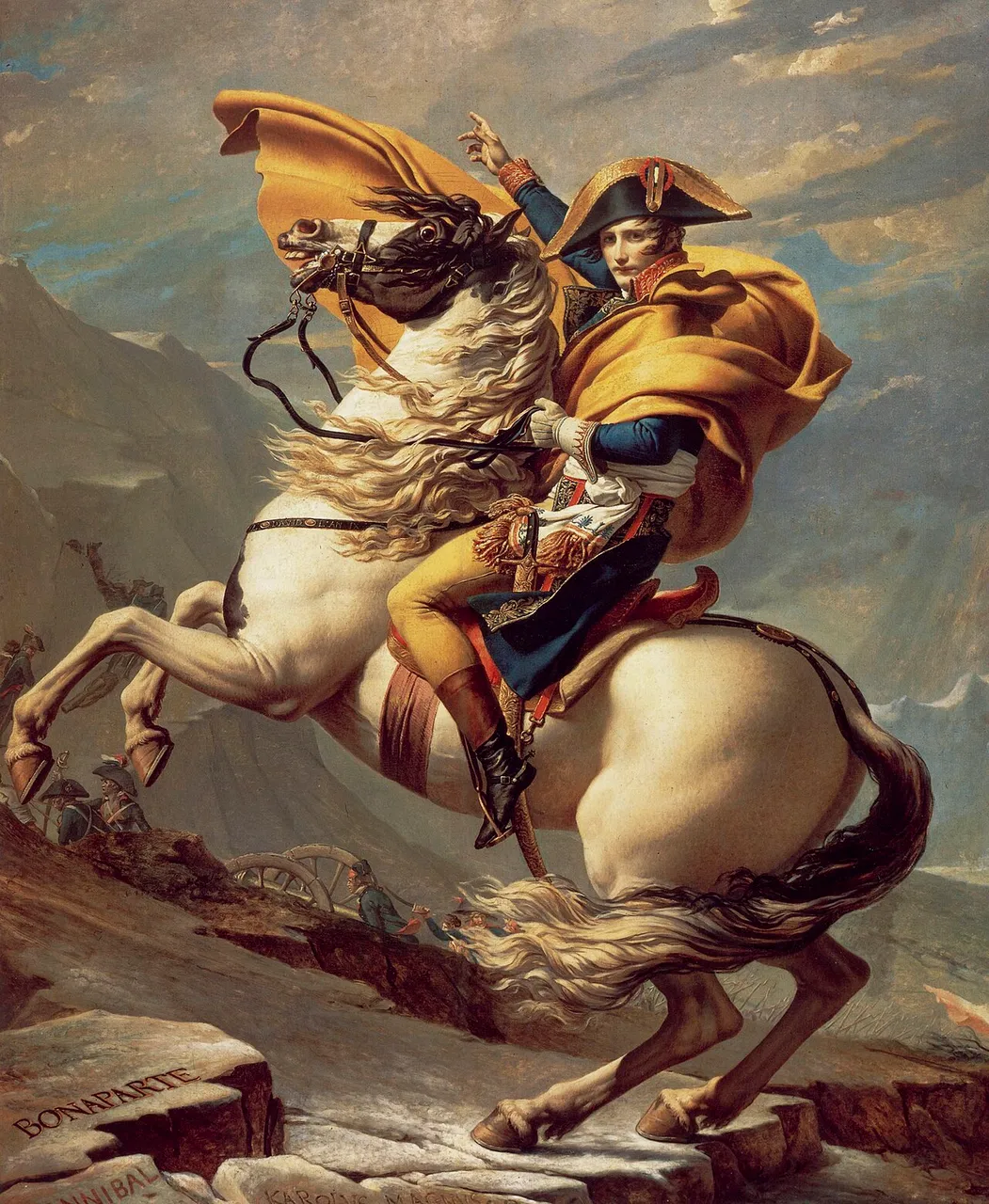 Bonaparte crossing the Great St Bernard, painting by Jacques-Louis David, 1801Wikimedia Commons, Jacques-Louis David, Public domain (David - Napoleon crossing the Alps - Malmaison2.jpg)
The French enter Milan on 2 June and cross the Po to block the main Austrian road to the east at Stradella. Genoa surrenders on 4 June, its people and garrison starving, which frees Ott’s corps, but on 9 June Lannes defeats Ott at Montebello. Melas gathers his army at Alessandria.
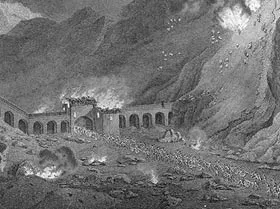 French troops passing under the guns of Fort Bard in 1800, engraving by Joseph John SkeltonWikimedia Commons, Joseph John Skelton, Public domain (Siege of Fort Bard (1800).jpg)
Expecting Melas to retreat, Bonaparte spreads his army out. Louis Desaix, back from Egypt, takes Boudet’s division of 6,000 men south towards Novi Ligure, and La Poype’s division goes north of the Po. On 13 June Victor drives an Austrian brigade out of the village of Marengo, east of Alessandria, and deploys his two divisions along the Fontanone stream.
Sources
- David G. Chandler, The Campaigns of Napoleon (1966).
- David Hollins, The Battle of Marengo 1800 (2000).
- James R. Arnold, Marengo & Hohenlinden: Napoleon’s Rise to Power (2005).
Prev: BrumaireNext: The Austrian attack on the Fontanone