15 June 1815
The armies in Belgium
Napoleon decides to strike before the coalition can bring its armies together. In early June he gathers the Army of the North, about 128,000 men, on the Belgian frontier. Facing it are two allied armies spread over nearly 145 km of what is now Belgium: Wellington's army of 93,000 British, Dutch-Belgian, Hanoverian, Brunswick and Nassau troops with its headquarters at Brussels, and Blücher's 116,000 Prussians with theirs at Namur.
Before dawn on 15 June the French cross the frontier at Thuin and take Charleroi on the Sambre, at the junction of the two allied armies. Zieten's Prussian I Corps fights a delaying action back towards Fleurus while Blücher gathers three corps around Sombreffe. Napoleon gives Ney the left wing to take the crossroads of Quatre Bras on the road to Brussels, and turns against the Prussians with the right wing under Grouchy and the reserve.
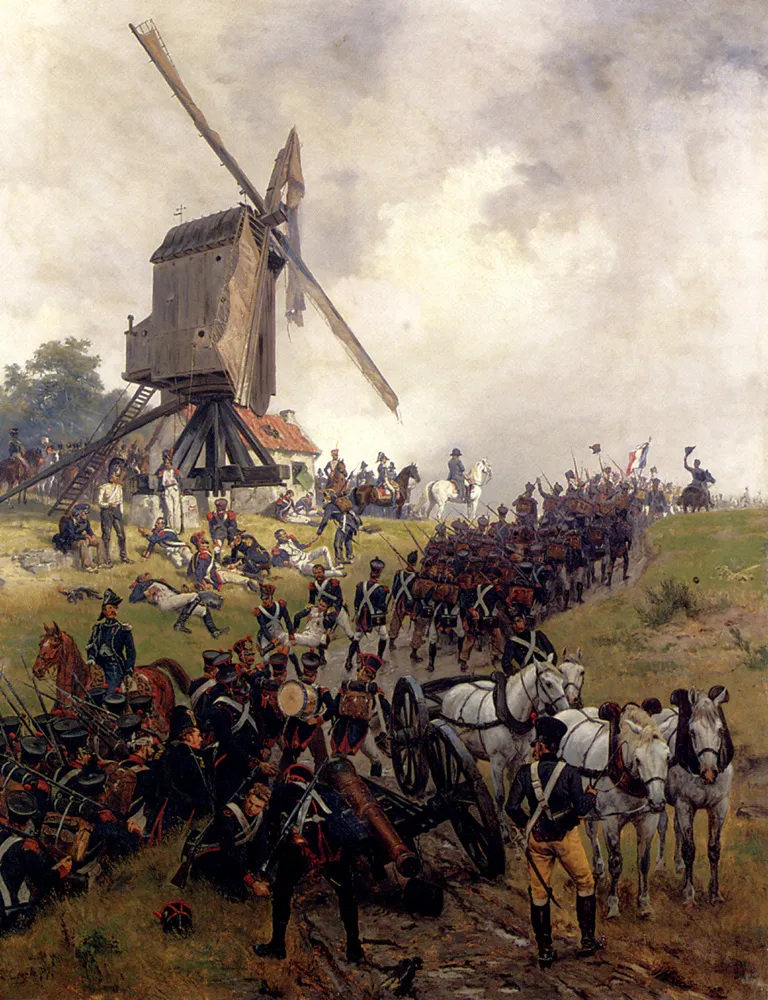 French columns march past Napoleon at Ligny, painting by Ernest Crofts, 1875Wikimedia Commons, Ernest Crofts, Public domain (Crofts Ernest The Battle Of Ligny.jpg)
Wellington hears of the attack at 15:00 but fears a second thrust through Mons, and he sends orders to concentrate near Nivelles and Quatre Bras only before midnight. At Quatre Bras the Dutch chief of staff, Jean Victor de Constant Rebecque, sets aside the order to gather at Nivelles and holds the crossroads with the Nassau brigade of Prince Bernhard of Saxe-Weimar, which turns back the first French cavalry that evening. In the early hours of 16 June, at the Duchess of Richmond's ball in Brussels, Wellington learns how far the French have come.
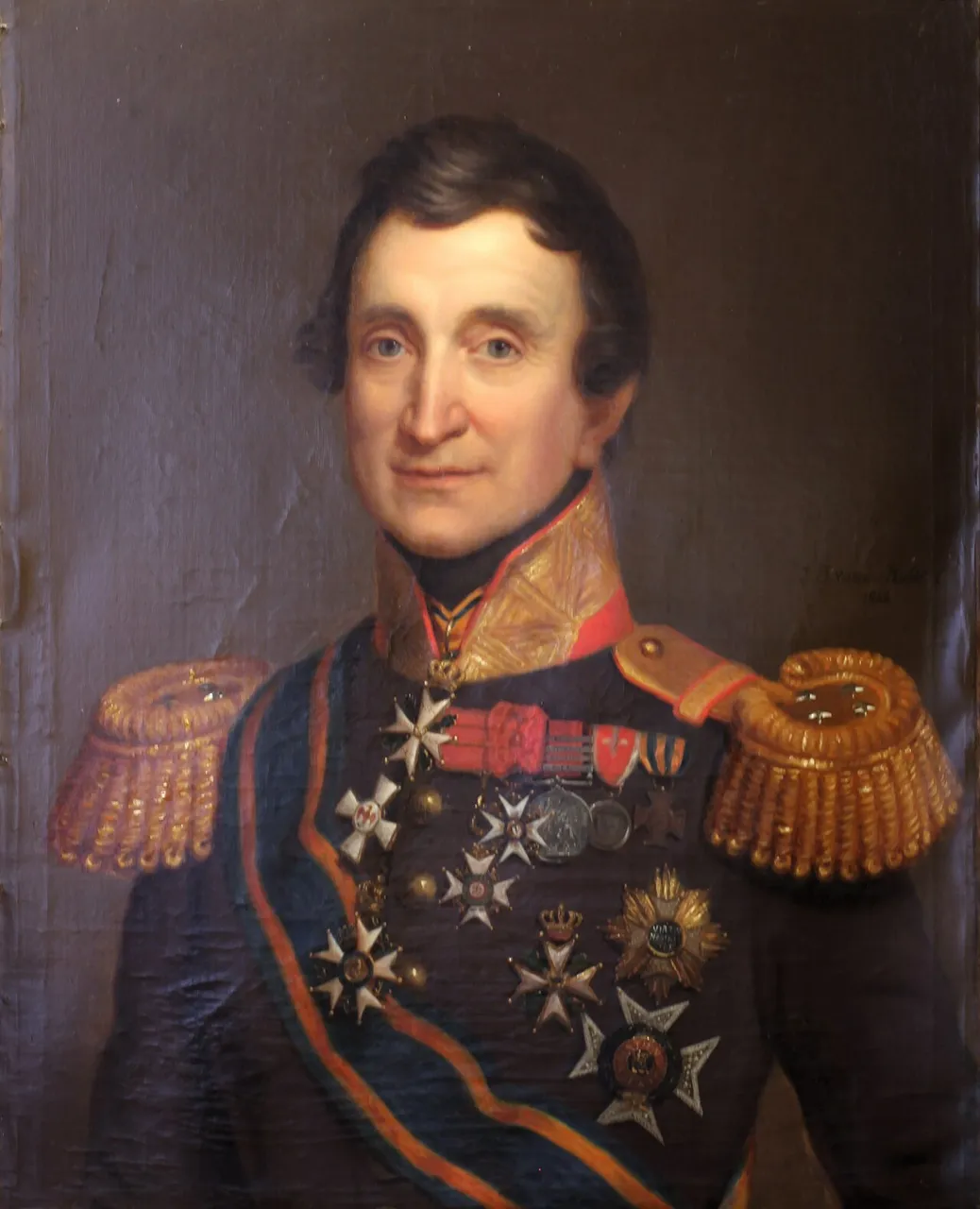 Jean Victor de Constant Rebecque, painting by Jan Baptist van der Hulst, 1842Wikimedia Commons, Jan Baptist van der Hulst, Public domain (Jean-Victor de Constant-Rebecque IMG 3222.JPG)
On the morning of 16 June Wellington rides to meet Blücher at the windmill of Bussy near Brye and promises him support. Blücher has 82,700 men in the villages behind the Ligny stream, and Napoleon brings about 60,800 against him. Bülow's IV Corps is still on the march from Liège.
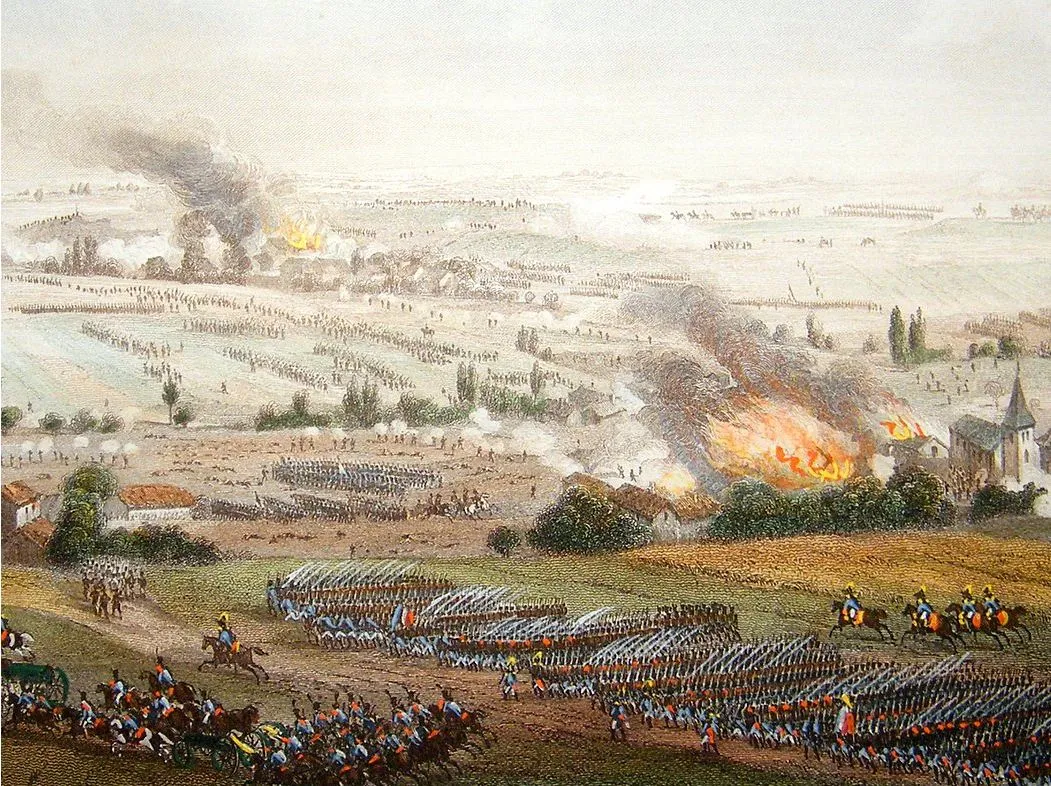 The battle of Ligny, by Théodore JungWikimedia Commons, Théodore Jung, Public domain (Battle of Ligny.JPG)
Sources
- William Siborne, The Waterloo Campaign, 1815 (1848).
- Peter Hofschröer, 1815: The Waterloo Campaign. The German Victory (1999).
- John Hussey, Waterloo: The Campaign of 1815, Volume 1 (2017).
Prev: The return from ElbaNext: Ligny: the fight for the villages