September to 15 October 1813
The armies close on Leipzig
After Dennewitz the Bavarians declare themselves neutral, and Saxon and Westphalian troops begin to desert to the allies. Napoleon stays at Dresden through September while the three allied armies work round his flanks. Blücher's Army of Silesia crosses the Elbe at Wartenburg and Charles John's Army of the North follows, while Schwarzenberg's Army of Bohemia marches north-west out of Bohemia. On 7 October Napoleon leaves Dresden, where Saint-Cyr and Lobau stay behind with their corps.
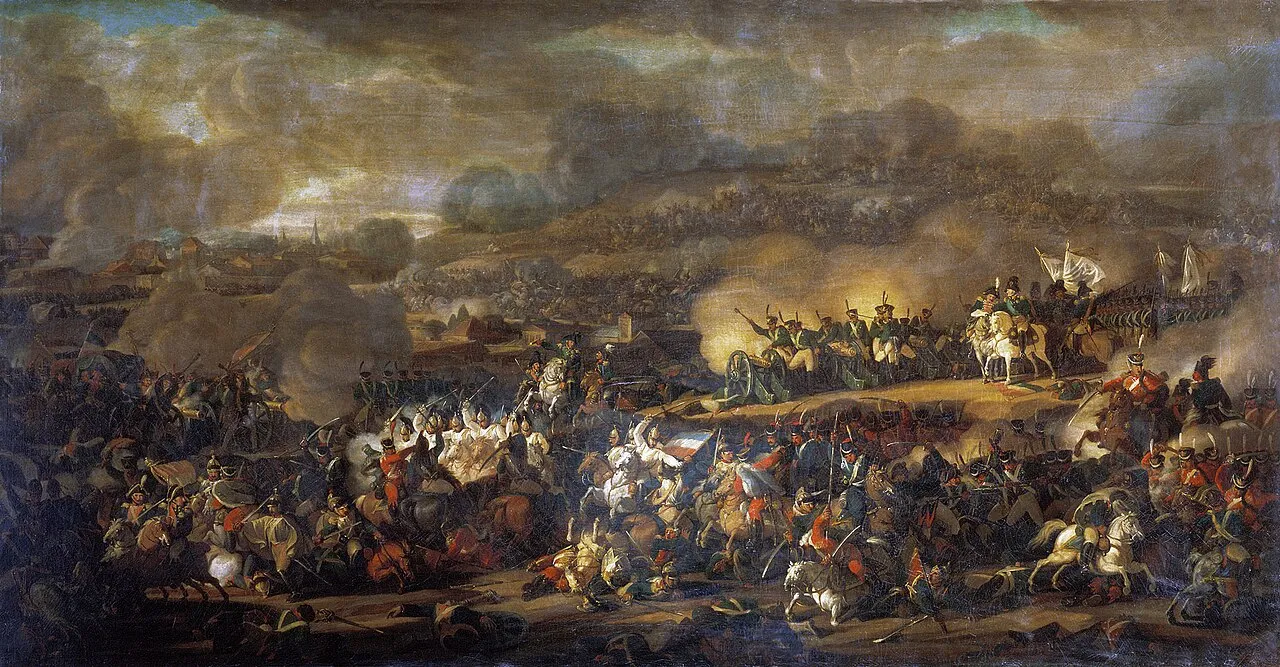 The battle of Leipzig, painting by Vladimir Moshkov, 1815Wikimedia Commons, Vladimir Moshkov, Public domain (MoshkovVI SrazhLeypcigomGRM.jpg)
From 10 to 13 October Napoleon lies at Düben and prepares to strike Blücher, who marches west and joins Charles John near Halle. Napoleon turns back, and on 15 October he concentrates his army to the east and south of Leipzig, with a weak detachment to the west. Schwarzenberg has 180,000 men at hand south of the town and Blücher about 60,000 to the north-west. Charles John and Bennigsen's Army of Poland are still on the way.
Napoleon has about 160,000 French troops, 10,000 Poles, 9,000 Italians and 19,000 Germans of the Confederation of the Rhine, about 198,000 men with 700 guns. Over the four days the allies bring about 380,000 men and 1,500 guns: 145,000 to 150,000 Russians, 115,000 Austrians, 75,000 to 90,000 Prussians and up to 30,000 Swedes. Alexander I, Francis I and Frederick William III are with the army. It is the largest battle of the Napoleonic Wars.
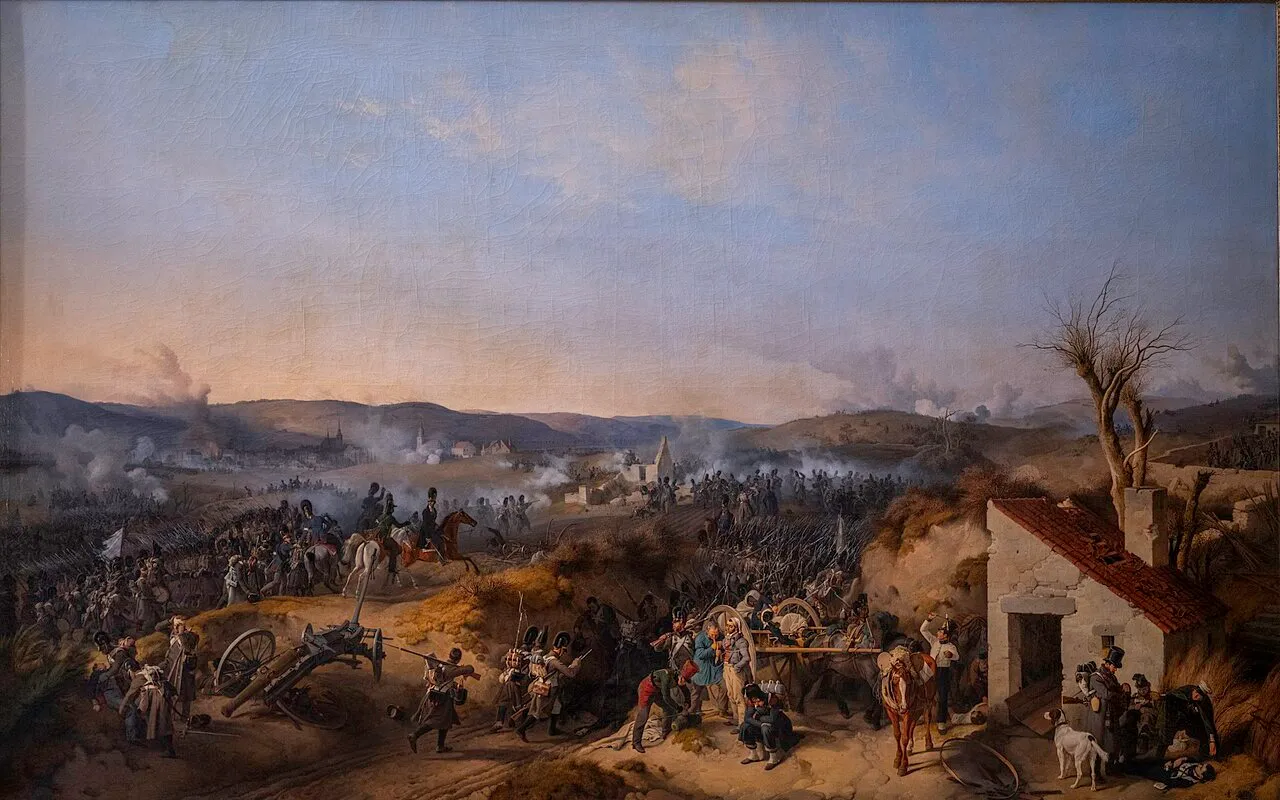 The Battle of the Nations at Leipzig, painting by Alexander von Sauerweid in the Munich ResidenzWikimedia Commons, Alexander von Sauerweid, CC0 (Die Völkerschlacht bei Leipzig.jpg)
The rivers Pleisse, White Elster and Parthe meet at Leipzig and divide the ground into sectors, and holding the town and its bridges Napoleon can shift troops between them faster than the allies. Ney and Marmont hold the north, Macdonald the east, and Poniatowski, Augereau and Lauriston the villages to the south from Markkleeberg through Wachau to Liebertwolkwitz. Schwarzenberg's plan sends Blücher down the road from Halle, Gyulay against Lindenau in the west and the main body of the Army of Bohemia against the southern villages.
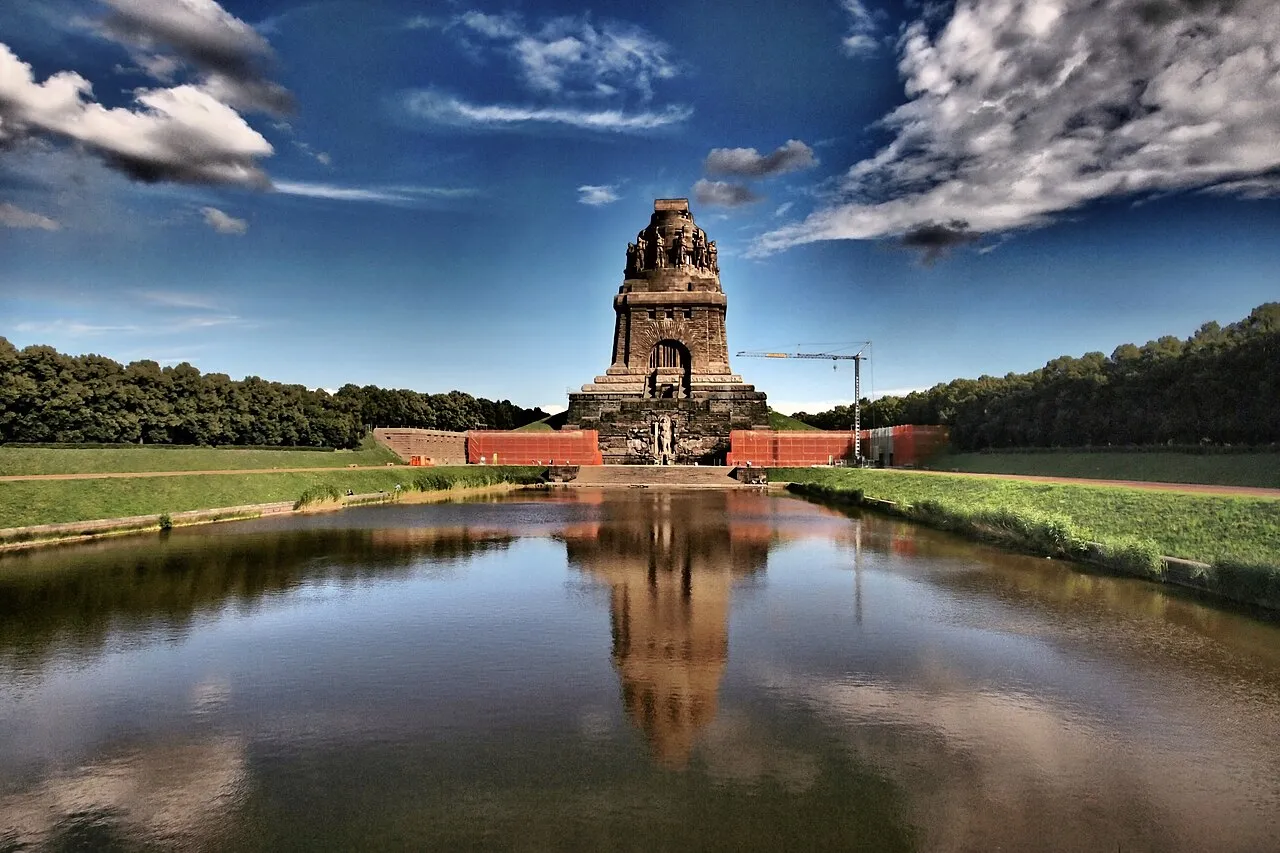 The Monument to the Battle of the Nations at Leipzig, completed in 1913, photographed in 2011Wikimedia Commons, Defector, CC BY-SA 3.0 (Das Völkerschlachtdenkmal.jpg)
Sources
- David G. Chandler, The Campaigns of Napoleon (1966).
- Digby Smith, 1813 Leipzig: Napoleon and the Battle of the Nations (2001).
- Peter Hofschröer, Leipzig 1813: The Battle of the Nations (2012).
Prev: The armistice and DresdenNext: The first day: Wachau and Möckern