March to May 1796
The Army of Italy
Bonaparte takes command of the Army of Italy at Nice in late March 1796. On paper it has 63,000 men, but only 37,600 and 60 field guns are ready for action, and the troops lack pay, food, shoes and transport. Facing them in the mountains between the Riviera and Piedmont are the Sardinian army of Michelangelo Alessandro Colli, 21,000 men, and the Austrian army of Johann Peter Beaulieu, 28,000. Bonaparte plans to strike at Carcare, where the two allied armies meet.
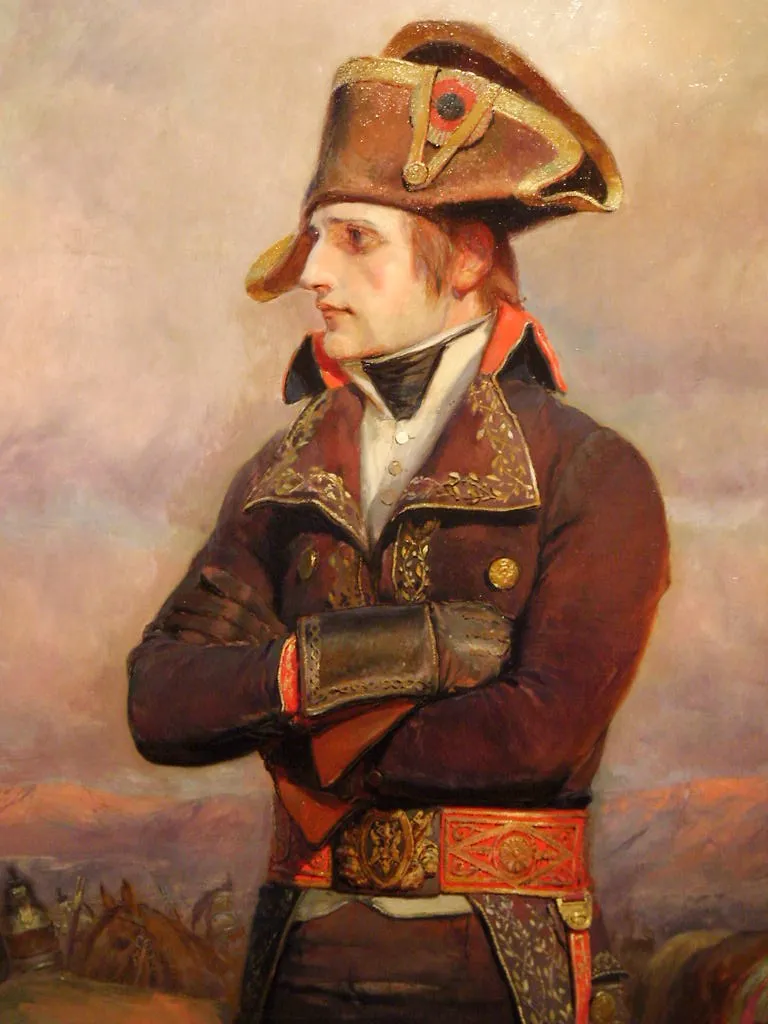 General Bonaparte in Italy, painting by Édouard Detaille, 19th centuryWikimedia Commons, Édouard Detaille, Public domain (Bonaparte di Edouard Detaille.jpg)
Beaulieu moves first and attacks the French right at Voltri on 10 April. Bonaparte answers by striking the boundary between the allies. He defeats the Austrians under Argenteau at Montenotte on 12 April, Provera at Millesimo on 13 April and Argenteau again at Dego on 14 and 15 April, then turns west against the Sardinians and beats Colli at Mondovì on 21 April. Under the armistice of Cherasco, signed on 28 April, Sardinia leaves the war and hands over the fortresses of Cuneo, Ceva and Tortona.
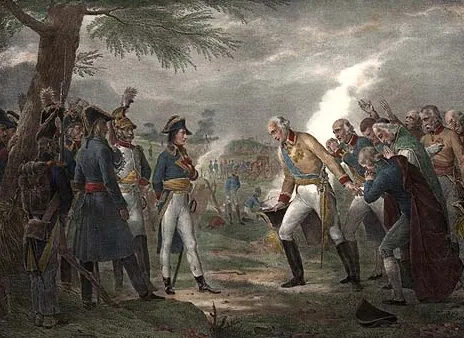 The armistice of Cherasco, 28 April 1796, lithograph by Charles Étienne Pierre Motte, about 1826Wikimedia Commons, Charles Étienne Pierre Motte, Public domain (Armistizio di Cherasco.jpg)
Bonaparte crosses the Po at Piacenza and on 10 May catches the Austrian rearguard of Karl Philipp Sebottendorf at Lodi on the Adda. Nine battalions and 14 guns hold the far end of a wooden bridge about 200 yards long. After a cannonade of several hours, at about 6 pm, a column of carabiniers storms onto the bridge while Beaumont’s cavalry fords the river upstream. When the column stops under fire, Masséna, Berthier, Lannes, Cervoni and Dallemagne rush to its head and lead it across, and the Austrians retreat towards Crema.
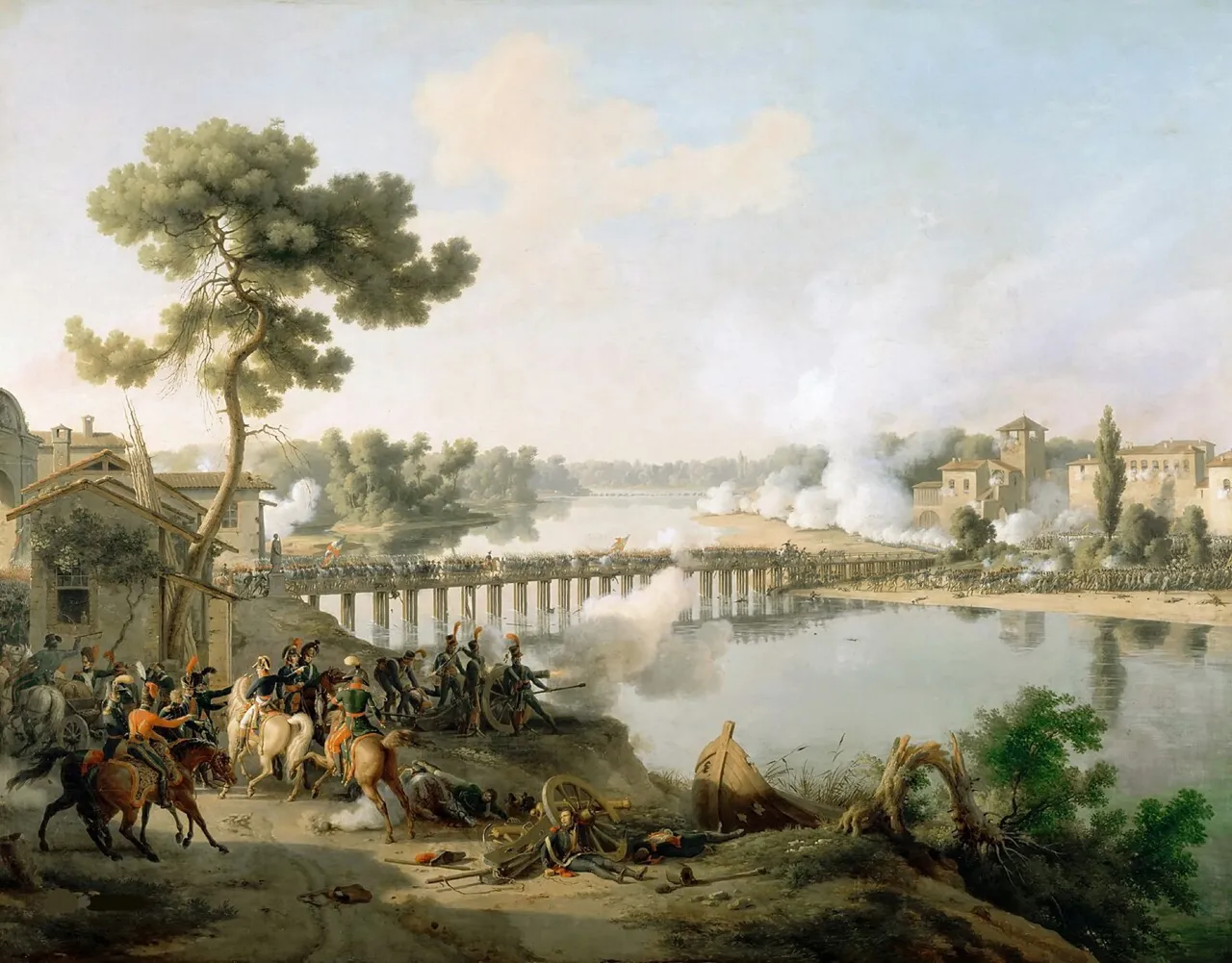 The Battle of Lodi, 10 May 1796, painting by Louis-François Lejeune, 1804Wikimedia Commons, Louis-François Lejeune, Public domain (Battle of Lodi, 10 May 1796 (by Louis-François Lejeune).jpg)
The Austrians lose 335 killed and wounded, 1,700 captured and 16 guns, the French at least 350. The main Austrian army escapes east, but the way to Milan is open, and the French enter the city five days later.
Sources
- David G. Chandler, The Campaigns of Napoleon (1966).
- Martin Boycott-Brown, The Road to Rivoli: Napoleon’s First Campaign (2001).
- Digby Smith, The Napoleonic Wars Data Book (1998).
Prev: The Peace of Basel and the DirectoryNext: Mantua and the Austrian relief armies