March to June 1813
Lützen and Bautzen
On 30 December 1812 the Prussian general Ludwig Yorck agrees a ceasefire with the Russians at Tauroggen. Prussia allies with Russia at the end of February 1813 and declares war on France in March, and on 17 March King Frederick William III calls his people to arms with the appeal "An Mein Volk". Eugène de Beauharnais falls back from Posen to Magdeburg with the remains of the Grande Armée, and the Russians and Prussians gather near Dresden.
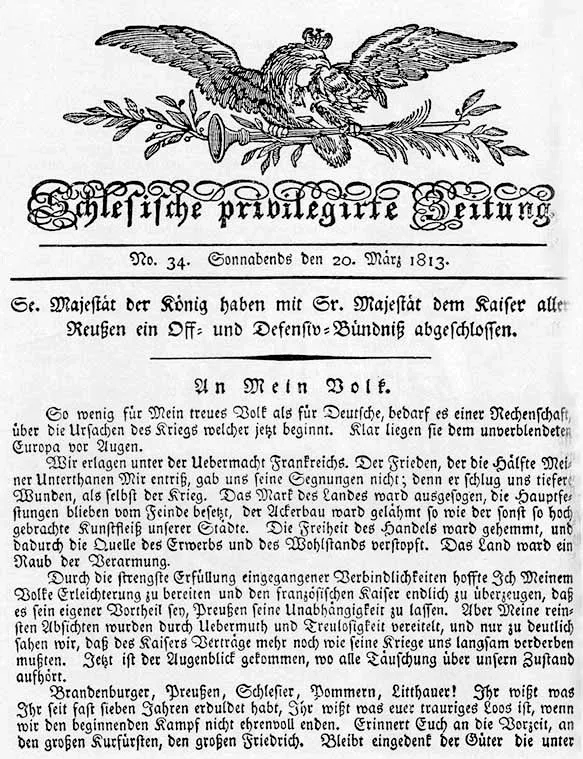 The opening of King Frederick William III’s appeal “An Mein Volk”, printed on 20 March 1813Wikimedia Commons, unknown author, Public domain (An Mein Volk.jpg)
Napoleon raises a new army of about 200,000 men, most of them young conscripts, with too few cavalry to scout. He takes command at Erfurt on 25 April and crosses the Saale towards Leipzig. On 2 May the Russian general Peter Wittgenstein, who has succeeded Kutuzov, attacks the French right flank at Lützen with the Prussians of Gebhard von Blücher. He expects a weak detachment and finds Ney's III Corps in the villages of Grossgörschen and Kaja.
Ney's conscripts hold the villages through the afternoon while Napoleon brings up the other corps. At 18:00 Antoine Drouot's 70 guns and the Young Guard retake the villages, and the allies withdraw after dark. The French lose 19,655 men, the Prussians at least 8,500 and the Russians 3,500. The Prussian general Gerhard von Scharnhorst is wounded, and the wound later proves fatal.
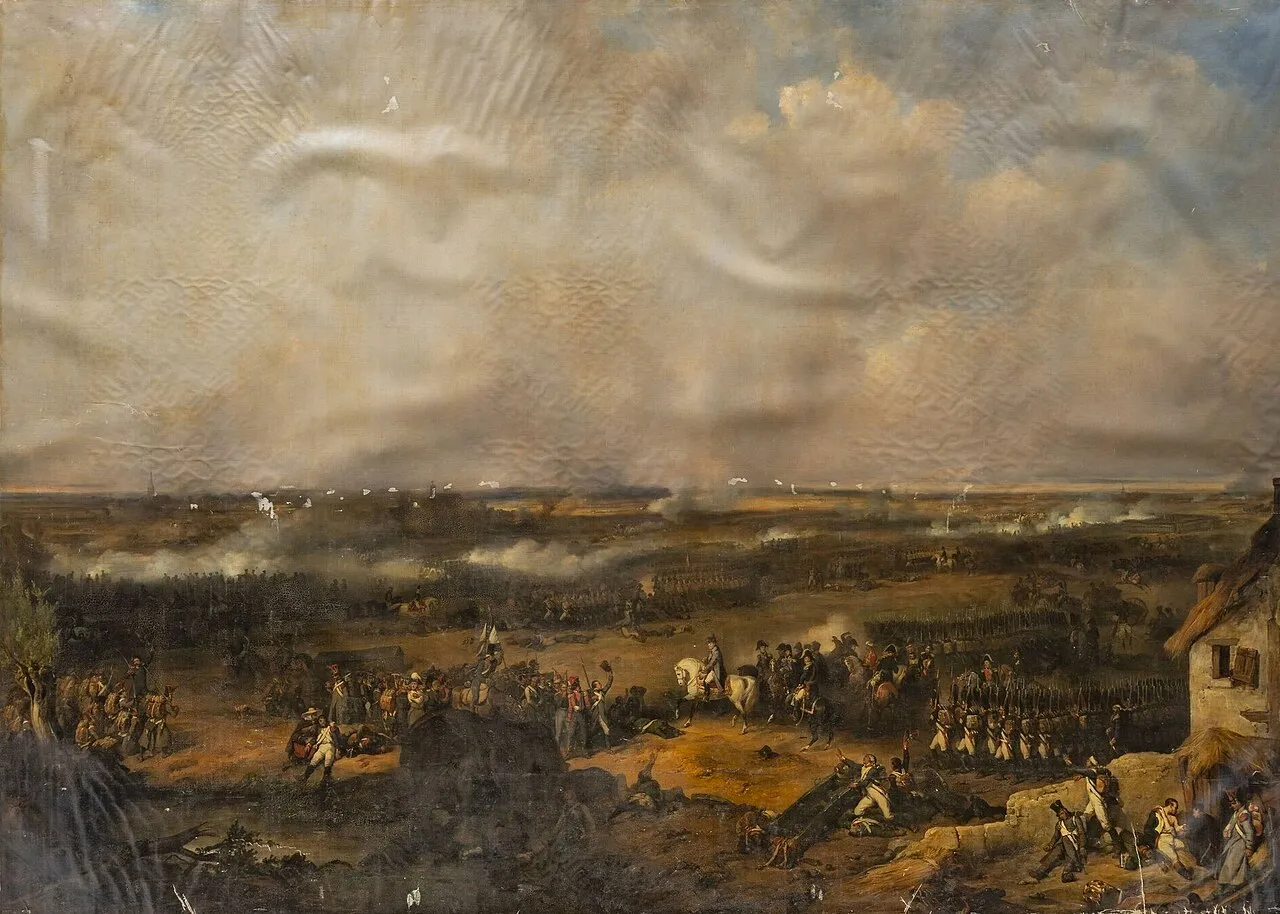 The battle of Lützen, 2 May 1813, painting by Joseph Beaume, 1836 to 1837Wikimedia Commons, Joseph Beaume, Public domain (Bataille de Lutzen, 2 mai 1813.jpg)
The allies retreat over the Elbe and blow up the bridge at Dresden, and Napoleon enters the city. On 20 and 21 May he attacks about 96,000 Russians and Prussians in a fortified position on the Spree at Bautzen with 144,000 men. Ney comes in on their right flank from the north but does not cut their line of retreat, and the allies withdraw in good order into Silesia. Each side loses about 20,000 men, and Napoleon's Grand Marshal of the Palace, Géraud Duroc, is mortally wounded by a cannonball on 22 May.
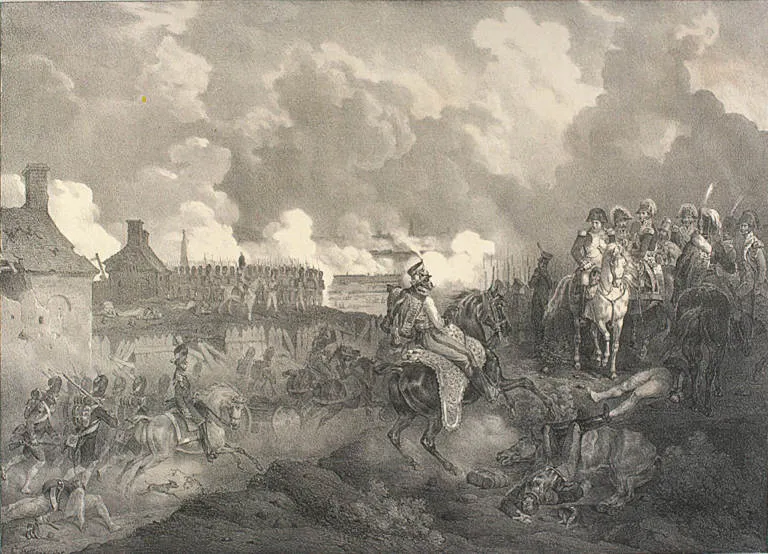 Napoleon and his staff at Bautzen, after Hippolyte Bellangé, 1825 to 1830Wikimedia Commons, After Hippolyte Bellangé, Public domain (Battle of Bautzen 1813 by Bellange.jpg)
Sources
- David G. Chandler, The Campaigns of Napoleon (1966).
- F. Loraine Petre, Napoleon’s Last Campaign in Germany, 1813 (1912).
- George Nafziger, Lutzen and Bautzen: Napoleon’s Spring Campaign of 1813 (1992).
Prev: The end of the Grande ArméeNext: The armistice and Dresden