February to 13 June 1807
Danzig and Heilsberg
After Eylau Napoleon offers Prussia a separate peace, which it refuses, and on 17 February the French begin to withdraw westward into winter quarters. Ney’s VI Corps holds an advanced post at Guttstadt. Marshal Lefebvre’s X Corps of French, Poles, Saxons, Badeners and Italians lays siege to Danzig on 19 March with about 27,000 men. The city is held by about 14,400 Prussians under Kalckreuth.
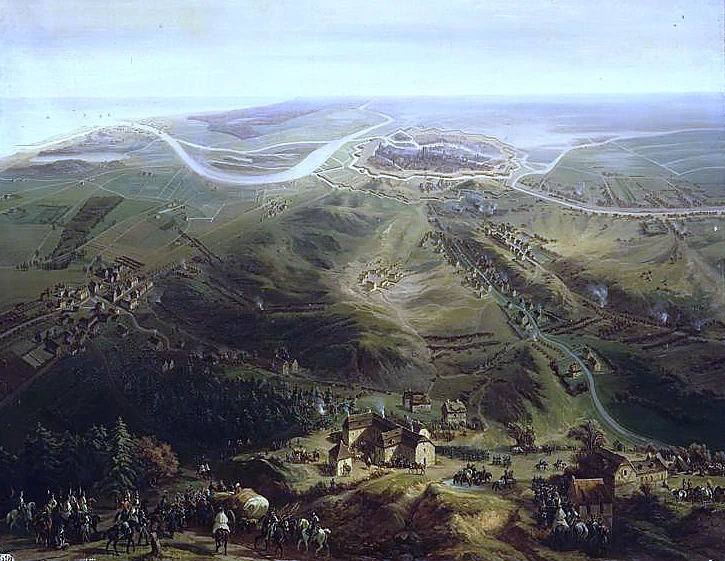 The French siege of Danzig in 1807, panorama by Jean-Antoine-Siméon Fort, 19th century, VersaillesWikimedia Commons, Jean-Antoine-Siméon Fort, Public domain (Panoramic view of the Siege of Gdańsk by French forces in 1807.PNG)
Between 10 and 15 May a Russian force of 7,000 under Nikolay Kamensky, brought by sea in 57 transports, tries to break through to the city and is beaten back with a loss of 1,500 men. Mortier’s corps arrives on 21 May, and on 24 May Kalckreuth capitulates and marches out with the honours of war. The siege costs the French 6,000 men, and Lefebvre is made Duke of Danzig.
Bennigsen strikes first. On 5 June his columns converge on Ney at Guttstadt, 63,000 against 17,000, and Ney fights his way back over the Passarge the next day with the loss of 2,042 men, his baggage and two guns. Napoleon closes in with 190,000 men on the 100,000 Russians and 15,000 Prussians, and Bennigsen falls back to his entrenched camp at Heilsberg on the Alle.
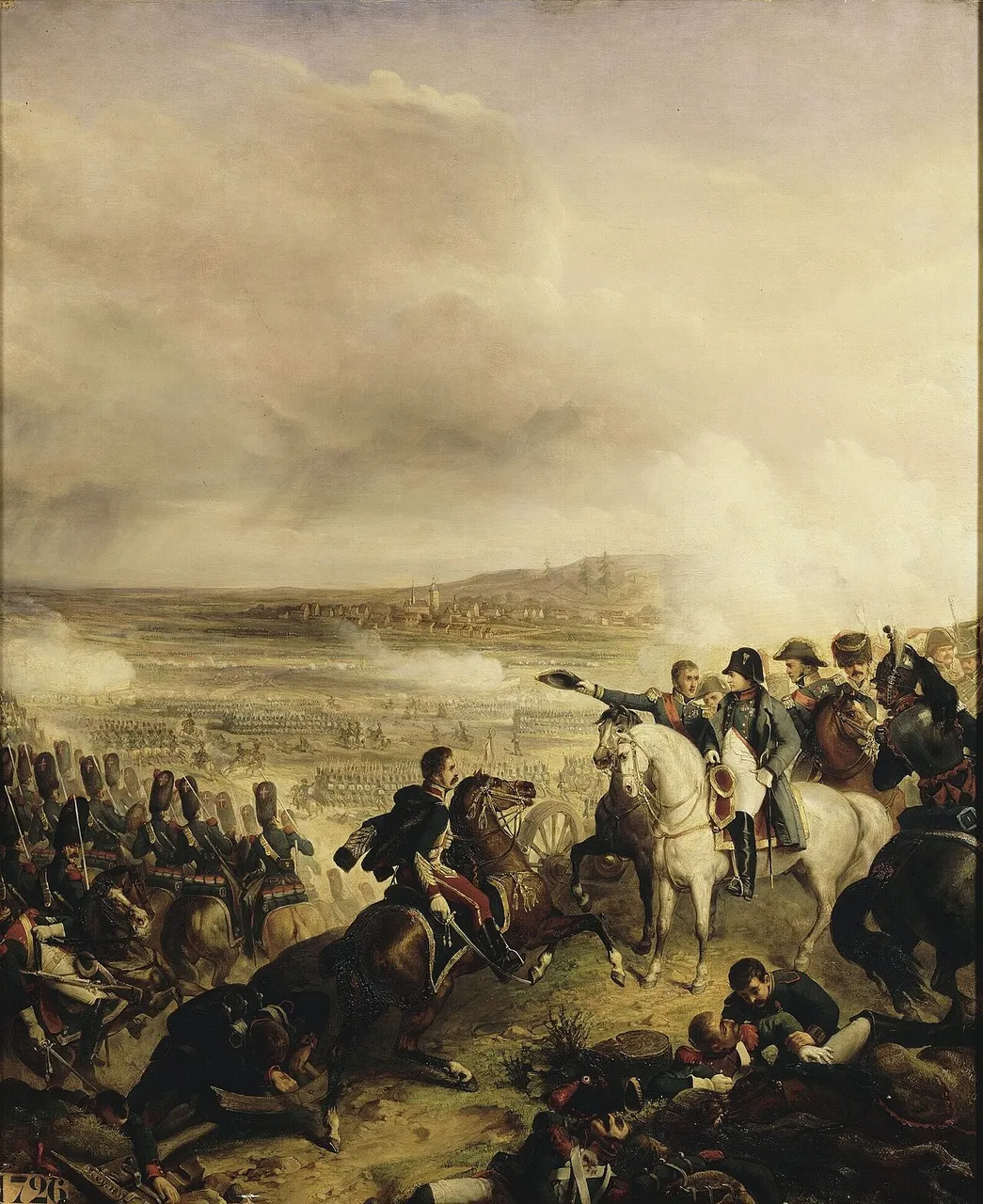 Napoleon on the battlefield of Heilsberg, 11 June 1807, painting by Joseph Nicolas Jouy, 1837Wikimedia Commons, Joseph Nicolas Jouy, Public domain (L'empereur Napoléon Ier sur le champ de bataille de Heilsberg, le 11 juin 1807.jpg)
On 10 June Murat attacks the camp before the rest of the army is up. Repeated assaults fail with heavy losses, by most counts about 10,000 French against 6,000 Russians. On 11 June Bennigsen withdraws down the Alle towards Friedland, while Napoleon turns towards Königsberg with part of his army. On 13 June Lannes’s advance guard reports large Russian forces at Friedland, where Golitsyn drives off the French cavalry outposts and Bennigsen’s main body begins to cross the river into the town.
Sources
- David G. Chandler, The Campaigns of Napoleon (1966).
- Christopher Summerville, Napoleon’s Polish Gamble: Eylau and Friedland 1807 (2005).
- F. G. Hourtoulle, From Eylau to Friedland, 1807: The Polish Campaign (2007).
Prev: Davout, L’Estocq and NeyNext: Lannes holds