January to March 1814
The campaign of France
In November 1813 the allies offer Napoleon peace on the basis of France's "natural frontiers", with Belgium and the left bank of the Rhine, and he does not accept. Schwarzenberg's Army of Bohemia, 200,000 to 210,000 men, crosses the Rhine between Basel and Schaffhausen on 20 December through Swiss territory, and Blücher's Army of Silesia crosses the middle Rhine on 1 January 1814. Napoleon has about 200,000 men in all, but over 100,000 of them face Wellington on the Spanish frontier, and fewer than 80,000 remain for the north-east, many of them young conscripts called the "Marie-Louises".
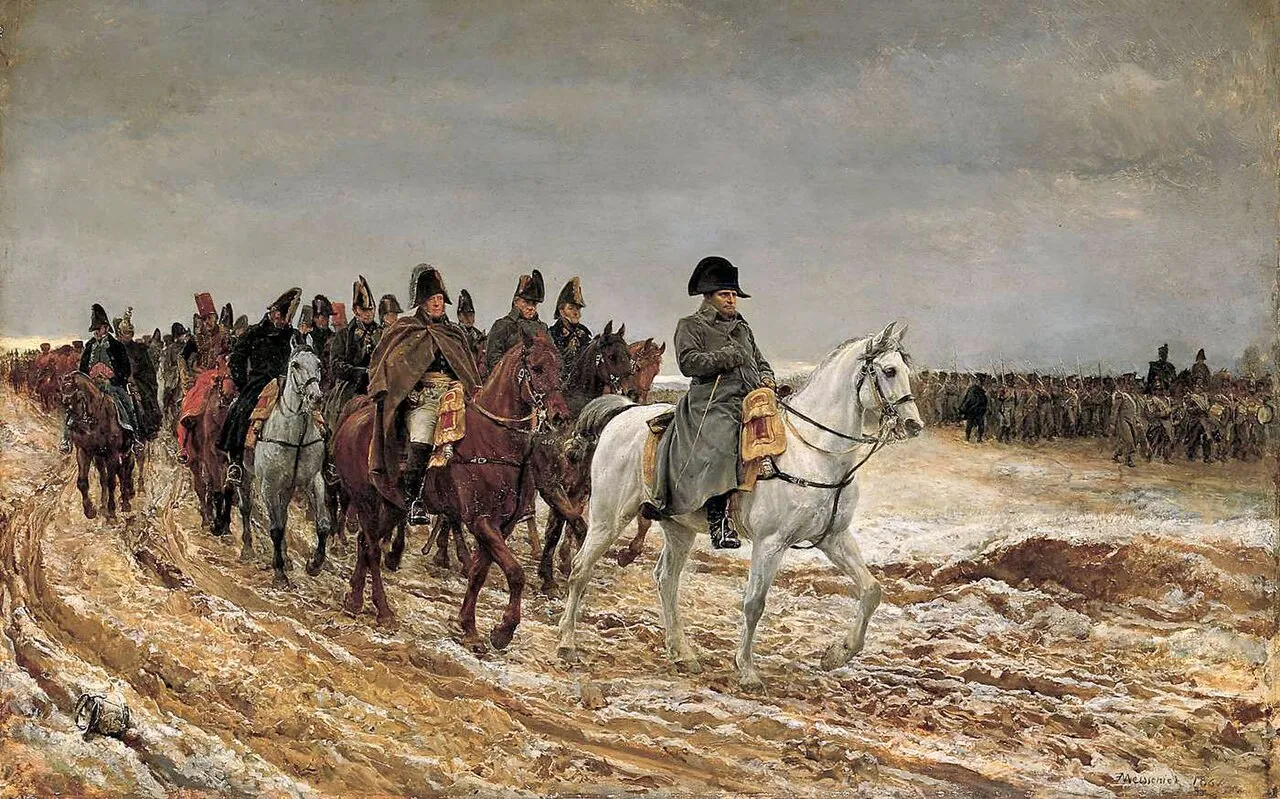 “1814, Campagne de France”, Napoleon and his staff in the campaign of France, painting by Ernest Meissonier, 1864Wikimedia Commons, Jean-Louis-Ernest Meissonier, Public domain (Meissonier - 1814, Campagne de France.jpg)
Napoleon surprises Blücher at Brienne on 29 January and nearly captures him, but on 1 February 80,000 allies defeat his 45,000 at La Rothière and he falls back to Troyes. The allies then separate. Schwarzenberg advances along the Seine and Blücher along the Marne towards Paris, with his corps spread out over 70 km.
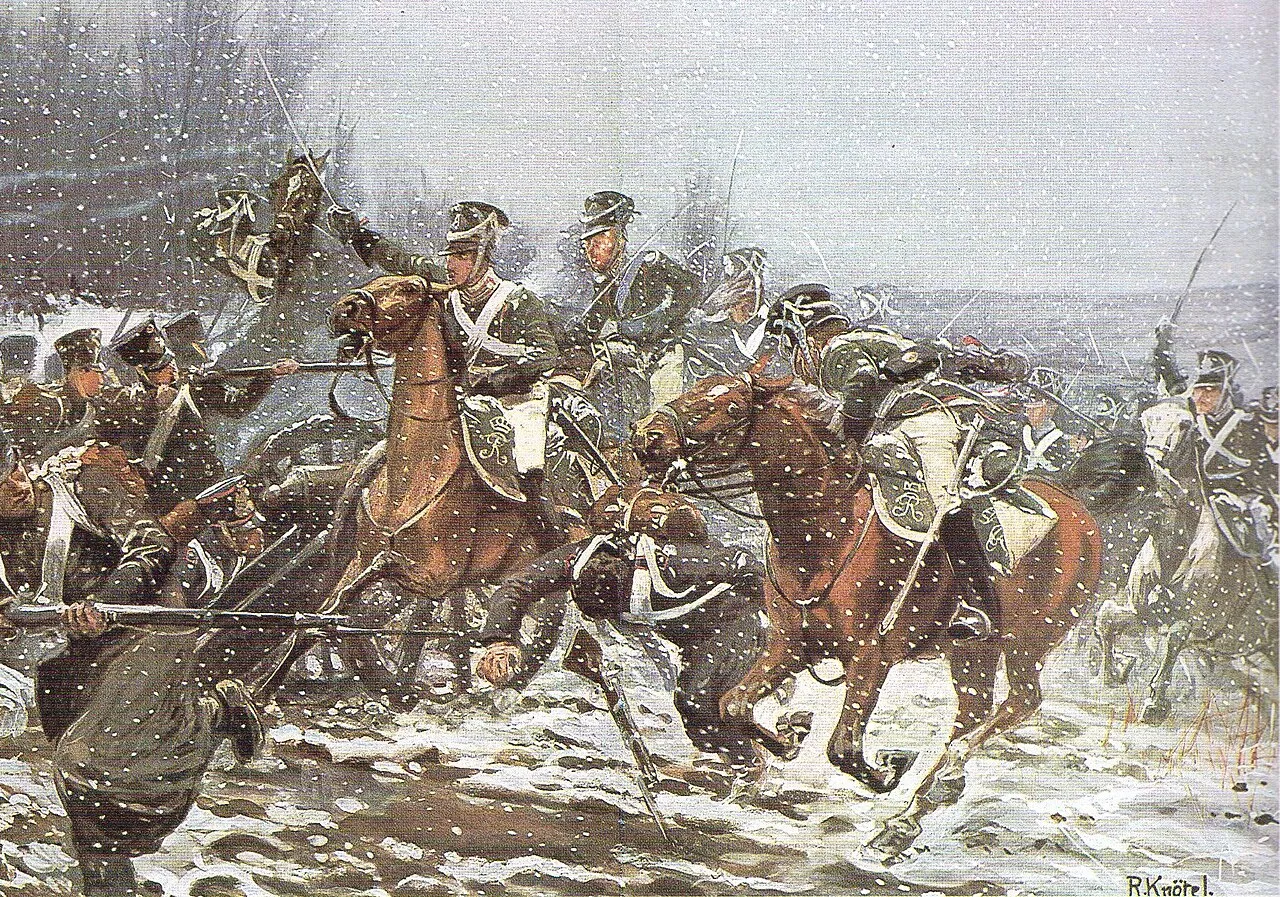 Württemberg cavalry charging at La Rothière on 1 February 1814, by Richard Knötel, late 19th centuryWikimedia Commons, Richard Knötel, Public domain (Bataille de La Rothière, par Knötel.jpg)
In the Six Days' Campaign Napoleon falls on Blücher's corps one at a time with about 30,000 men. He destroys Olsufiev's Russian corps at Champaubert on 10 February. At Montmirail on 11 February Sacken's Russians try to break through eastwards, and Napoleon holds them with the Old Guard, the cavalry and Ricard's division until reinforcements arrive.
The village of Marchais changes hands several times before the Russians give it up at 17:00 and retreat north with Yorck's Prussians. Napoleon beats them again at Château-Thierry on 12 February and Blücher himself at Vauchamps on 14 February. The Army of Silesia, 50,000 to 56,000 men, loses about 17,750, the French 3,400.
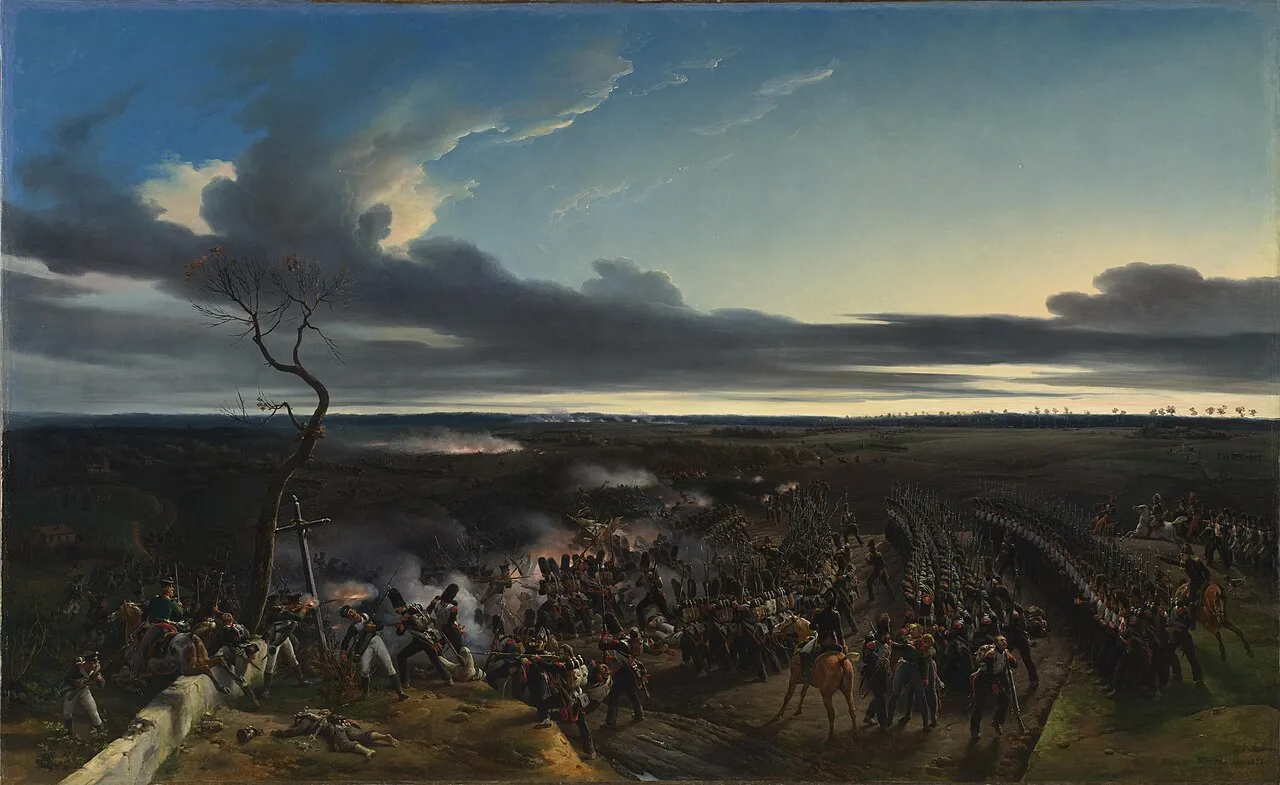 The battle of Montmirail, 11 February 1814, painting by Horace Vernet, 1822Wikimedia Commons, Horace Vernet, Public domain (The battle of Montmirail in 1814 (1822), by Horace Vernet.jpg)
Napoleon turns south against Schwarzenberg, crushes his advance guard at Mormant on 17 February and routs the Crown Prince of Württemberg at Montereau on 18 February, and the Army of Bohemia falls back. Blücher marches north and joins the Army of the North at Laon, which gives him over 100,000 men. Napoleon attacks his advance guard at Craonne on 7 March and is defeated at Laon on 9 and 10 March. He retakes Reims on 13 March, but at Arcis-sur-Aube on 20 and 21 March he meets Schwarzenberg's main army, 80,000 men against his 28,000, and withdraws eastwards.
Sources
- David G. Chandler, The Campaigns of Napoleon (1966).
- F. Loraine Petre, Napoleon at Bay, 1814 (1914).
- George Nafziger, The End of Empire: Napoleon’s 1814 Campaign (2015).
Prev: The retreat over the ElsterNext: Paris and the abdication