8 February 1807, afternoon and evening
Davout, L’Estocq and Ney
Davout’s corps, about 15,000 strong, attacks the Russian left, and with Saint-Hilaire’s help bends it back until it stands at a right angle to the Russian centre. Napoleon keeps the Guard in reserve, because L’Estocq’s Prussians are still unaccounted for. By 3.30 p.m. the Russian left is in retreat.
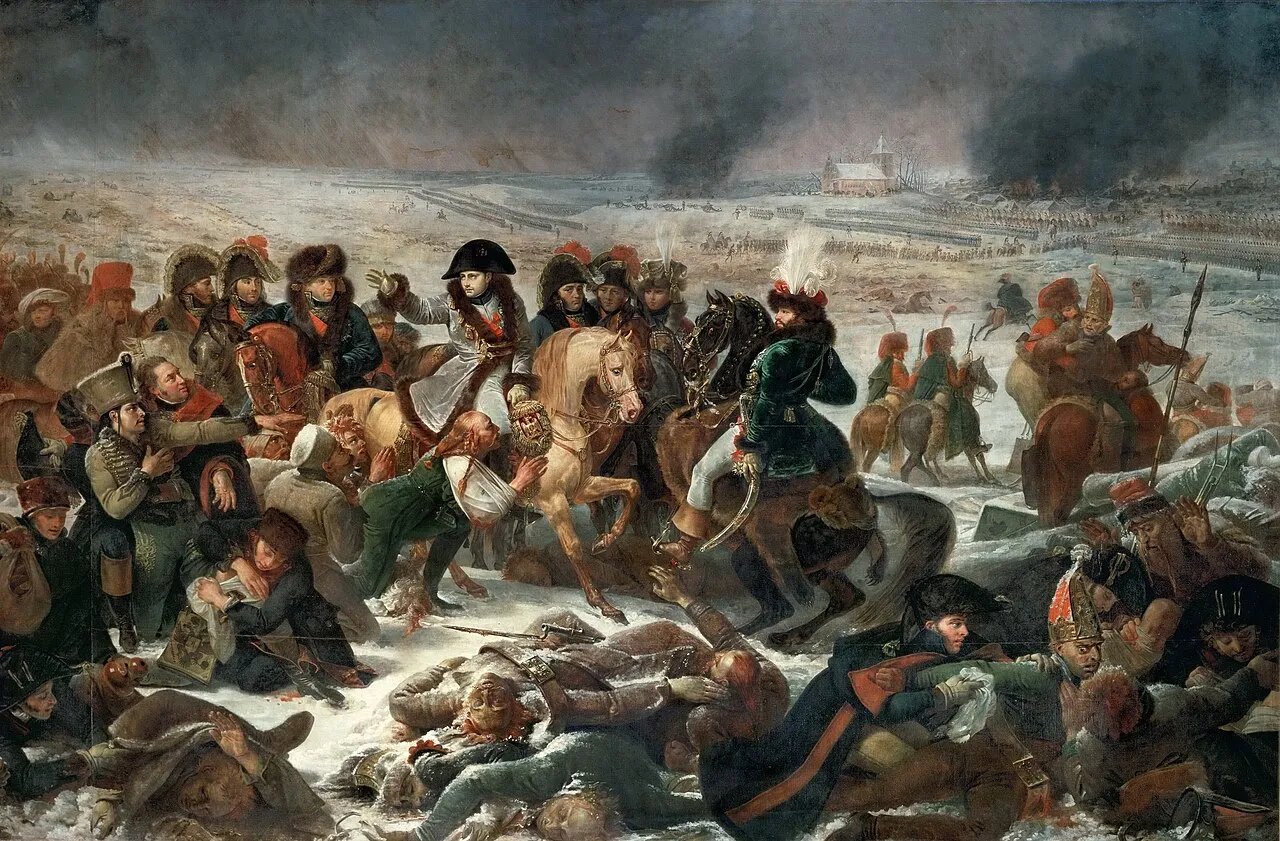 Napoleon on the battlefield of Eylau the day after the battle, painting by Antoine-Jean Gros, 1808Wikimedia Commons, Antoine-Jean Gros, Public domain (Gros, Napoleon at Eylau.jpg)
L’Estocq’s corps, down to about 6,000 men after its rearguard fights with Ney, marches behind the whole Russian position to its left wing and attacks Davout’s exposed right at 4 p.m. With the help of 36 guns under Aleksey Yermolov, Prussians and Russians push Davout back to a line from Kutschitten towards Anklappen, where his guns on the heights of Klein Sausgarten stop them at nightfall. About 7 p.m. Ney’s leading division reaches the field on the French left and attacks the Russian right, and fighting goes on there until 10 p.m.
At 11 p.m. Bennigsen decides to retreat, and the Russians leave in silence behind a screen of Cossacks. Estimates of the losses differ widely, from 15,000 to almost 30,000 French and from 15,000 to 26,000 Russians. Riding over the field the next morning, Ney remarks: “What a massacre! And without result!”
Sources
- F. Loraine Petre, Napoleon’s Campaign in Poland 1806–1807 (1901).
- David G. Chandler, The Campaigns of Napoleon (1966).
- Christopher Summerville, Napoleon’s Polish Gamble: Eylau and Friedland 1807 (2005).
Prev: Murat’s chargeNext: Danzig and Heilsberg