May 1803 to August 1805
War with Britain and the Empire
On 18 May 1803 Britain declares war on France, one year after the Peace of Amiens. Britain has not evacuated Malta as the treaty requires, and it protests against the annexation of Piedmont, the Act of Mediation that binds Switzerland to France and the French troops left in Holland. Bonaparte orders the arrest of every British man between 18 and 60 in France and its dependencies and gathers an army again on the Channel coast.
From 1803 to 1805 about 200,000 men, the Army of England, train in camps at Boulogne, Bruges and Montreuil. A flotilla of invasion barges is built in the ports from Étaples to Flushing and assembled at Boulogne. To cross, Napoleon needs command of the Channel for a few days, but the Royal Navy blockades his fleets in Brest, Toulon and the other ports. In England Martello towers go up along the south coast and militias are raised.
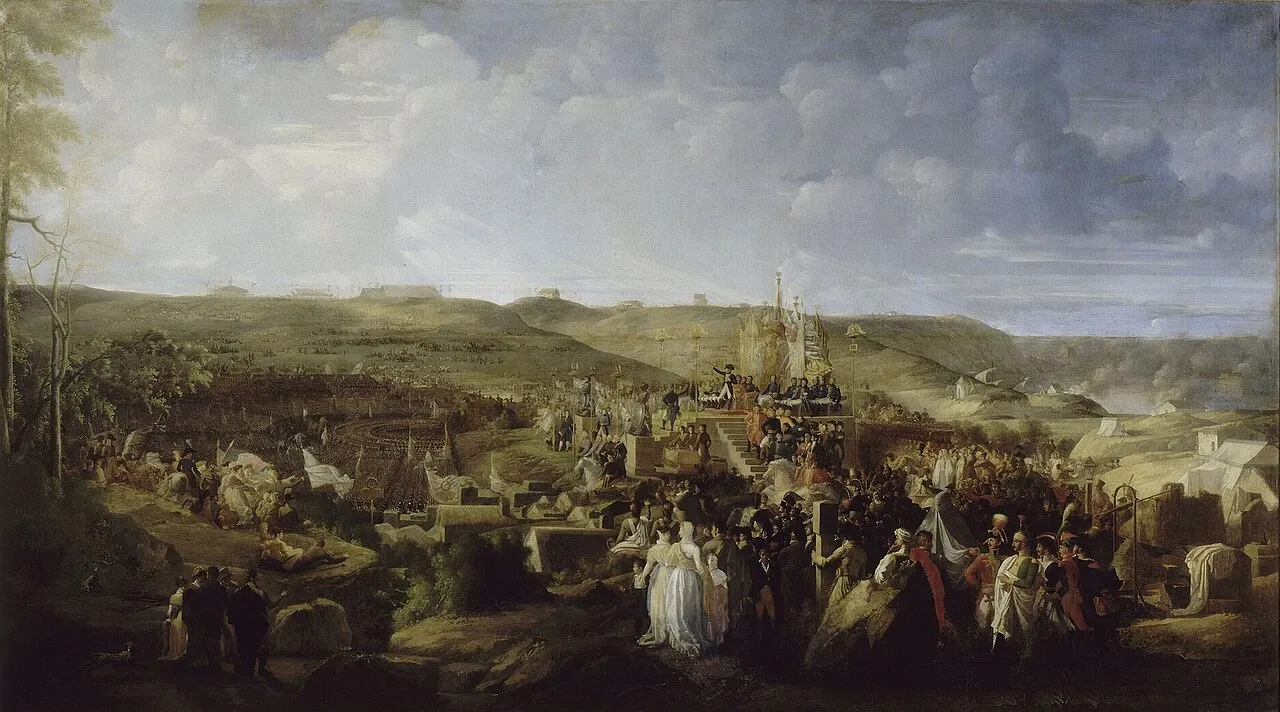 Napoleon gives out the crosses of the Legion of Honour at the camp of Boulogne, 16 August 1804, painting by Philippe-Auguste Hennequin, about 1804 to 1806Wikimedia Commons, Philippe-Auguste Hennequin, Public domain (Hennequin - Napoléon Ier distribue les croix de la légion d'honneur au camp de Boulogne le 16 août 1804 (grand).jpg)
In February 1804 the police uncover a royalist plot to kidnap or kill Bonaparte. On Talleyrand’s advice he has the Duke of Enghien, a Bourbon prince, seized in Baden and executed after a secret military trial, although there is no proof of his part in the plot. Russia protests formally. On 18 May 1804 the Senate proclaims Napoleon Emperor of the French, and the next day he names 18 of his generals Marshals of the Empire.
A plebiscite in June confirms the hereditary empire with 3.5 million votes for and 2,569 against, a count inflated by 300,000 to 500,000 votes. On 2 December 1804 Napoleon crowns himself and Joséphine in Notre-Dame de Paris in the presence of Pope Pius VII. On 17 March 1805 he declares himself King of Italy and is crowned with the Iron Crown in Milan Cathedral, and he then annexes Genoa and Liguria to France.
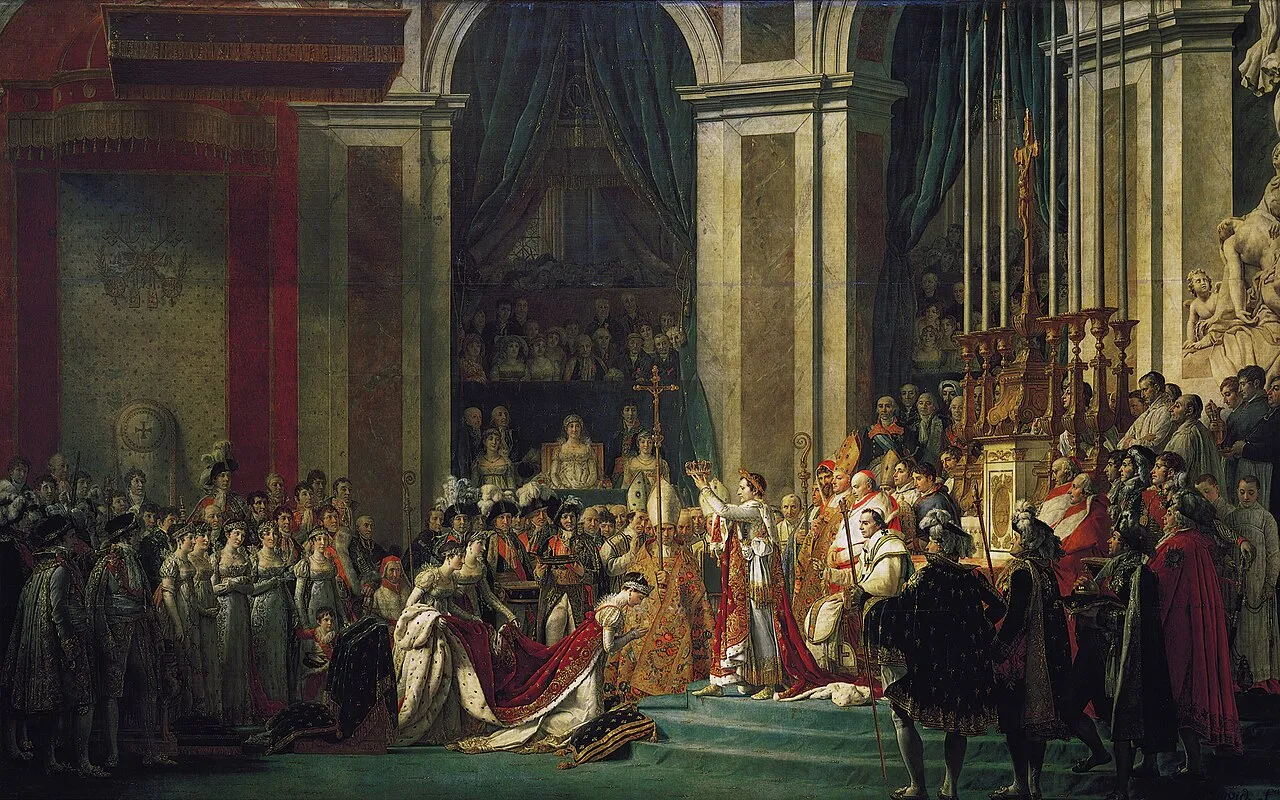 The coronation of Napoleon and Joséphine in Notre-Dame, painting by Jacques-Louis David, 1805 to 1807Wikimedia Commons, Jacques-Louis David, Public domain (Jacques-Louis David, The Coronation of Napoleon edit.jpg)
William Pitt, Prime Minister again since May 1804, builds a new coalition. Sweden allies with Britain in December 1804 and Russia on 11 April 1805, and Austria joins on 9 August. On 27 August, with his fleets unable to reach the Channel, Napoleon breaks up the camps on the coast and turns the army, now named the Grande Armée, towards the Danube.
Sources
- David G. Chandler, The Campaigns of Napoleon (1966).
- J. D. Grainger, The Amiens Truce: Britain and Bonaparte, 1801–1803 (2004).
- Frederick W. Kagan, The End of the Old Order: Napoleon and Europe, 1801–1805 (2006).
Prev: Lunéville, Copenhagen and AmiensNext: From the Channel to the Danube