May to July 1798
The expedition to Egypt
After the Treaty of Campo Formio in October 1797, Britain is the only great power still at war with France. In March 1798 the Directory approves Bonaparte’s plan to occupy Egypt, an Ottoman province ruled in practice by the Mamluk beys Murad Bey and Ibrahim Bey, and to threaten British trade with India from there. Bonaparte is named commander of the Army of the Orient.
His chief of staff Louis-Alexandre Berthier prepares the expedition in Toulon, Marseille, Genoa, Corsica and Civitavecchia. About 300 transports are requisitioned, escorted by 13 ships of the line and as many frigates under Vice-admiral François-Paul Brueys d’Aigalliers. By 11 May the army counts 30,800 infantry, 3,475 cavalry and 1,660 artillerymen, with 60 field guns and 40 siege guns. With 167 scholars and artists and the other civilians, about 38,000 people sail.
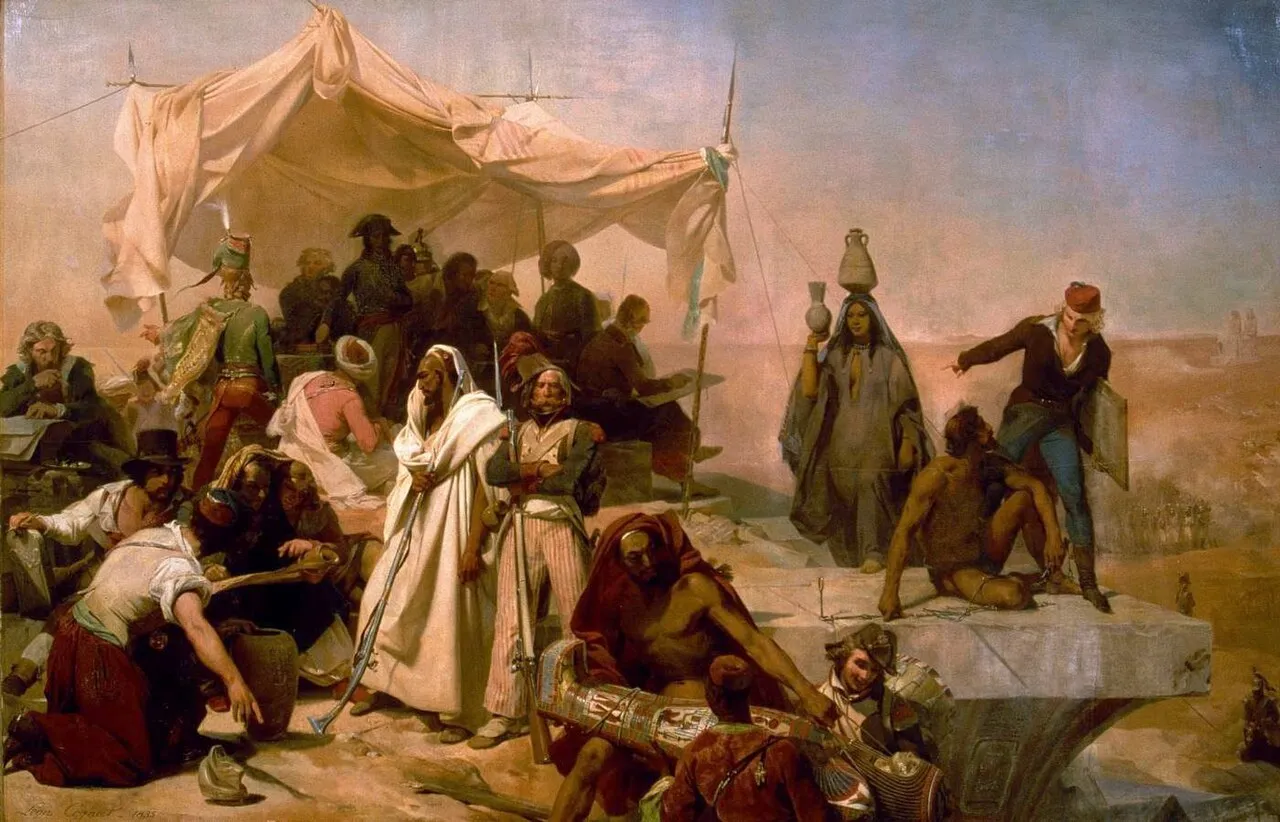 The expedition to Egypt under the orders of Bonaparte, ceiling painting by Léon Cogniet in the Louvre, 1835Wikimedia Commons, Léon Cogniet, Public domain (Leon Cogniet - L Expedition D Egypte Sous Les Ordres De Bonaparte.jpg)
Bonaparte leaves Toulon on 19 May aboard the flagship L’Orient and keeps the destination secret even from most of his officers. The fleet passes Corsica and Sardinia and reaches Malta on 9 June, where the convoy from Civitavecchia joins it. Grand Master Ferdinand von Hompesch zu Bolheim allows only two ships at a time into Valletta, so the French land troops, and the Knights of St John surrender on 12 June. Bonaparte leaves 4,000 men under General Claude-Henri Vaubois and sails for Egypt on 19 June.
The fleet arrives off Alexandria on 1 July. Bonaparte lands his men that night at the cove of Marabout, west of the city, without waiting for the cavalry and the guns. Early on 2 July he attacks with 4,000 to 5,000 men in three columns under Menou, Kléber and Bon. Menou is wounded seven times and Kléber hit in the forehead, and after a short fight the governor Koraim Pasha and his 500 defenders give up the city.
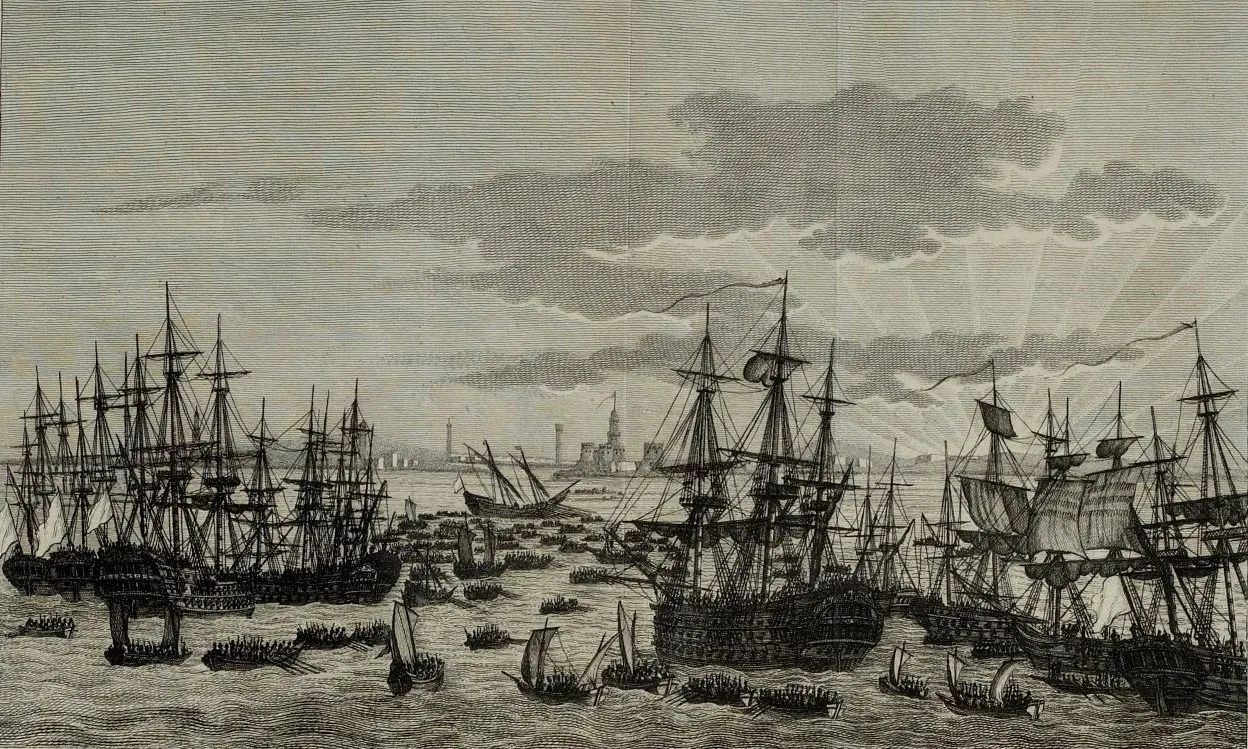 The landing in Egypt in July 1798, engraving from the Tableaux historiques de la Révolution française, 1802 editionWikimedia Commons, Desaux/Allart J., CC BY-SA 4.0 (Débarquement de Napoléon en Egypte juillet 1798, Musée de la révolution française - Vizillejpg.jpg)
Sources
- David G. Chandler, The Campaigns of Napoleon (1966).
- Juan Cole, Napoleon’s Egypt: Invading the Middle East (2007).
- Paul Strathern, Napoleon in Egypt (2008).
Prev: Leoben and Campo FormioNext: The march on Cairo