February to October 1797
Leoben and Campo Formio
Wurmser surrenders Mantua on 2 February 1797. He goes free with his staff and an escort of 700 men and six guns, and the garrison, of which only 16,000 men are fit to march out, leaves with the honours of war. The French find 325 guns in the fortress. Bonaparte then turns south against the Papal States, defeats the papal army at Faenza, and Pope Pius VI accepts his terms at Tolentino.
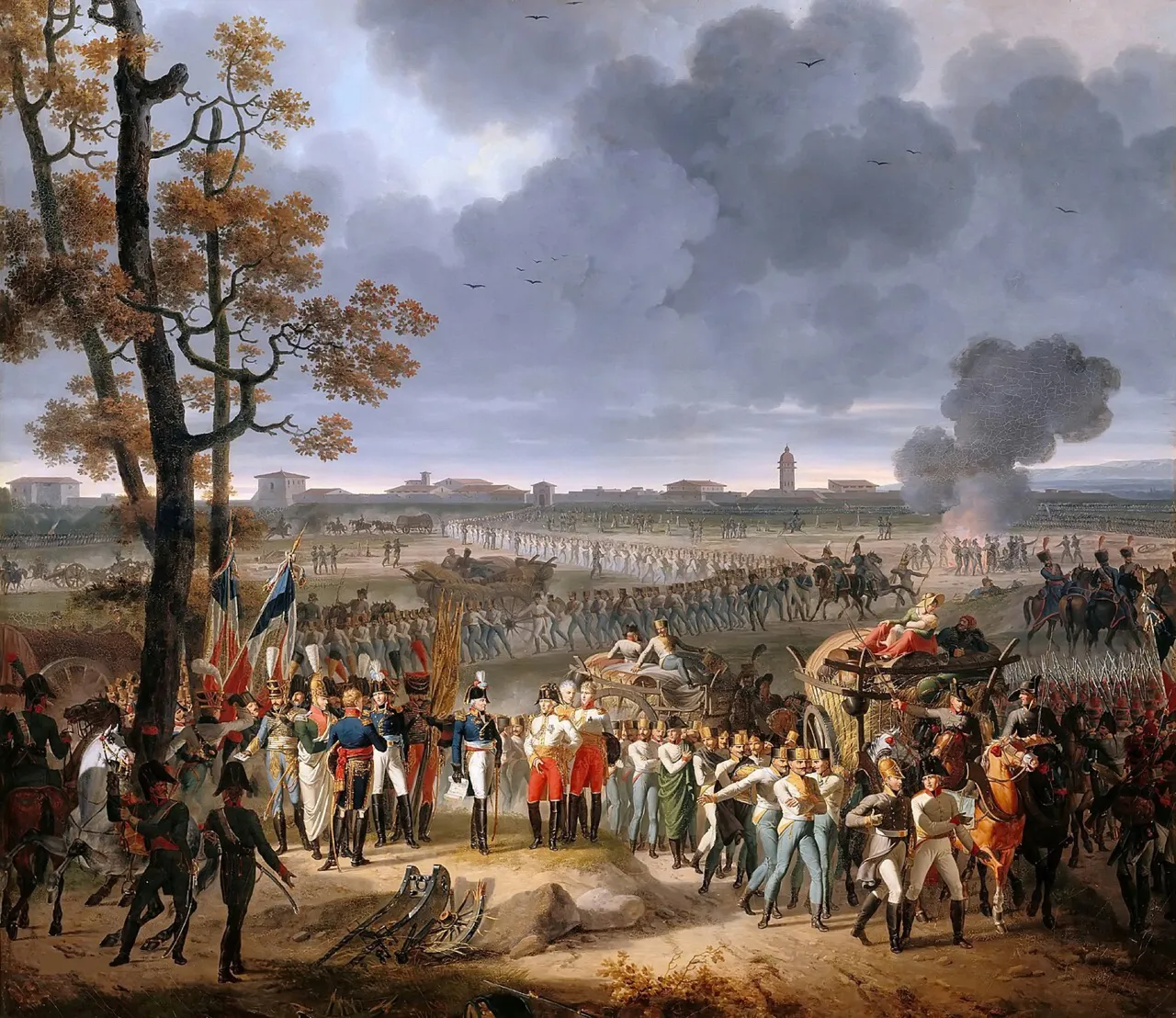 Wurmser surrenders Mantua to Sérurier on 2 February 1797, painting by Hippolyte Lecomte, 1812Wikimedia Commons, Hippolyte Lecomte, Public domain (Lecomte - Reddition de Mantoue, le 2 février 1797, le général Wurmser se rend au général Sérurier.jpg)
Reinforced with troops from the Rhine, Bonaparte attacks the Austrian army of Archduke Charles in north-eastern Italy in March, while Joubert’s wing advances through Tyrol. The archduke is driven into retreat, and from 21 to 23 March the divisions of Masséna, Guieu and Sérurier close the Tarvis pass and capture 3,500 Austrians. Bonaparte reaches Klagenfurt on 30 March and Judenburg on 7 April.
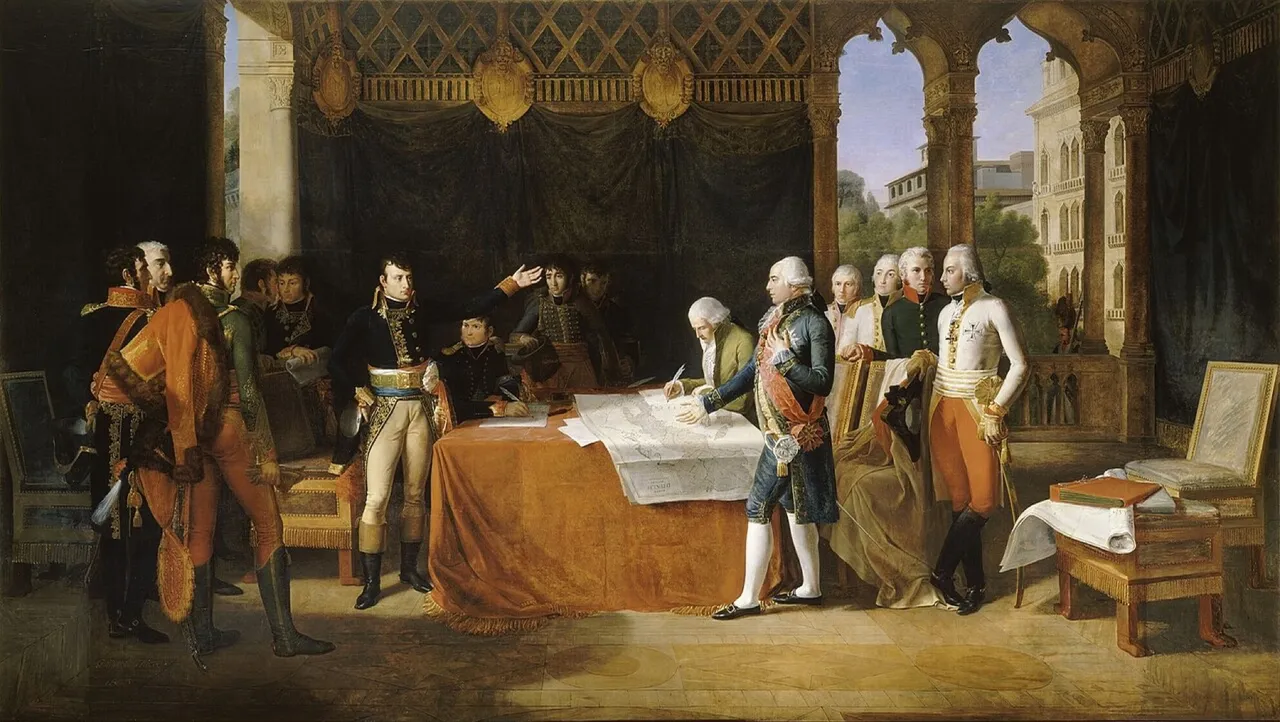 The preliminary peace of Leoben, painting by Guillaume Guillon-Lethière, 1805Wikimedia Commons, Guillaume Guillon-Lethière, Public domain (Guillon Lethière - Traité de Leoben, 17 avril 1797.jpg)
On 18 April Bonaparte and the Austrian envoys sign the preliminary peace of Leoben, about 100 km from Vienna. Austria gives up the Austrian Netherlands and, in secret articles, Lombardy, in exchange for the mainland territories of the Republic of Venice. On 12 May the Great Council of Venice votes to dissolve the Republic in favour of a provisional municipality, and French troops occupy the city.
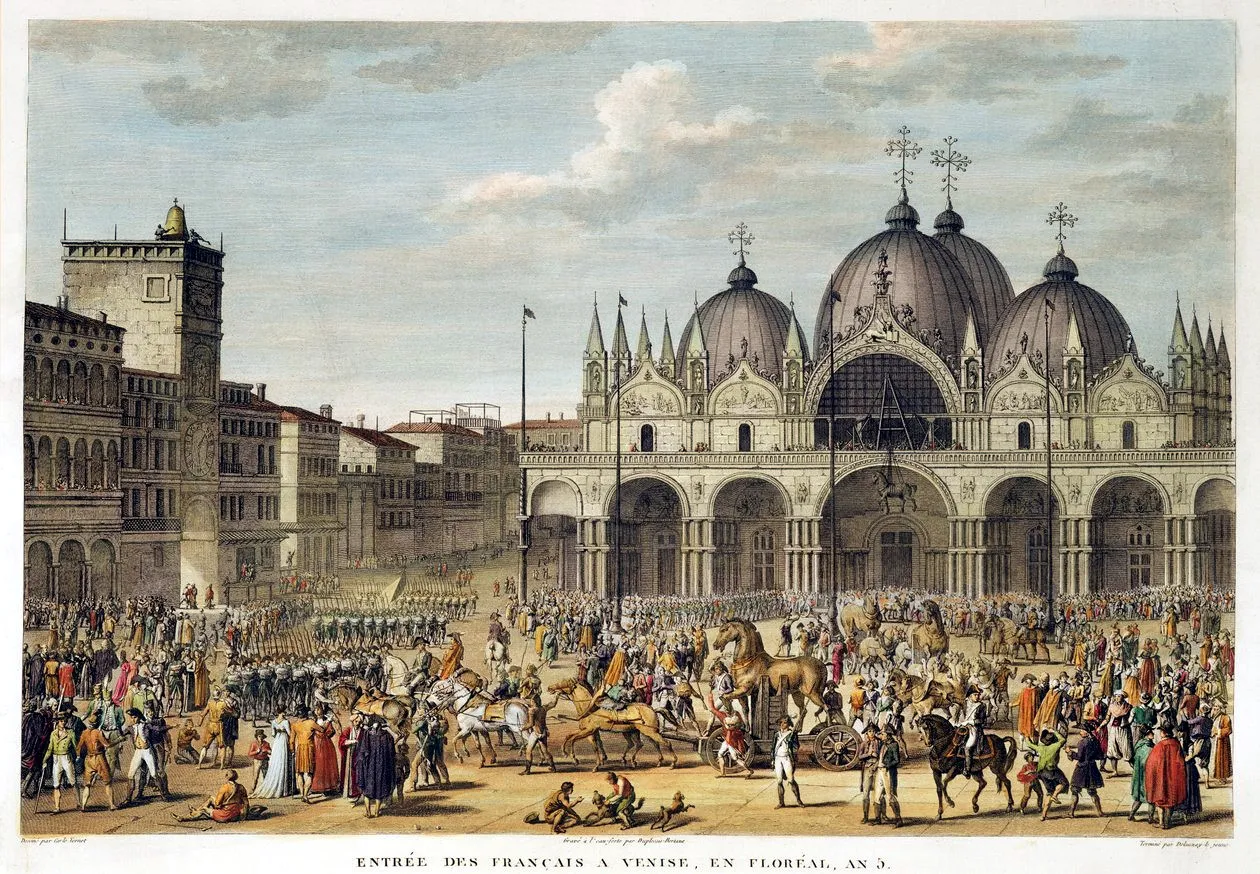 The French enter Venice and remove the horses of St Mark’s, print after Carle Vernet and Jean Duplessis-Bertaux, 1797Wikimedia Commons, Carle Vernet and Jean Duplessis-Bertaux, Public domain (Entrée des Francais a Venise, en Floréal, An 5.jpg)
In Paris troops sent by Bonaparte under Augereau help the Directory purge the royalists from the councils in the coup of 18 Fructidor on 4 September. On 17 October Bonaparte and Count Philipp von Cobenzl sign the Treaty of Campo Formio. Austria cedes the Austrian Netherlands, recognises the Cisalpine and Ligurian Republics and receives Venice with its mainland, Istria and Dalmatia, while France takes the Ionian Islands and, by secret articles, the frontier of the Rhine. The war of the First Coalition is over, and Britain is left alone at war with France.
Sources
- Paul W. Schroeder, The Transformation of European Politics 1763–1848 (1996).
- Georges Lefebvre, The French Revolution: From 1793 to 1799 (1964).
- David G. Chandler, The Campaigns of Napoleon (1966).
Prev: La FavoritaNext: The expedition to Egypt