24 August to 6 September 1812
The road to Moscow
On 24 August the Grande Armée marches out of Smolensk on the road to Moscow, with Eugène on the left, Poniatowski on the right and Murat in the centre, and Napoleon with the Guard and the corps of Davout and Ney behind them. Kutuzov takes over the Russian armies on 29 August at Tsaryovo-Zaymishche. He keeps to Barclay’s strategy of retreat, but cannot give up Moscow without a battle.
Kutuzov chooses a position near the village of Borodino, about 110 km west of Moscow, which blocks both roads from Smolensk to Moscow. From 3 September his men build earthworks: a large redoubt in the centre, later named after Nikolay Raevsky, and three arrow-shaped flèches on the left, named after Bagration. The line runs for about 8 km from the Moskva along its tributary the Kolocha to the village of Utitsa, with about 80,000 men of Barclay’s 1st Army on the right and 34,000 of Bagration’s 2nd Army on the left.
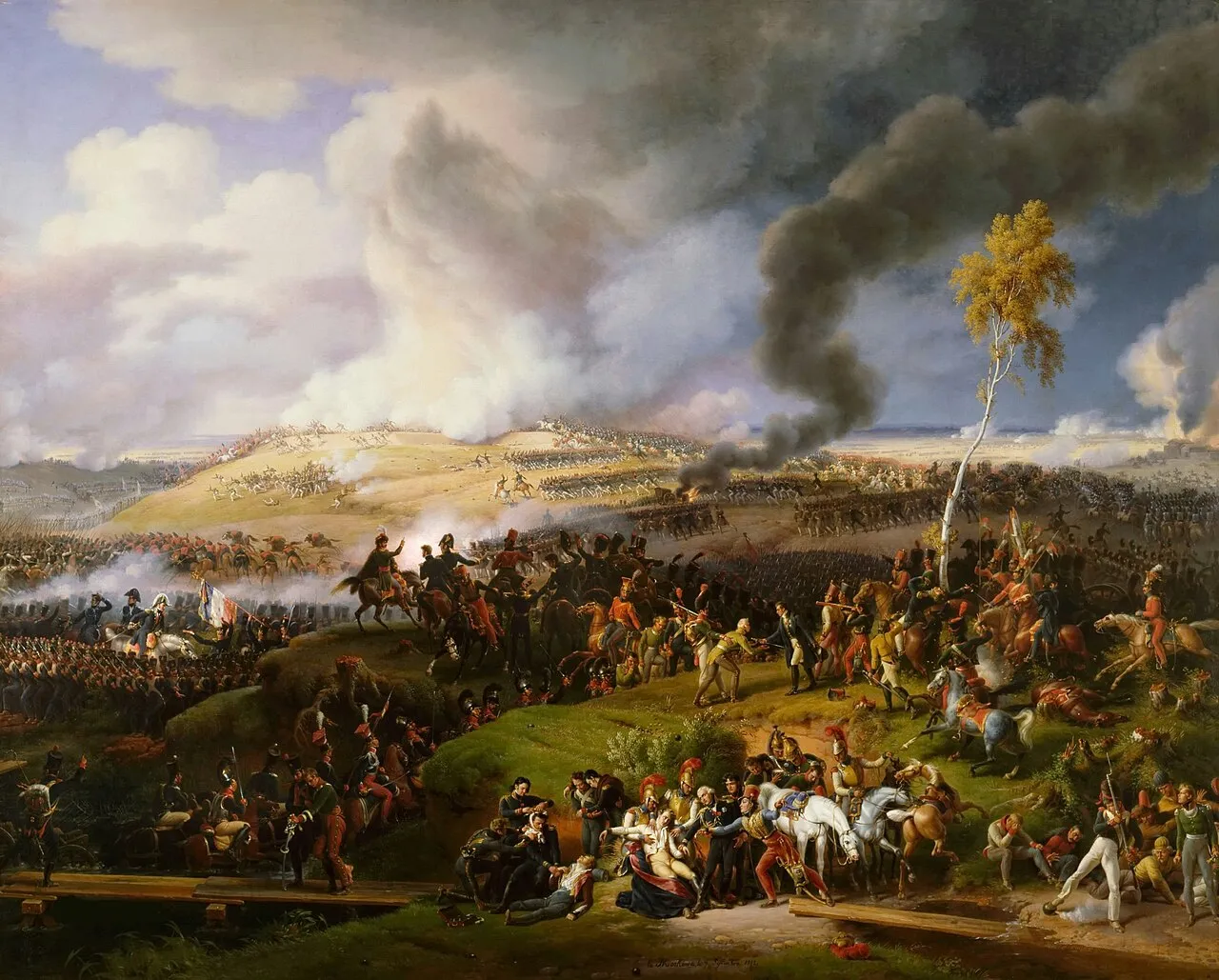 The battle of the Moskva, painting by Louis-François Lejeune, 1822Wikimedia Commons, Louis Lejeune, Public domain (Battle of Borodino.jpg)
In front of the Russian left a five-sided redoubt stands on a mound near Shevardino. On 5 September Murat’s cavalry, Compans’s division of Davout’s corps and Poniatowski’s Poles attack it, and the Russians leave it only on Kutuzov’s order. The French lose about 4,000 men and the Russians 6,000, and the Russian left is drawn back towards Utitsa.
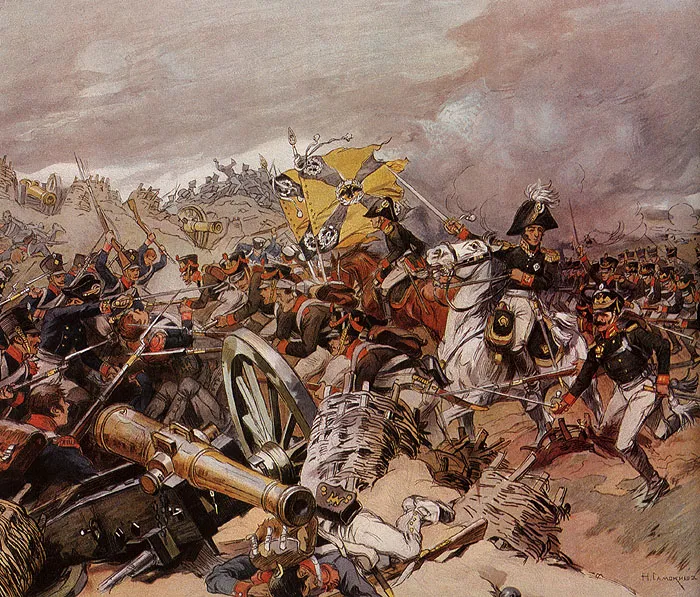 The attack on the Shevardino redoubt, by Nikolai Samokish, 1910Wikimedia Commons, Nikolai Samokysh, Public domain (SamokishBorodinoLitograf.jpg)
The Russians have about 155,000 men on the field, including 10,000 Cossacks, with 637 guns, 300 of them in reserve, and 33,000 militia stand nearby without fighting. The French have about 128,000 men and 587 guns, among them the 18,500 men of the Imperial Guard.
Sources
- Alexander Mikaberidze, The Battle of Borodino: Napoleon Against Kutuzov (2007).
- Christopher Duffy, Borodino and the War of 1812 (1972).
- Richard K. Riehn, 1812: Napoleon’s Russian Campaign (1990).
Prev: SmolenskNext: The flèches