15 October to 21 November 1806
Berlin and the Continental System
The beaten Prussian armies flee north towards the Elbe with Murat’s cavalry behind them. At Erfurt on 16 October more than 10,000 Prussians lay down their arms, and on 17 October Bernadotte’s corps defeats the Prussian Reserve under Duke Eugene of Württemberg at Halle, which had not yet fought. The wounded Brunswick is carried away to Altona, where he dies on 10 November.
 Napoleon enters Berlin through the Brandenburg Gate on 27 October 1806, painting by Charles Meynier, 1810Wikimedia Commons, Charles Meynier, Public domain (Charles Meynier - Entrée de Napoléon à Berlin. 27 octobre 1806.jpg)
Napoleon gives Davout’s corps the honour of entering Berlin first, and it marches in on 25 October. Napoleon follows on 27 October and visits the tomb of Frederick the Great at Potsdam, telling his marshals that if Frederick were alive they would not be there. The king and queen escape to East Prussia.
Hohenlohe, making for the Oder, is overtaken by Murat at Prenzlau on 28 October and surrenders his whole corps of about 10,000 men, believing himself surrounded, although only Murat’s cavalry and a brigade of infantry are near. Stettin and other fortresses give up in the following days. Blücher, with the last 21,000 Prussian field troops west of the Oder, turns west with Bernadotte, Soult and Murat in pursuit and forces his way into the neutral city of Lübeck. Bernadotte’s corps storms the town on 6 November, and the next day Blücher surrenders with about 9,000 men near the Danish border.
In 19 days from the start of the invasion the Grande Armée has destroyed almost the whole Prussian army of a quarter of a million men. Sources differ on the totals, from 140,000 to 150,000 prisoners and from 2,000 to over 4,000 guns, and Magdeburg falls to Ney in November. The French lose about 15,000 men in the whole campaign.
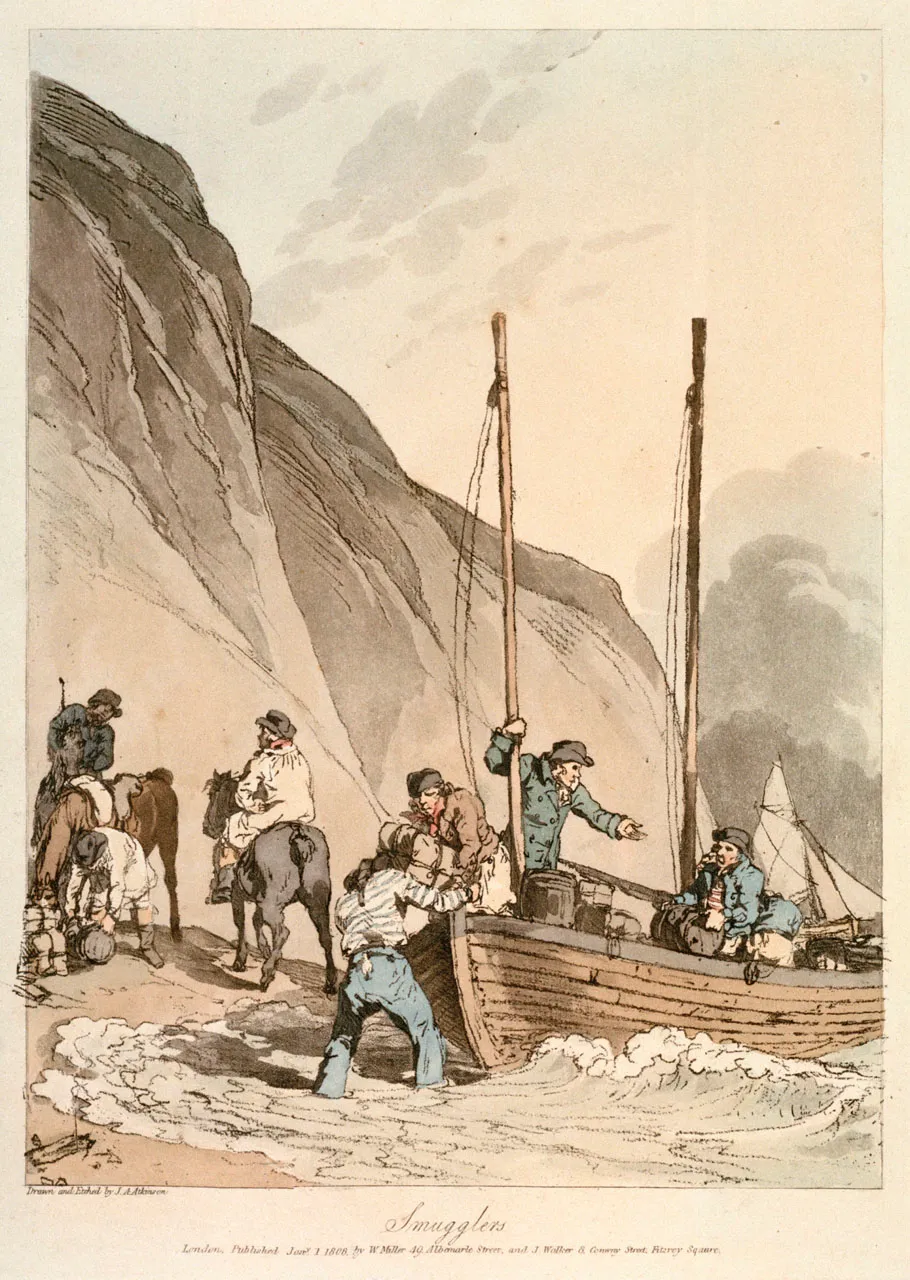 Smugglers landing goods, hand-coloured etching after John Augustus Atkinson, 1808Wikimedia Commons, John Augustus Atkinson, Public domain (Smugglers by John Atkinson.jpg)
On 21 November Napoleon signs the Berlin Decree, his answer to the British blockade of the French coast proclaimed in May. It declares the British Isles under blockade, forbids all trade and correspondence with Britain, and orders British subjects in French or allied territory arrested and British goods seized. This is the start of the Continental System, which lasts until 1814, but smuggling and British control of the sea limit its effect.
Sources
- F. Loraine Petre, Napoleon’s Conquest of Prussia 1806 (1907).
- David G. Chandler, The Campaigns of Napoleon (1966).
- Paul W. Schroeder, The Transformation of European Politics, 1763–1848 (1994).
Prev: Davout counterattacksNext: Into Poland and East Prussia