9 to 25 November 1812
Krasnoi and the Berezina
At Smolensk only about 37,000 of Napoleon’s men are still fit to fight, and the stores there cannot feed the army. A blizzard on 14 November brings heavy snow and temperatures of −24 °C. The army leaves the city corps by corps, and from 15 to 18 November Kutuzov, marching on a parallel road to the south, attacks it around Krasnoi. The Guard holds Krasnoi and makes a feint on 17 November that lets Davout through, but the corps of Eugène and Davout are badly mauled, and the Russians take about 26,000 prisoners, most of them stragglers, and some 230 guns.
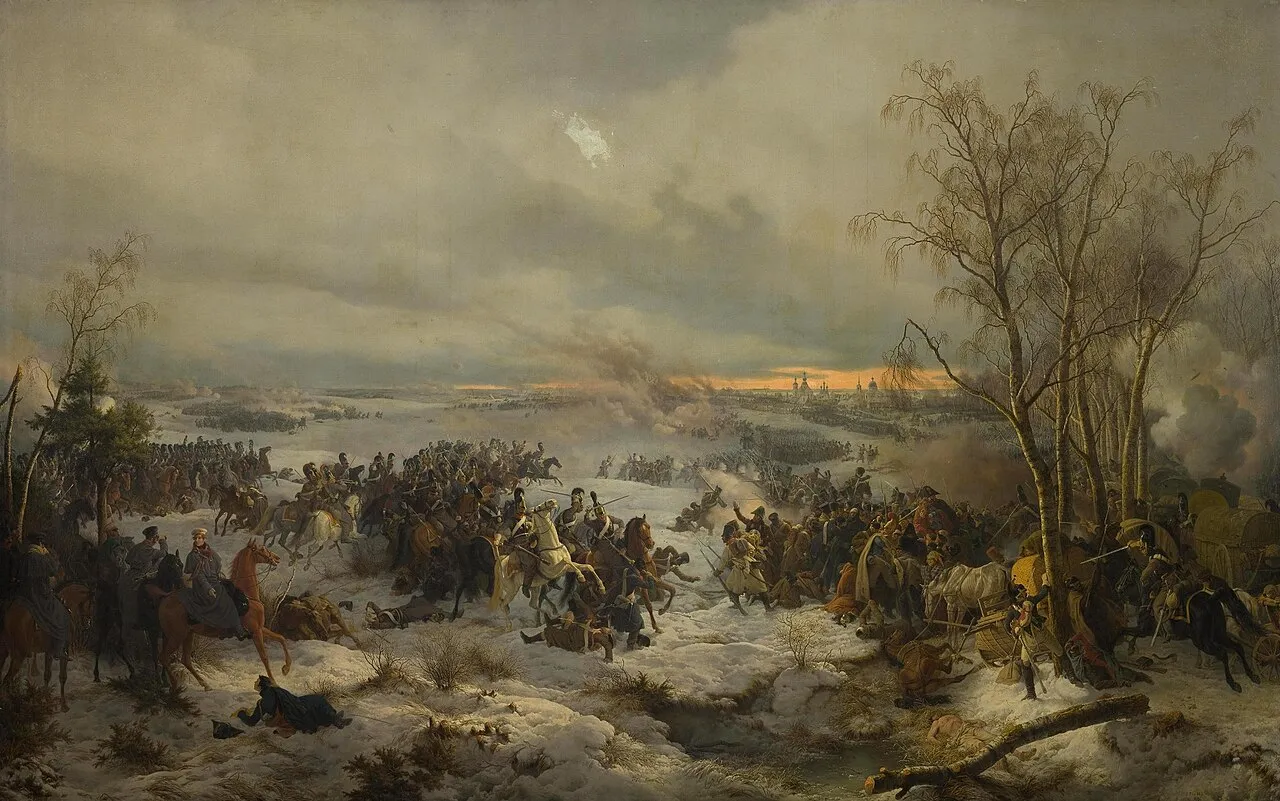 The battle of Krasnoi, painting by Peter von Hess, 1849Wikimedia Commons, Peter von Hess, Public domain (Krasnoi.jpg)
Ney’s III Corps, the rearguard, leaves Smolensk last with about 3,000 men and six guns. On 18 November it runs into Miloradovich’s troops on the Losvinka stream near Krasnoi and loses more than half of its men. That night Ney crosses the frozen Dnieper to the north, and pursued by Platov’s Cossacks he rejoins Eugène near Orsha on 20 November with about 800 or 900 men.
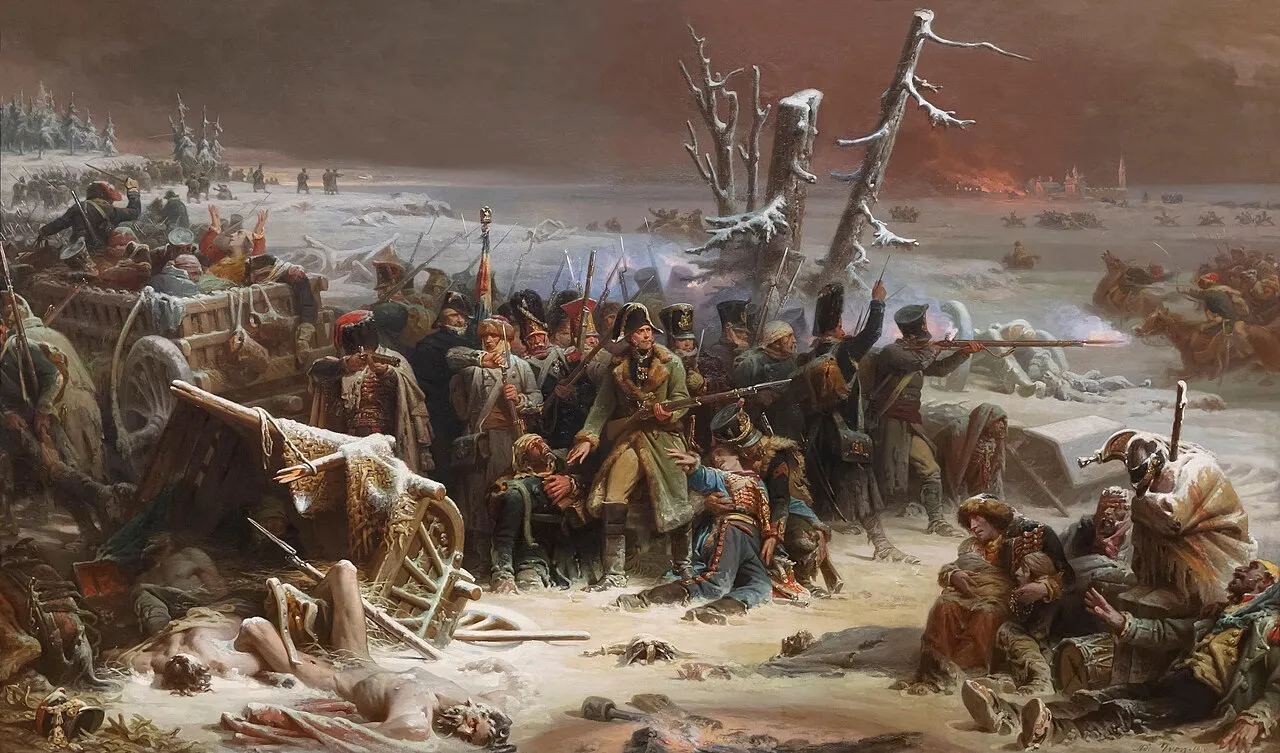 Ney with the rearguard during the retreat from Moscow, painting by Adolphe Yvon, 1856Wikimedia Commons, Adolphe Yvon, Public domain (Marshal Ney supporting the rear guard during the retreat from Moscow.jpg)
Two more Russian armies close in. Peter Wittgenstein comes south from the Dvina with 30,000 men, and Admiral Pavel Chichagov, whose army has been freed by the peace with the Ottoman Empire, advances from Minsk with 35,000 and takes the town and bridge of Borisov on the Berezina on 21 November. A French attempt to retake Borisov on 23 November fails, and the Russians destroy the bridge.
At Bobr the corps of Victor and Oudinot join Napoleon, giving him about 49,000 men under arms and 40,000 stragglers. A French cavalry brigade finds a ford at Studienka, about 13 km north of Borisov, and General Eblé has kept the tools and forges for bridging despite orders to destroy them. Oudinot’s movements south of Borisov lead the Russians to expect a crossing downstream, and Chichagov moves his main body south.
Sources
- David G. Chandler, The Campaigns of Napoleon (1966).
- Adam Zamoyski, Moscow 1812: Napoleon’s Fatal March (2004).
- Paul Britten Austin, 1812: The Great Retreat (1996).
Prev: Moscow and the retreatNext: The bridges at Studienka