April to May 1809
Austria attacks
In October 1808 France withdraws 108,000 troops from Germany, more than half its strength there, to reinforce its armies in Spain. In Vienna the foreign minister Johann Philipp Stadion argues for a war to recover the lands lost in 1805, and on 8 February 1809 Emperor Francis I decides on it. Archduke Charles has reformed the army and gathers about 200,000 men in six corps and two reserve corps for the main theatre. Britain sends £250,000 in silver and promises £1 million more, while Prussia stays neutral.
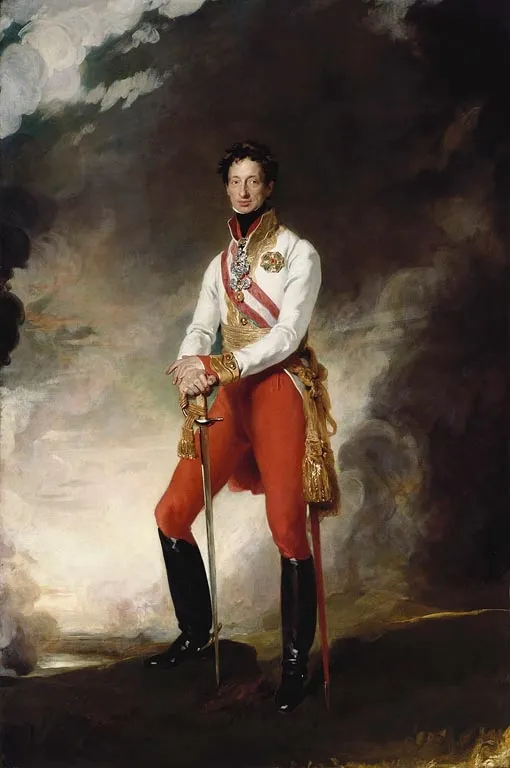 Archduke Charles of Austria, portrait by Thomas Lawrence, 1819Wikimedia Commons, Thomas Lawrence, Public domain (Sir Thomas Lawrence (1769-1830) - Charles, Archduke of Austria (1771-1847) - RCIN 405140 - Royal Collection.jpg)
On 10 April the Austrian main army crosses the Inn into Bavaria, a French ally, without a declaration of war. Marshal Louis-Alexandre Berthier, in command until Napoleon arrives, misreads his orders and sends Davout’s III Corps to Regensburg, leaving the two wings of the French army about 120 km apart. Napoleon reaches Donauwörth on 17 April and orders the army to concentrate. On 19 April Davout fights his way past the Austrians at Teugen-Hausen.
Napoleon breaks the Austrian centre at Abensberg on 20 April and takes Landshut on 21 April, while Johann von Hiller’s wing escapes south over the Isar. Charles meanwhile turns on Davout with about 75,000 men, and on 22 April Napoleon marches north to Eckmühl with most of the army. Dominique Vandamme’s Württembergers storm the bridge and the château of Eckmühl, Davout takes the villages of Unterlaichling and Oberlaichling, and Charles orders a retreat. The Austrians lose about 11,000 men, the French about 3,000.
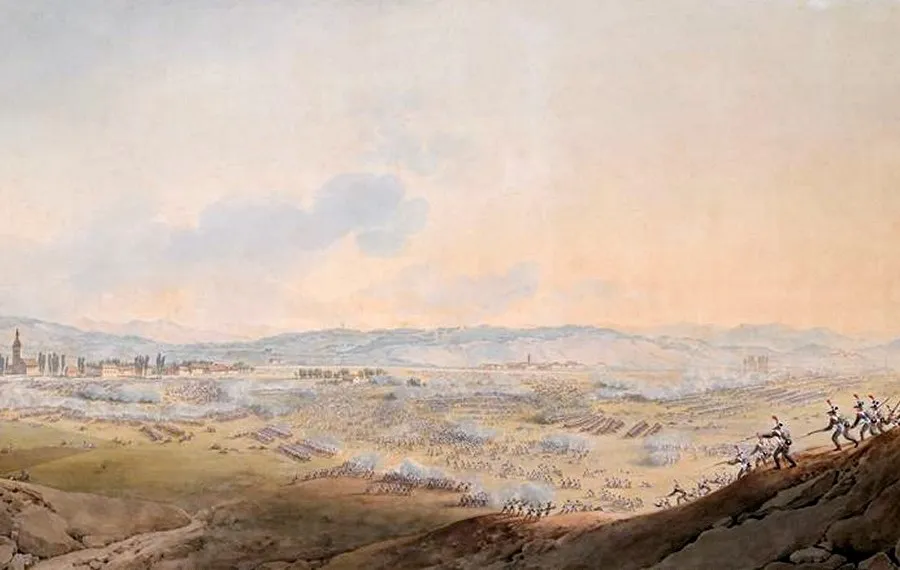 The battle of Eckmühl on 22 April 1809, watercolour by Giuseppe Pietro BagettiWikimedia Commons, Giuseppe Pietro Bagetti, Public domain (Battle of Eckmühl.jpg)
Charles crosses the Danube at Regensburg, whose bridge the Austrians took on 20 April, and leaves 6,000 men in the town. Marshal Jean Lannes storms it on 23 April at the second attempt, and the Austrian army withdraws into Bohemia. Napoleon marches down the Danube, where Hiller holds the bridge at Ebelsberg until Masséna takes it on 3 May. Vienna surrenders on 12 May, the French enter it the next day, and its garrison destroys the Danube bridges behind it.
In Italy Archduke John defeats Eugène de Beauharnais at Sacile on 15 and 16 April, falls back after the news from Bavaria and is beaten on the Piave on 8 May. An Austrian corps defeats Józef Poniatowski at Raszyn on 19 April and occupies Warsaw four days later. In the Tyrol Andreas Hofer leads a rising against Bavarian rule.
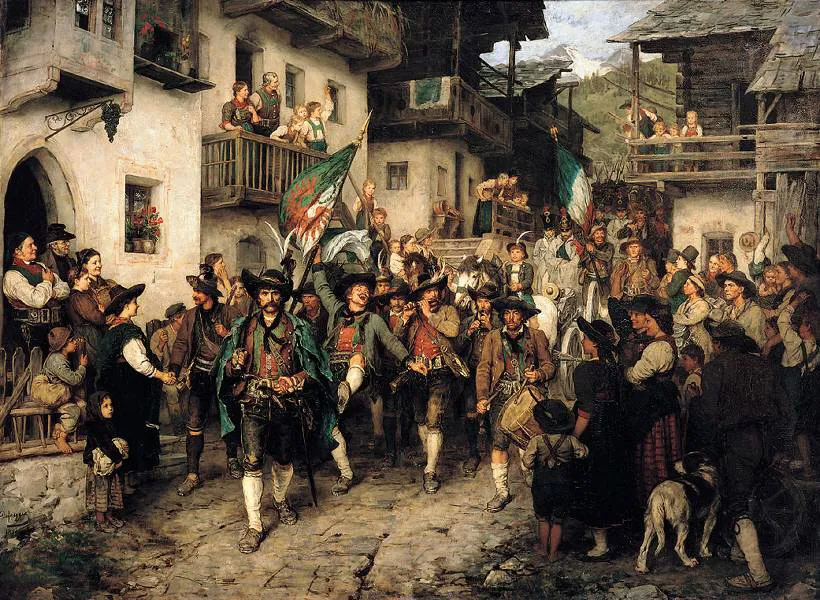 Tyrolean militia returning home in 1809, painting by Franz Defregger, 1876Wikimedia Commons, Franz Defregger, Public domain (Franz von Defregger Heimkehrender Tiroler Landsturm.jpg)
Sources
- David G. Chandler, The Campaigns of Napoleon (1966).
- John H. Gill, 1809: Thunder on the Danube, volume I: Abensberg (2008).
- F. Loraine Petre, Napoleon and the Archduke Charles (1909).
Prev: Into FranceNext: Crossing the Danube