Late October to 1 December 1805
Vienna and Moravia
After Ulm the Grande Armée follows Kutuzov’s Russians and the remaining Austrians down the Danube. Kutuzov fights a rearguard action at Amstetten on 5 November, crosses to the north bank and destroys the bridges, and on 11 November falls on Gazan’s division of Mortier’s corps at Dürenstein, where each side loses about 4,000 men. On 13 November Murat and Lannes take the Danube bridge at Vienna intact by claiming that an armistice has been signed. In Vienna the French find 100,000 muskets and 500 guns.
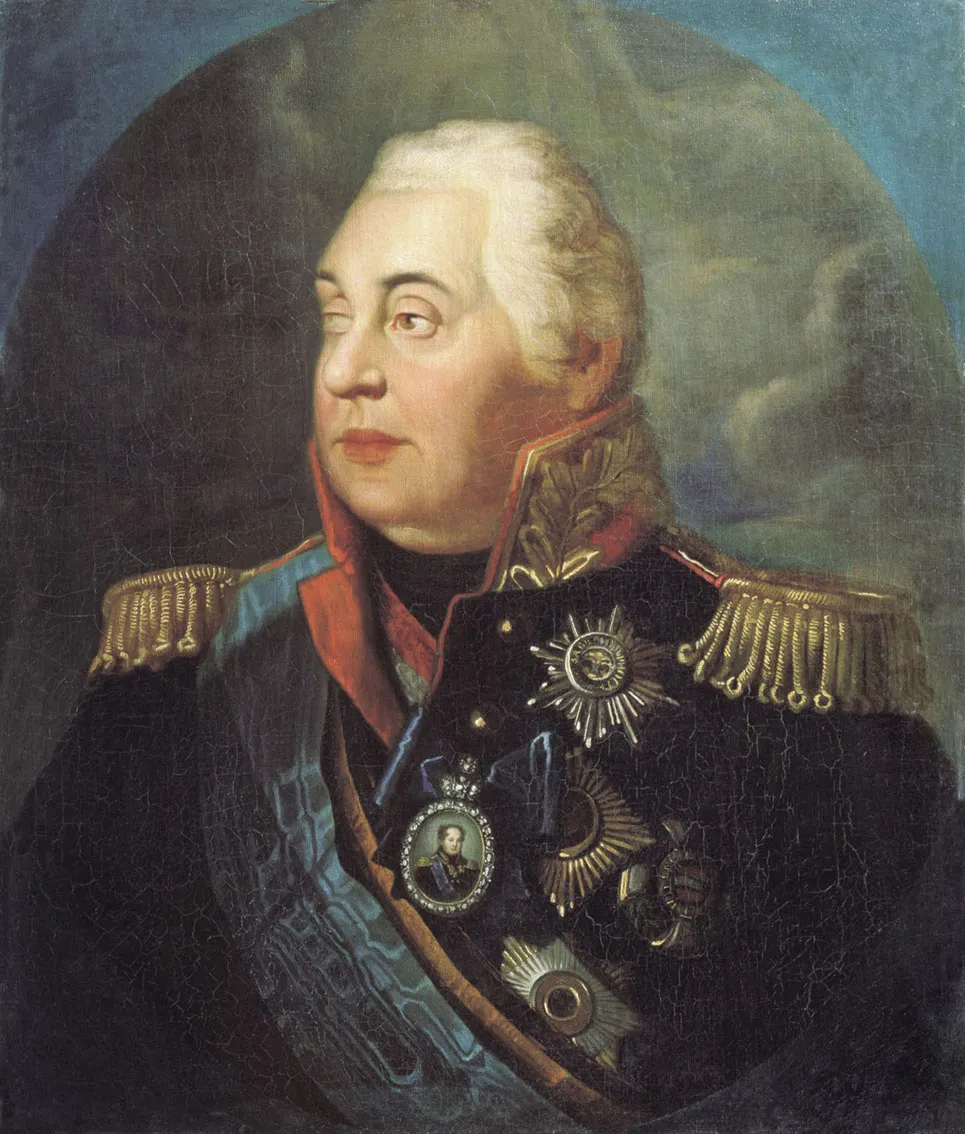 Mikhail Kutuzov, portrait by Roman VolkovWikimedia Commons, R.M. Volkov (1776-1831), Public domain (Kutuzov by Volkov.jpg)
Kutuzov retreats north into Moravia to meet Buxhoeveden’s army. His rearguard under Pyotr Bagration, about 7,000 men, stops Murat and Lannes at Schöngrabern near Hollabrunn. Murat takes it for the whole Russian army and accepts an offer of an armistice, and when he attacks on 16 November Bagration holds for six hours before he withdraws in order. The allies gather at Olmütz under Tsar Alexander I and Emperor Francis, by different counts 73,000 to 89,000 men.
Napoleon halts at Brünn with about 53,000 men at hand. His lines of communication are long and Prussia’s intentions unknown, and he needs a battle. On 25 November he sends Savary to the allied headquarters to speak of peace, on 27 November he accepts an Austrian offer of an armistice, and he orders Soult to give up Austerlitz and the Pratzen Heights as if in disorder. Bernadotte is called in from Iglau and Davout from Vienna.
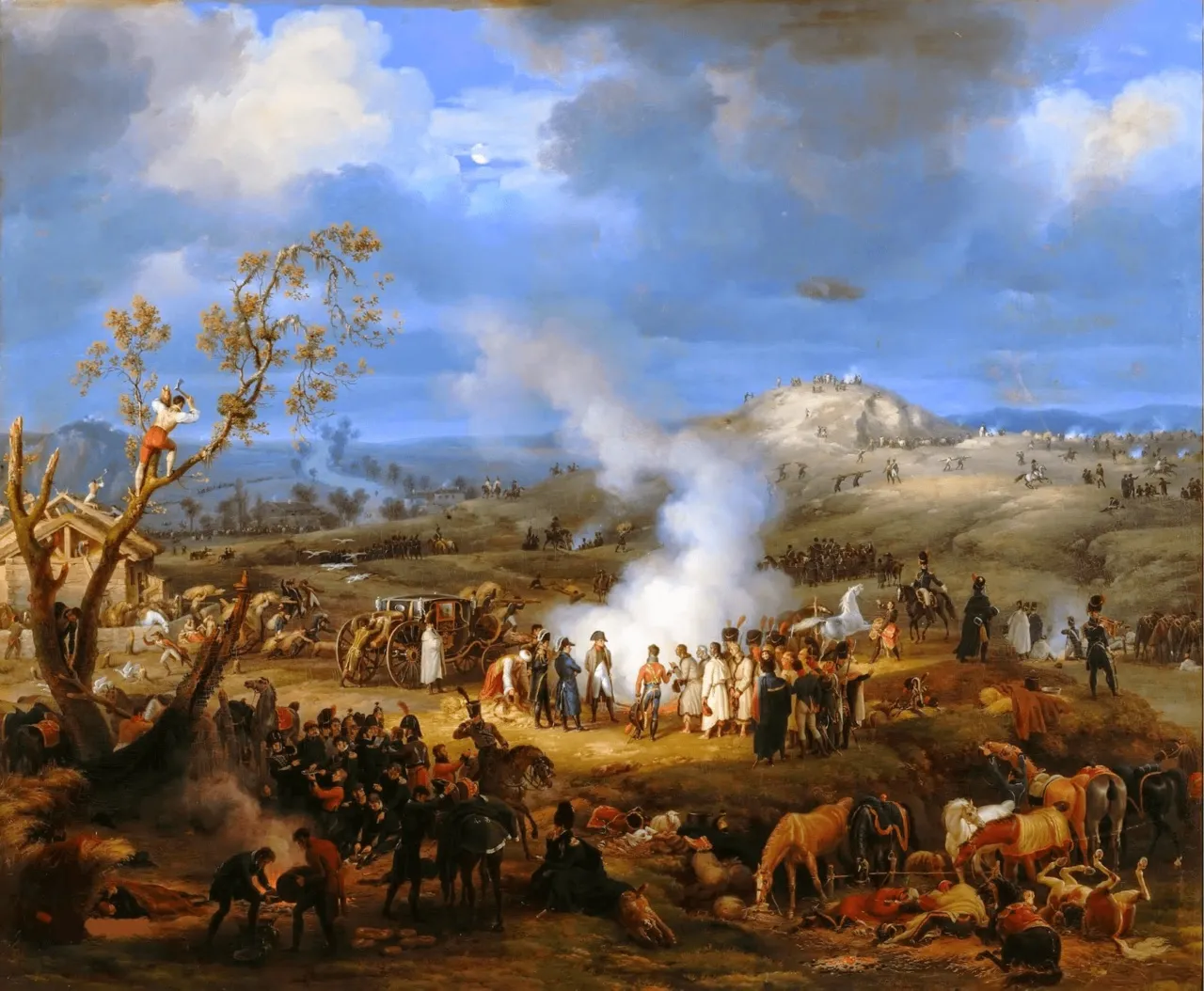 Napoleon among his troops on the eve of Austerlitz, 1 December 1805, painting by Louis-François Lejeune, 1808Wikimedia Commons, Louis-François, Baron Lejeune, Public domain (Bivouac on the Eve of the Battle of Austerlitz, 1st December 1805.PNG)
The Tsar’s aides and the Austrian chief of staff Franz von Weyrother press for an attack, and Kutuzov’s advice to fall back towards the Carpathians is overruled. The allies march from Olmütz and on 1 December occupy the Pratzen. Their council adopts Weyrother’s plan: four columns are to descend from the heights against the weak French right on the Goldbach stream and cut the road to Vienna, while Bagration holds the right on the road to Olmütz and the Russian Guard stays in reserve. Napoleon moves most of his army into the low ground behind the Bosenitz stream, out of sight, and fortifies the Santon hill on his left with 18 guns.
Sources
- David G. Chandler, The Campaigns of Napoleon (1966).
- Ian Castle, Austerlitz 1805: The Fate of Empires (2002).
- Robert Goetz, 1805: Austerlitz: Napoleon and the Destruction of the Third Coalition (2005).
Prev: The mêléeNext: The morning of 2 December