13 to 21 May 1809
Crossing the Danube
With the Danube bridges at Vienna destroyed, Napoleon has to force a crossing to reach the Austrian army. On 16 and 17 May Archduke Charles brings it to the Marchfeld, the plain on the left bank north-east of the city, where he gathers about 115,000 men. Napoleon has about 82,000 men at hand near Vienna, while other corps guard the Danube upstream and watch Archduke John’s army in the south.
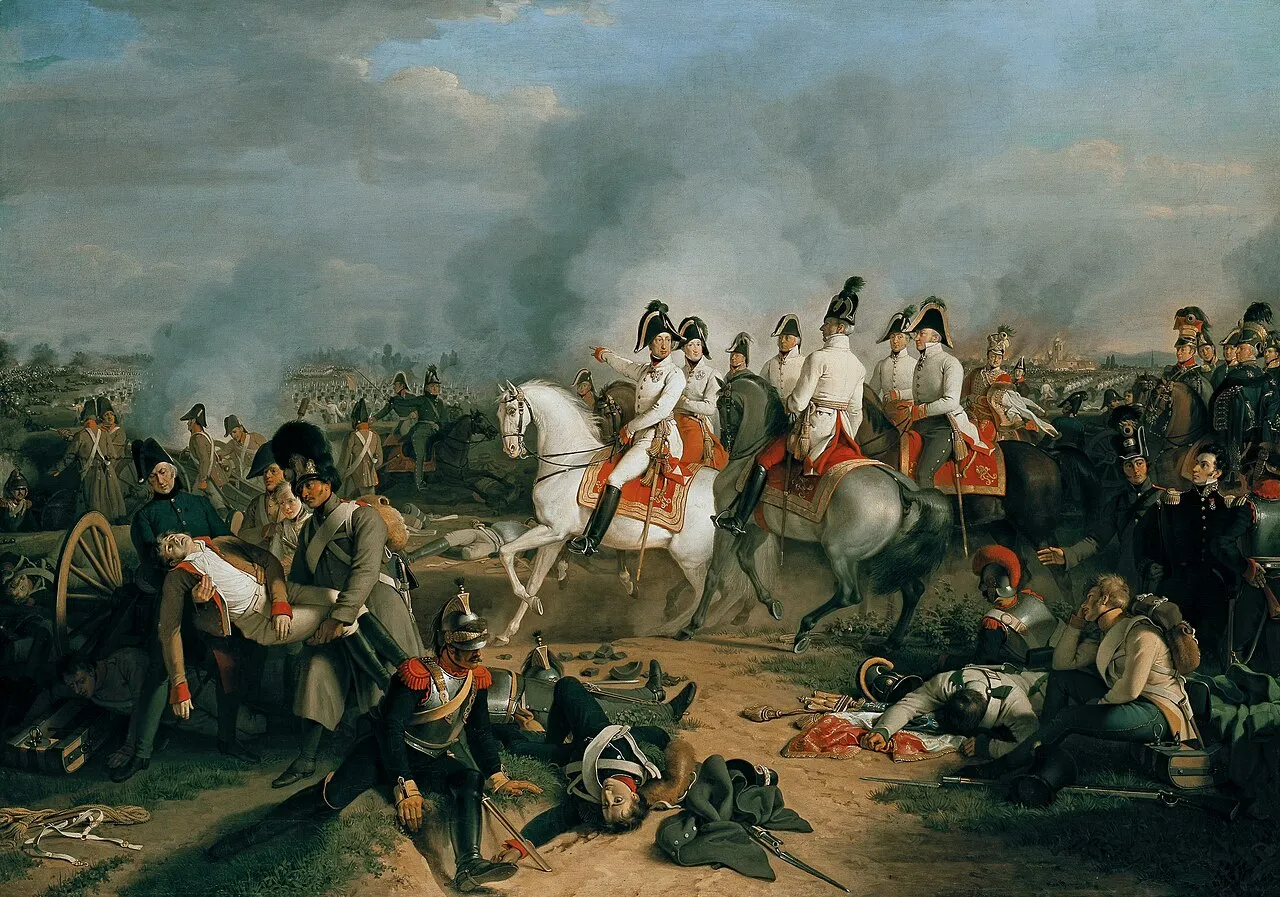 Archduke Charles with his staff at the battle of Aspern-Essling, painting by Johann Peter Krafft, 1820Wikimedia Commons, Johann Peter Krafft, Public domain (Archduke Charles, Duke of Teschen, with his Staff at the Battle of Aspern-Essling, 21–22 May 1809 (by Johann Peter Krafft, 1820).jpg)
A first French attempt to cross at the Schwarze Lackenau, upstream of the city, is repulsed with about 700 losses. Napoleon then chooses the Lobau, the largest of the islands that split the river below Vienna into several arms. In the night of 19 to 20 May the French bridge the arms between Kaiserebersdorf and the island, and by the evening of 20 May the last arm to the left bank. Masséna’s corps crosses at once and drives off the Austrian outposts.
Austrian observers on the Bisamberg hill report the work, and Charles leaves the crossing unopposed, intending to attack once part of the French army stands on the left bank. By daybreak on 21 May 25,000 French troops in three infantry and two cavalry divisions are on the Marchfeld. They face north between two villages close to the river, Aspern on the left and Essling on the right. The bridges behind them have no palisades against floating objects, and the river is rising.
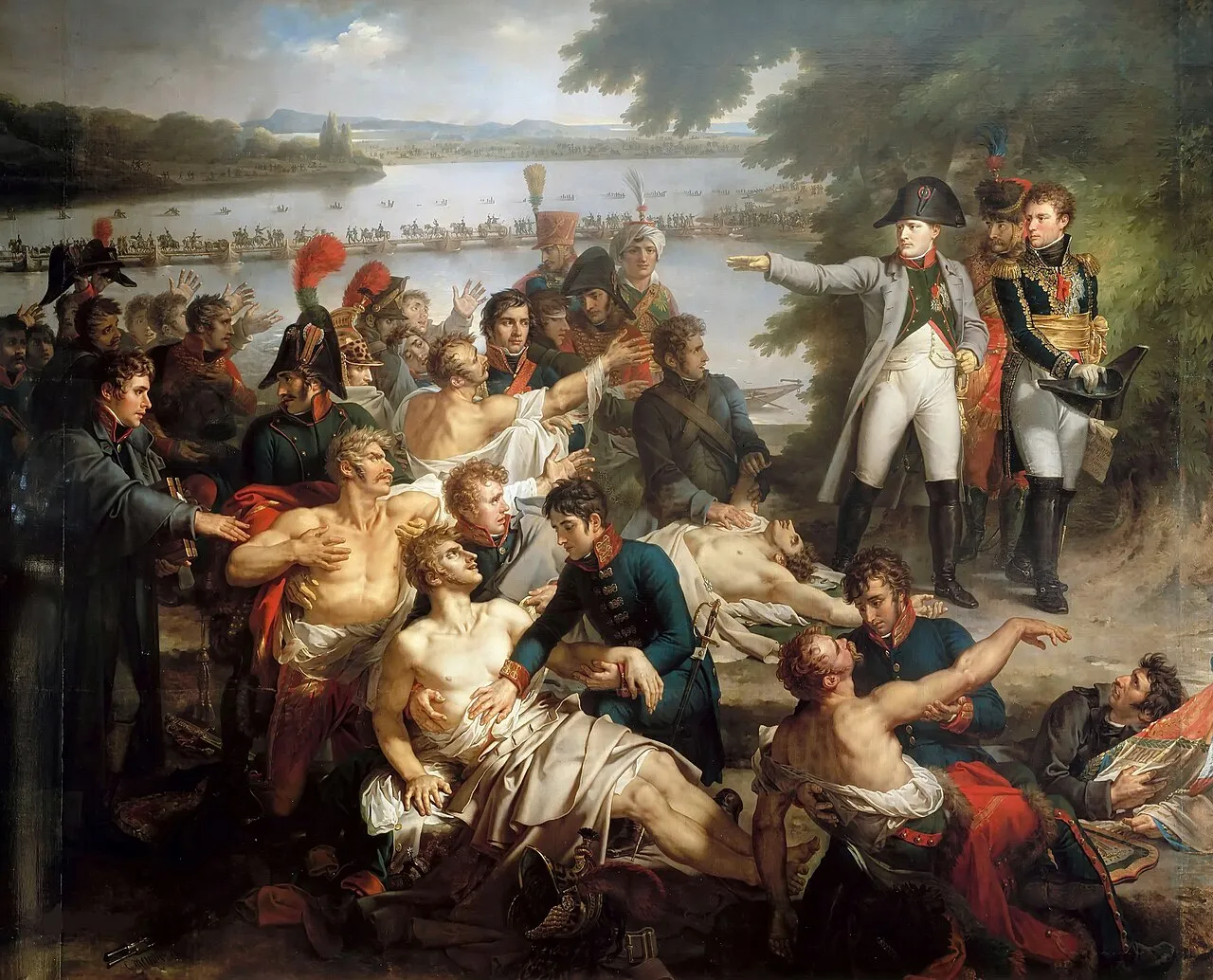 Napoleon’s return to the Lobau after the battle, 23 May 1809, painting by Charles Meynier, 1812Wikimedia Commons, Charles Meynier, Public domain (Return of Napoleon to the Isle of Lobau after the Battle of Essling, 23 May 1809 (by Charles Meynier).jpg)
On 21 May Charles orders a general advance of about 98,000 men and 292 guns in five columns. Johann von Hiller, Heinrich von Bellegarde and Friedrich of Hohenzollern-Hechingen are to converge on Aspern, Franz Seraph von Rosenberg on Essling, and Prince Johann of Liechtenstein’s reserve cavalry moves in the centre.
Sources
- David G. Chandler, The Campaigns of Napoleon (1966).
- John H. Gill, 1809: Thunder on the Danube, volume II: The Fall of Vienna and the Battle of Aspern (2009).
- Gunther E. Rothenberg, Napoleon’s Great Adversary: Archduke Charles and the Austrian Army, 1792–1814 (1995).
Prev: Austria attacksNext: The first day