c. AD 250 – 900
Jade, obsidian, salt and cacao
In the Early Classic a market with dense rows of stalls stands at Chunchucmil, near the salt coast of Yucatán, and its soil still holds traces of the food sold there. Murals at Calakmul show people selling atole, tamales and tobacco, and goods also move as tribute and as royal gifts. Cacao beans serve as small change, certainly by the Postclassic, while jade, gold and copper pay for costly goods.
Jade comes from the middle Motagua valley and the mountains on either side, and kings wear it as headbands, beads and funeral masks. Obsidian, a volcanic glass for blades and points, comes from El Chayal, 25 km north of Kaminaljuyu, from San Martín Jilotepeque and from Ixtepeque, and highland cities such as Kaminaljuyu control access to the sources. The long green tail feathers of the quetzal, a bird of the highland cloud forests, crown the headdresses of kings.
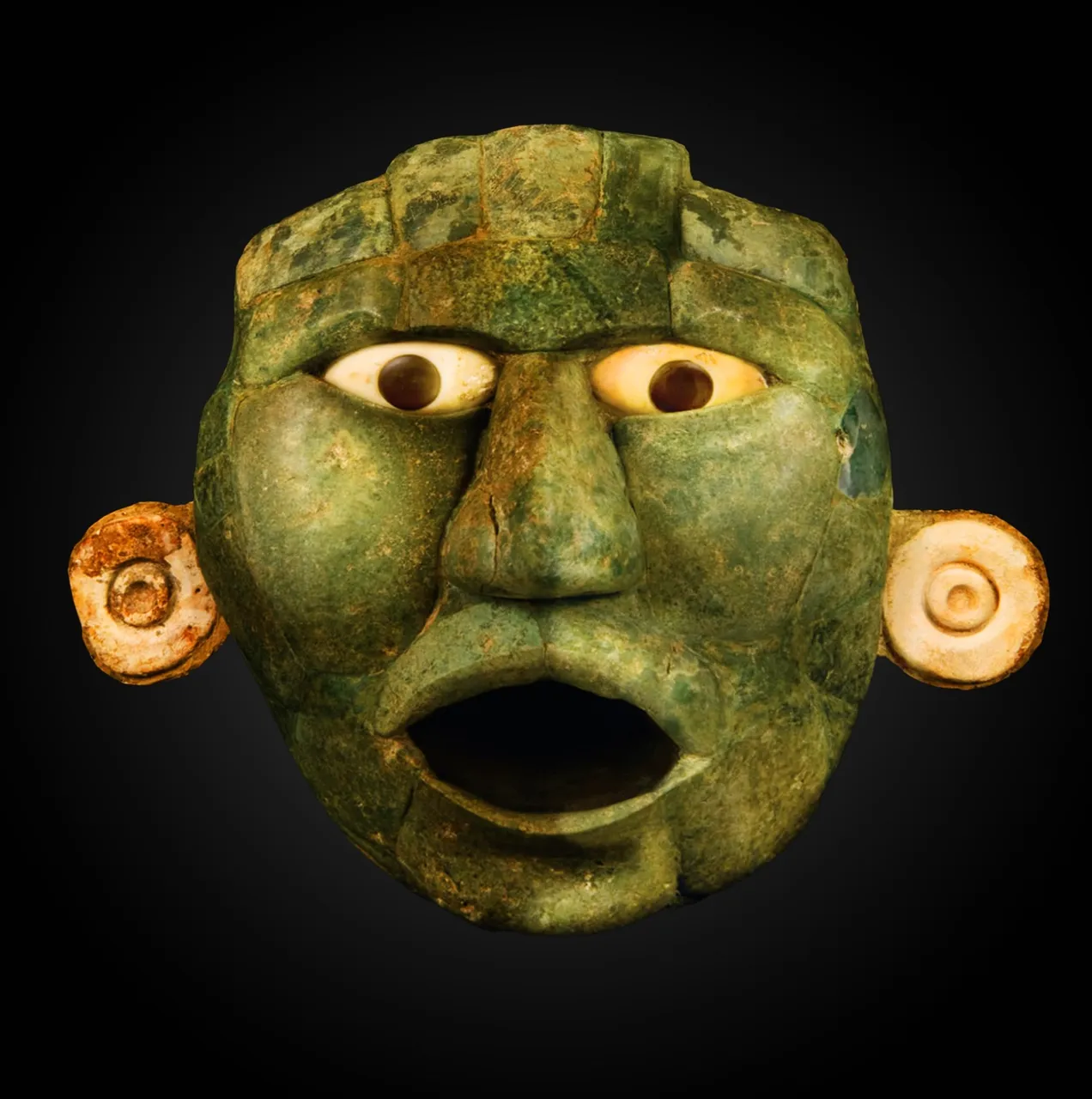 A Maya funerary mask of jade with eyes of shell, found at La Rovirosa in Quintana Roo, Museo Maya de CancúnWikimedia Commons, Act6789, CC0 (Mayan jade mask from La Rovirosa- Noh kah, Quintana Roo (MUSEO MAYA de CANCUN).png)
Salt, needed in the diet and to preserve meat, is dried from seawater in pans along the north coast of Yucatán, the largest source in Mesoamerica, and boiled from the brine springs of Salinas de los Nueve Cerros on the Chixoy, whose output peaks in the Late Classic. By one estimate Early Classic Tikal, with about 45,000 people, uses some 131 tons a year. Cacao grows in wet lowlands such as Soconusco and the Chontalpa of Tabasco, and nobles drink it frothed from painted cylinder vessels.
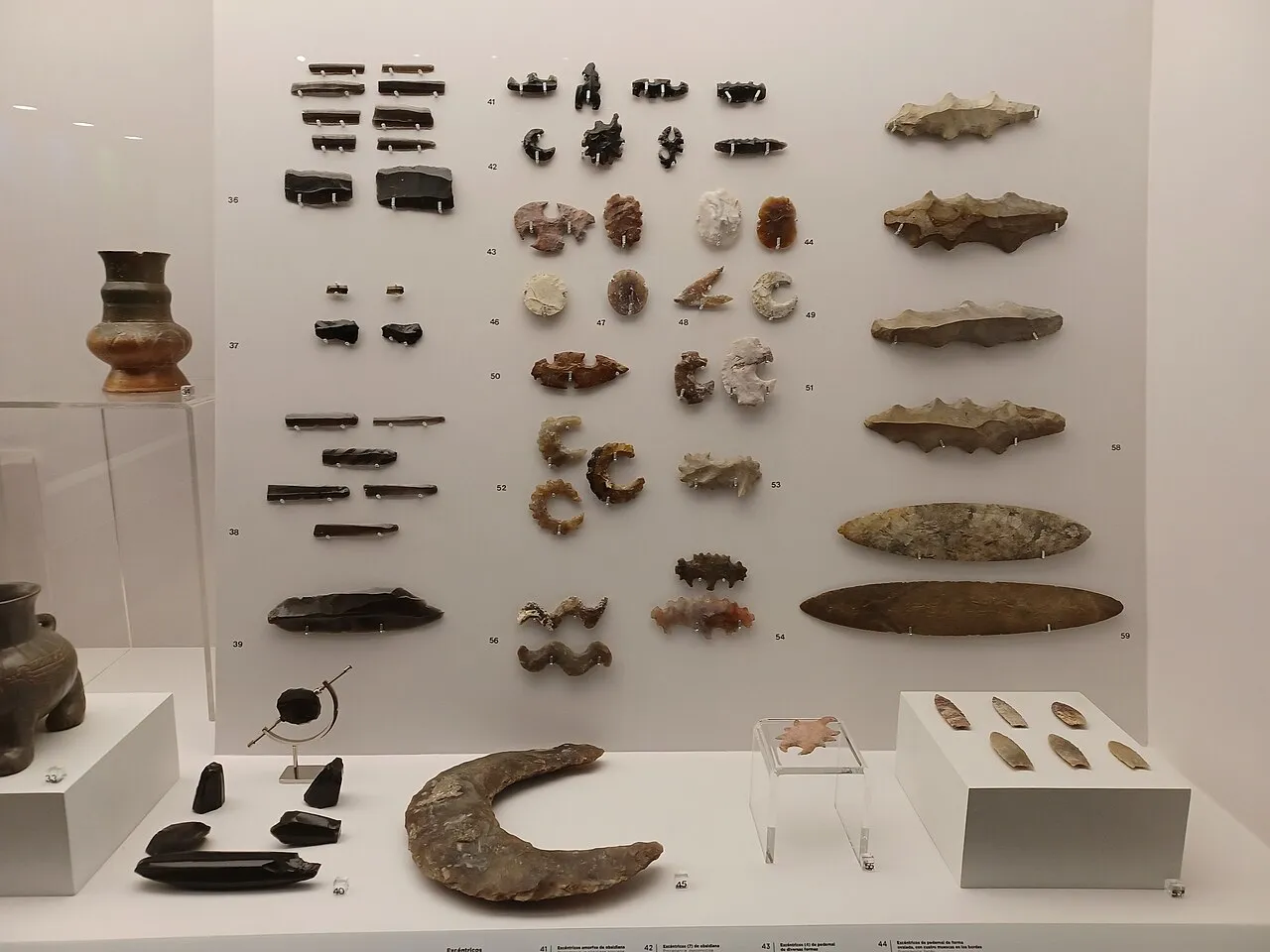 Obsidian blades and cores and eccentric flints, among them Late Classic blades from Kaminaljuyu, Miraflores Museum, Guatemala CityWikimedia Commons, Simon Burchell, CC BY-SA 4.0 (Museo Miraflores 007.jpg)
With no pack animals or carts, porters carry goods overland and canoes carry them on rivers and along the coasts. The Pasión and the Chixoy meet to form the Usumacinta, which runs past Yaxchilan and Piedras Negras to the Gulf of Mexico. Cancuén, with a marketplace and a dock on the upper Pasión, trades and works jade, pyrite and obsidian from the highlands, and obsidian from El Chayal and Ixtepeque also goes down the Motagua to the Caribbean and up the rivers of Belize to the Petén. After the Classic period much of the long distance trade moves to canoes along the coasts of Yucatán.
Sources
- Lynn V. Foster, Handbook to Life in the Ancient Maya World (2002), pp. 319 to 325.
- Bruce H. Dahlin and others, “In Search of an Ancient Maya Market”, Latin American Antiquity 18 (2007), pp. 363 to 384.
- Brian Dillon, Kevin Pope and Michael Love, “An Ancient Extractive Industry: Maya Saltmaking at Salinas de los Nueve Cerros, Guatemala”, Journal of New World Archaeology 7 (1988), pp. 37 to 58.
Prev: Farms, causeways and reservoirsNext: The Classic Maya collapse