1540 – 1542
Mérida on the ruins of T'ho
In 1540 the elder Montejo, now in his late sixties, hands his rights in Yucatán to his son, Francisco de Montejo the Younger. The son joins his cousin of the same name, known as the Nephew, at Champotón and moves to Campeche with 300 to 400 Spanish soldiers. San Francisco de Campeche, founded on 4 October 1540, holds the first permanent Spanish town council on the peninsula.
Montejo the Younger summons the Maya lords to submit to the Spanish Crown. Several do, the Xiu ruler among them, but the Canul refuse. In 1541 the Nephew, with a company of 40 Spaniards and Maya allies, fights his way north through the Canul towns of Tenabo, Hecelchakán, Calkiní and Maxcanú, while Montejo the Younger waits at Campeche for reinforcements.
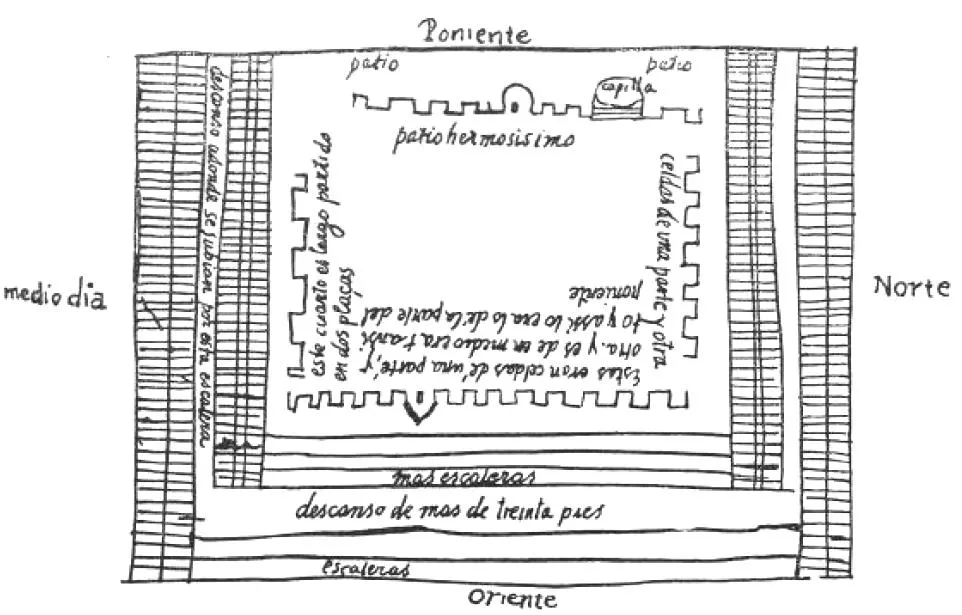 Diego de Landa’s plan of a Maya building at T'ho, on the site where the Franciscans built their convent in Mérida, from his Relación of about 1566Wikimedia Commons, Fray Diego de Landa, Public domain (Croquis de Fray Diego de Landa (01).JPG)
The Nephew meets the Canul at Chakan and occupies T'ho, also called Ichcaanzihó, a Maya town among pyramids and stone buildings. On 6 January 1542 Montejo the Younger founds the city of Mérida there. The Spanish name it after Mérida in Spain because the worked stone of its buildings recalls the Roman ones there, and they reuse the stones in the new town.
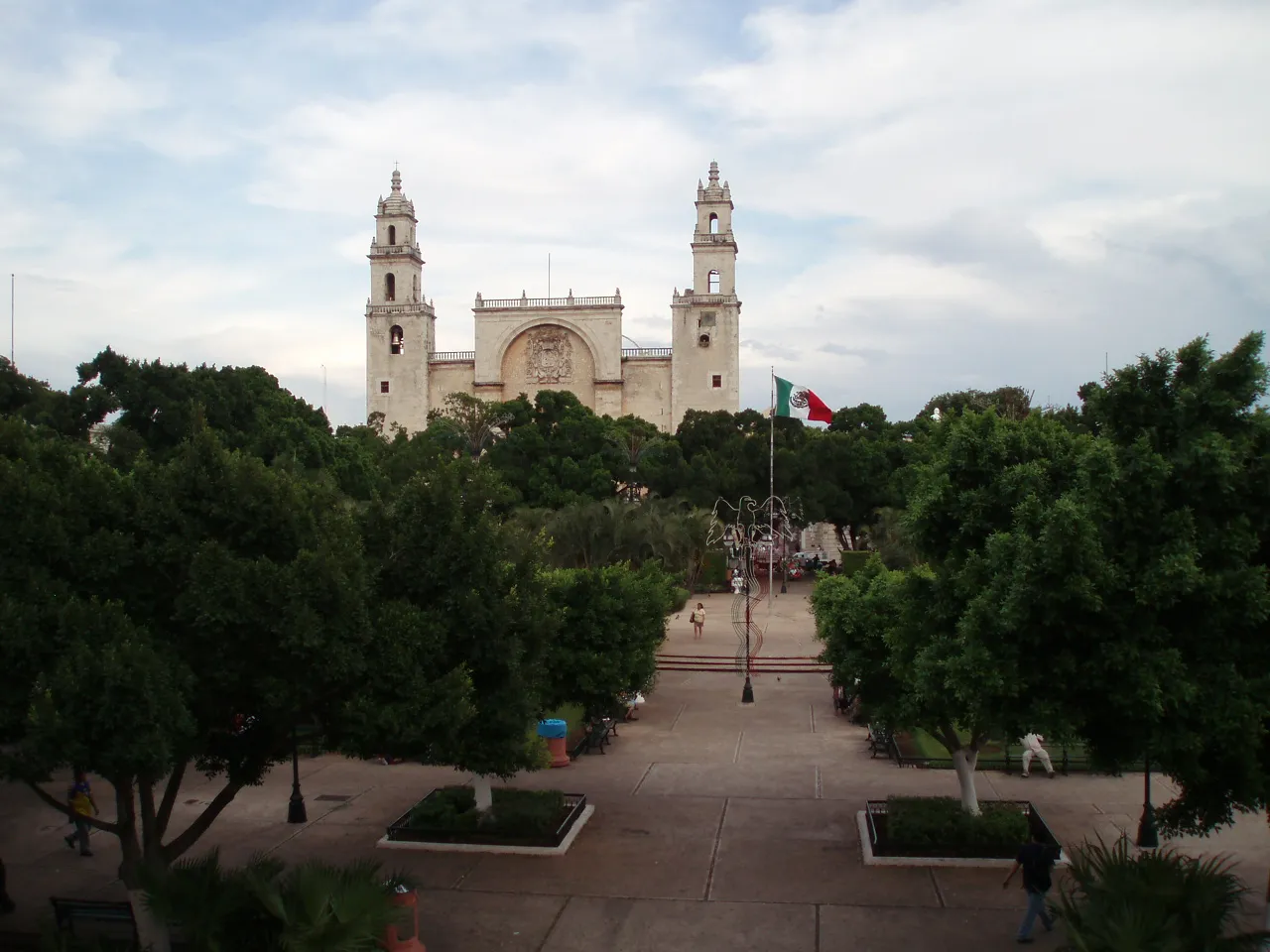 The cathedral of San Ildefonso on the main square of Mérida, built in 1562 – 1598 with stone from the buildings of T'hoWikimedia Commons, David Holt, CC BY-SA 2.0 (Mérida, Yucatán Oct 2006 Cathedral.jpg)
On 23 January 1542 Tutul Xiu, lord of Maní and ruler of the strongest province of northern Yucatán, comes to the Spanish camp in peace with food. He is baptised as Melchor and stays two months at Mérida. His submission leads the lords of the western provinces to accept Spanish rule, while the eastern provinces hold out.
Sources
- Robert J. Sharer and Loa P. Traxler, The Ancient Maya (6th ed. 2006), p. 772.
- Robert S. Chamberlain, The Conquest and Colonization of Yucatan, 1517 – 1550 (1948), ch. 11 and 12.
- Diego López de Cogolludo, Historia de Yucatán (1688), book 3, ch. 4 to 7.
Prev: Campeche and Chichen ItzaNext: The attack on Mérida