1502
Tulum, Cozumel and the sea trade
In the Late Postclassic, trading canoes follow the coast of the Yucatán Peninsula from Honduras to Tabasco and Campeche. Xicalango, in the land of the Chontal Maya, draws merchants from all of Mesoamerica. The province of Chetumal, the one large cacao grower in Yucatán, holds a quarter of the port of Nito on the Dulce River. Yucatán sends salt, cotton cloth and honey, and receives cacao, obsidian, jade and copper. The Motagua and the Usumacinta carry goods on into the highlands.
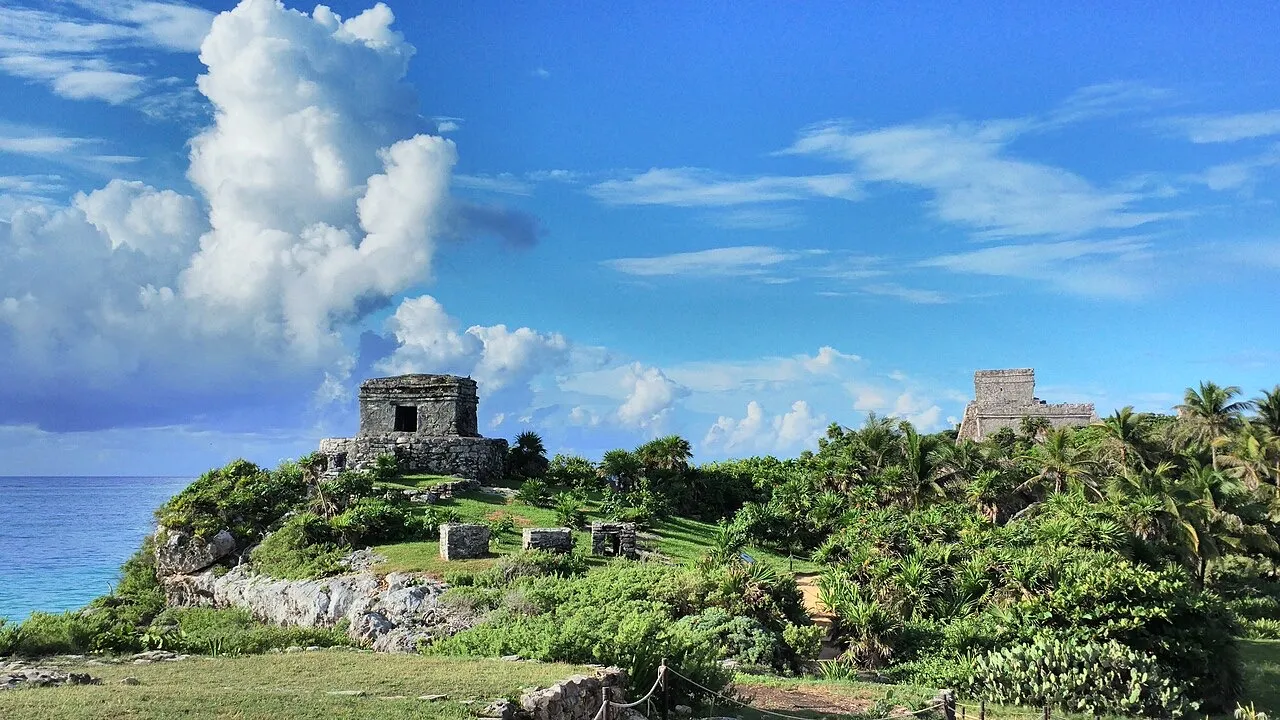 The Temple of the Wind God, left, and the Castillo, right, on the cliffs of Tulum above the Caribbean, 2016Wikimedia Commons, Popo le Chien, CC BY-SA 3.0 (Tulum 2.jpg)
Tulum, perhaps called Zama, stands on a cliff above the Caribbean from about 1200. A wall 3 to 5 m high, 400 m long and pierced by five narrow gates, closes it on the land side. A shrine on the Castillo marks a gap in the reef, and canoes land on a small beach below. Cozumel, a port and place of pilgrimage from about 1250, draws merchants and pilgrims to the shrine of the goddess Ixchel.
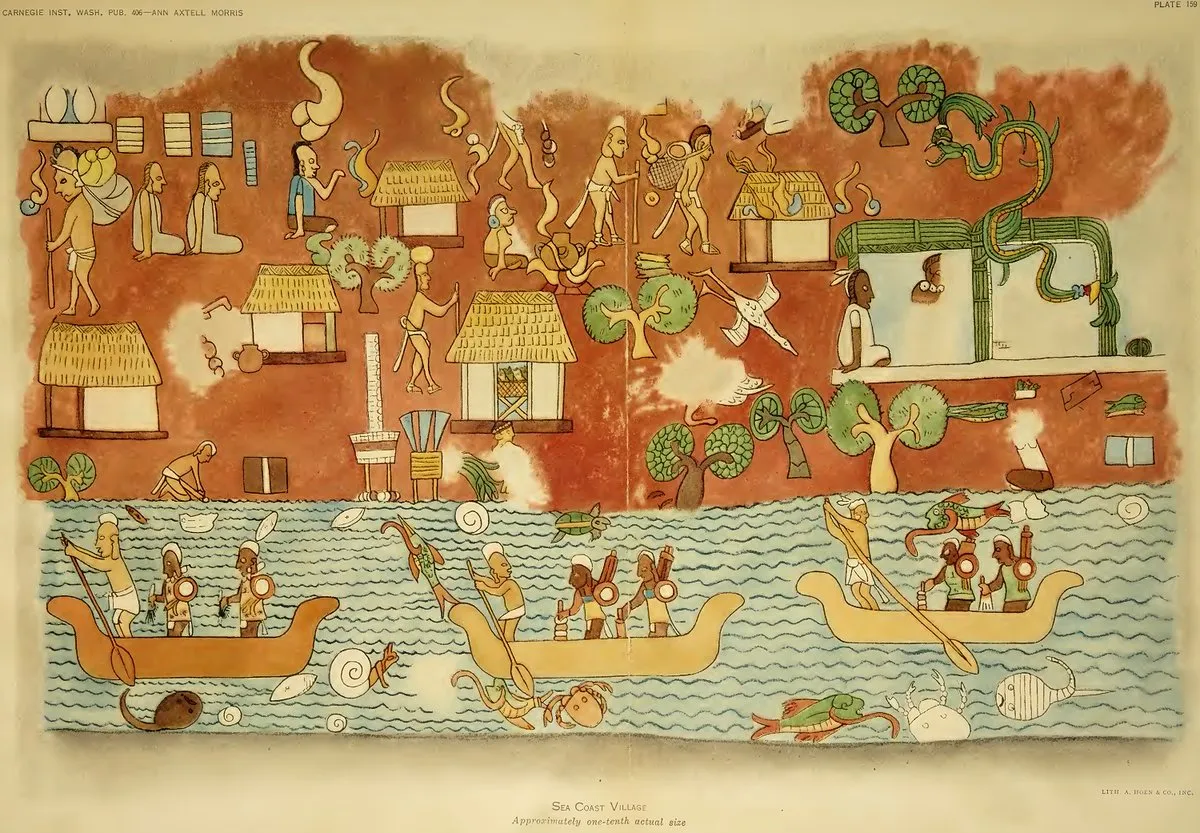 Canoes off a coastal town on a mural in the Temple of the Warriors at Chichen Itza, copy by Ann Axtell Morris, 1931Wikimedia Commons, Ann Axtell Morris, CC0 (Maya mural of coastal town, Temple of the Warriors, Chichen Itza.jpg)
On 30 July 1502, on his fourth voyage, Christopher Columbus reaches Guanaja in the Bay Islands. A canoe cut from one tree trunk, 2.5 m wide and rowed by 25 men, comes from the west. His brother Bartholomew boards it. It carries cacao, cotton cloth, pottery, copper axes and bells, and wooden swords edged with flint. The Spaniards take what they want and keep the old captain as an interpreter. By the usual account the canoe comes from Yucatán, and this is the first recorded meeting of Europeans and Maya. Some scholars hold that its crew came from the Honduran coast.
Sources
- Inga Clendinnen, Ambivalent Conquests: Maya and Spaniard in Yucatan, 1517 to 1570 (2nd ed. 2003), pp. 3 to 4.
- Silvio A. Bedini (ed.), The Christopher Columbus Encyclopedia (2000), p. 724.
- Ferdinand Columbus, The Life of the Admiral Christopher Columbus by his Son Ferdinand.
Prev: The Kaqchikel at IximcheNext: Aguilar and Guerrero