c. AD 800 – 1000
Uxmal and the Puuc cities
While the southern kingdoms decline, the cities of the Puuc hills in western Yucatán grow. Sayil is settled around AD 800 and by 900 has about 10,000 inhabitants, with 5,000 to 7,000 more in the surrounding valley. The hills have no cenotes, so the cities store the seasonal rain in cisterns. Puuc buildings have plain lower walls below upper façades of cut stone mosaic, often with masks of the rain god Chaac.
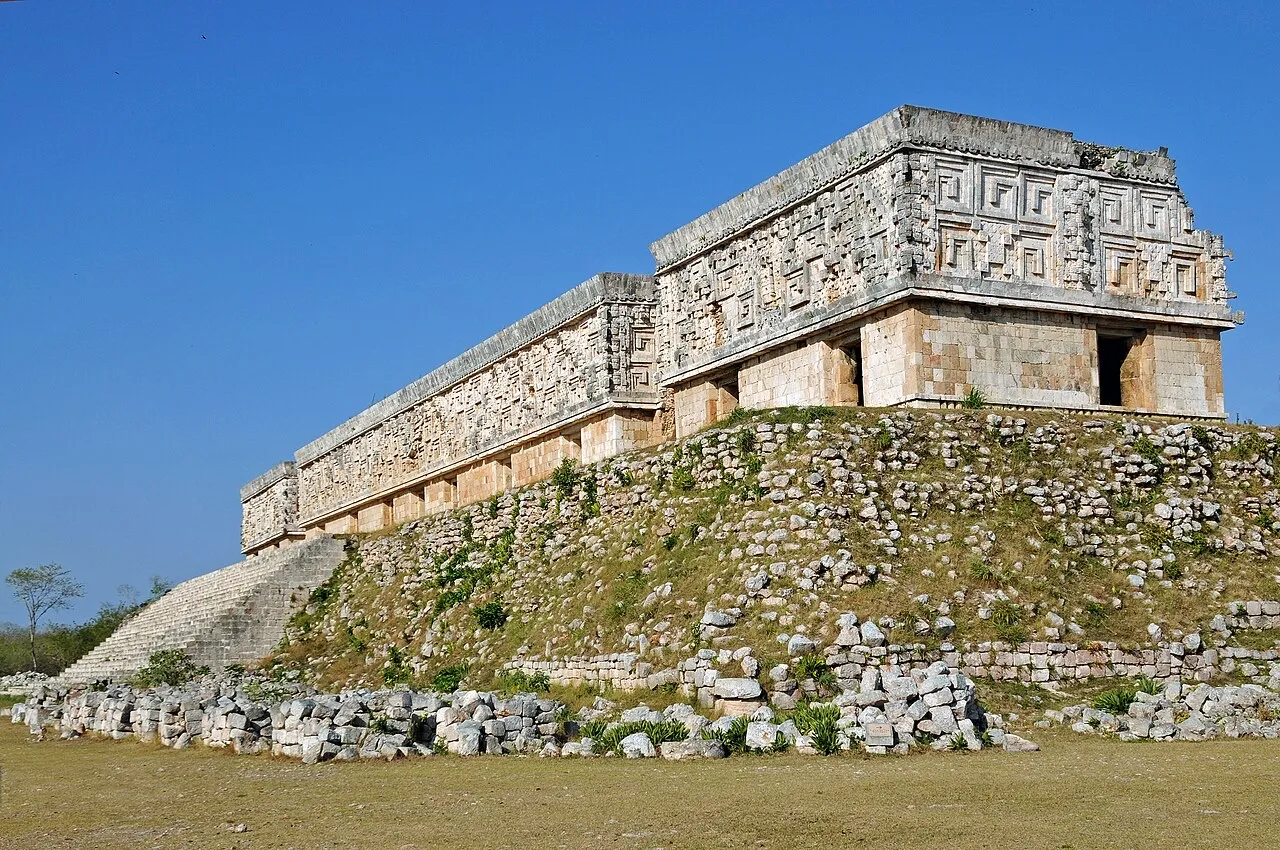 The Governor’s Palace at Uxmal: plain lower walls under a frieze of stone mosaicWikimedia Commons, Dennis G. Jarvis, CC BY-SA 2.0 (Mexico-6362 - Governor's Palace (4690921713).jpg)
Uxmal is the largest Puuc city. Its ballcourt bears a dedication of 901 by the ruler Chan Chak K'ak'nal Ajaw, and painted capstones in the Nunnery Quadrangle give dates of 906 and 907. A causeway 18 km long and 5 m wide, with an arch at each end, runs south to Kabah, whose Palace of the Masks carries hundreds of Chaac masks. At Labna the palace bears a date of 862.
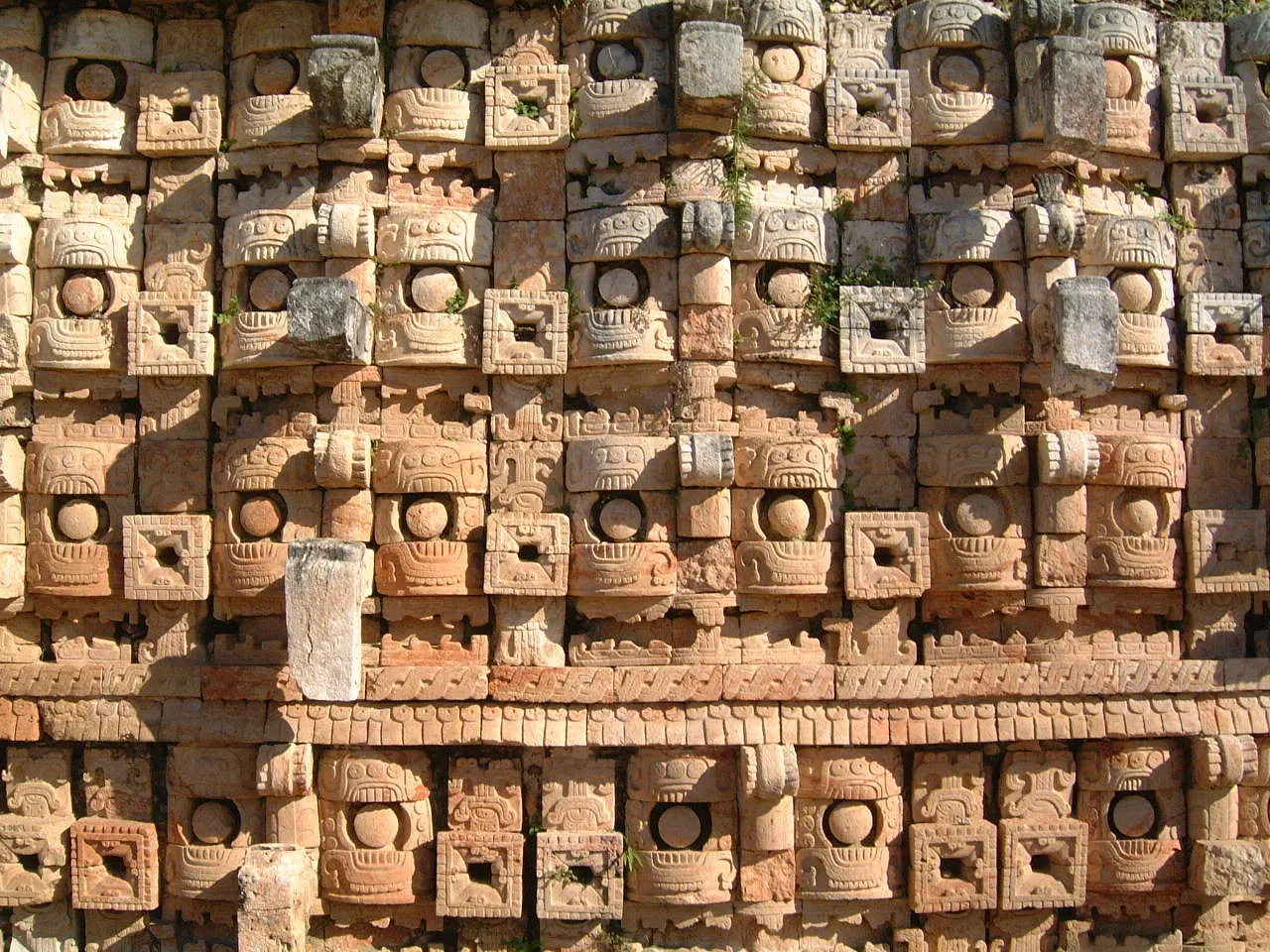 Masks of the rain god Chaac on the Codz Poop, the Palace of the Masks, at KabahWikimedia Commons, Hermann Luyken, CC BY-SA 3.0 (2002.12.29 18 Codz Poop Kabah Yucatan Mexico.jpg)
East of the Puuc, Ek' Balam is at its height from 770 to 840. Its king Ukit Kan Le'k Tok', crowned on 26 May 770, is buried in the Acropolis, inside two rings of walls. Coba, between two lakes, has some 50,000 inhabitants at its peak, and its longest causeway runs about 100 km west to Yaxuna.
Sayil declines from about 950 and is abandoned by 1000, a pattern of fast growth and decline that is probably typical of the Puuc cities.
Sources
- Robert J. Sharer and Loa P. Traxler, The Ancient Maya (6th ed. 2006), pp. 545 to 546.
- Harry E. D. Pollock, The Puuc: An Architectural Survey of the Hill Country of Yucatan and Northern Campeche, Mexico (1980).
- Kelli Carmean, Nicholas Dunning and Jeff K. Kowalski, “High times in the hill country: a perspective from the Terminal Classic Puuc region”, in The Terminal Classic in the Maya Lowlands (2004), pp. 424 to 449.
Prev: The Classic Maya collapseNext: Chichen Itza