1518
Juan de Grijalva
Velázquez sends a second fleet of four ships and about 240 men under his nephew Juan de Grijalva. Pedro de Alvarado, Francisco de Montejo and Alonso de Ávila captain the other ships, and Julián and Melchor come as interpreters. The fleet leaves Matanzas on 8 April 1518 and reaches Cozumel on 3 May, where the islanders flee inland.
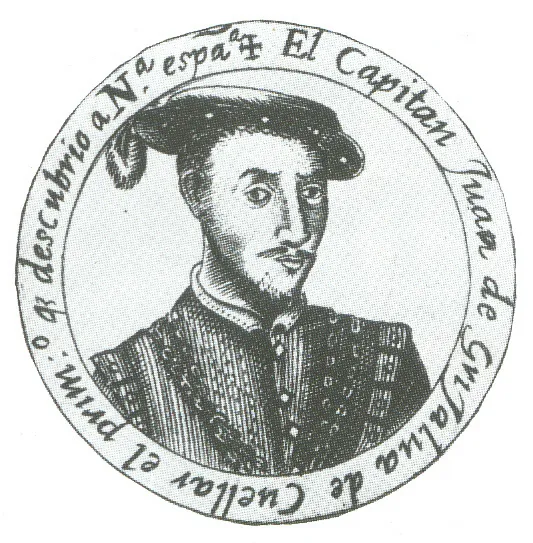 Juan de Grijalva in a medallion on the title page of the second Década of Antonio de Herrera’s Historia general, Madrid, 1601Wikimedia Commons, unknown engraver, Public domain (JuanGrijalvaCuellar.jpg)
Grijalva follows the east coast south past three large towns, one of them probably Tulum, to a bay he names Ascensión. He turns back north round the peninsula without landing. At Campeche the people refuse water, so the Spaniards fire on the town with small cannon and enter it after its people flee.
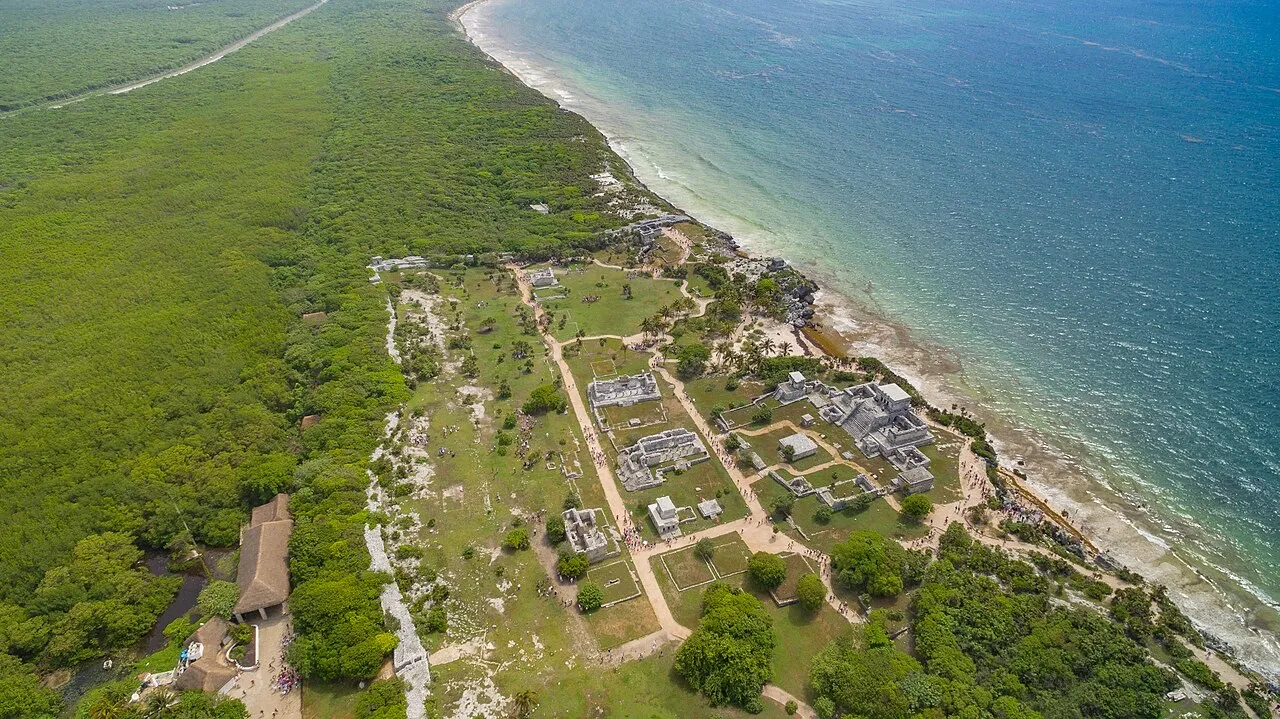 Tulum, a walled town on the east coast of Yucatán, from the air, 2015Wikimedia Commons, Dronepicr, CC BY 3.0 (Tulum Maya-10.jpg)
At Champotón the Spaniards land to avenge the defeat of the year before. Spanish accounts give one to seven Spaniards killed and fifty to sixty wounded, Grijalva among them with two arrow wounds and broken teeth. About 200 Maya die, among them Moch Couoh. Landa places this fight on the way west, Sharer and Traxler on the voyage home.
On 8 June the fleet reaches the mouth of a large river, which the crew names the Grijalva. At Potonchán the Chontal lord Tabscoob exchanges gifts with Grijalva, who gives him his green velvet doublet. Tabscoob speaks of a land called Culua to the west with much gold, and asks the Spaniards to leave. Grijalva sails on to San Juan de Ulúa, where envoys of Moctezuma meet him, and as far as the Pánuco River before returning to Cuba.
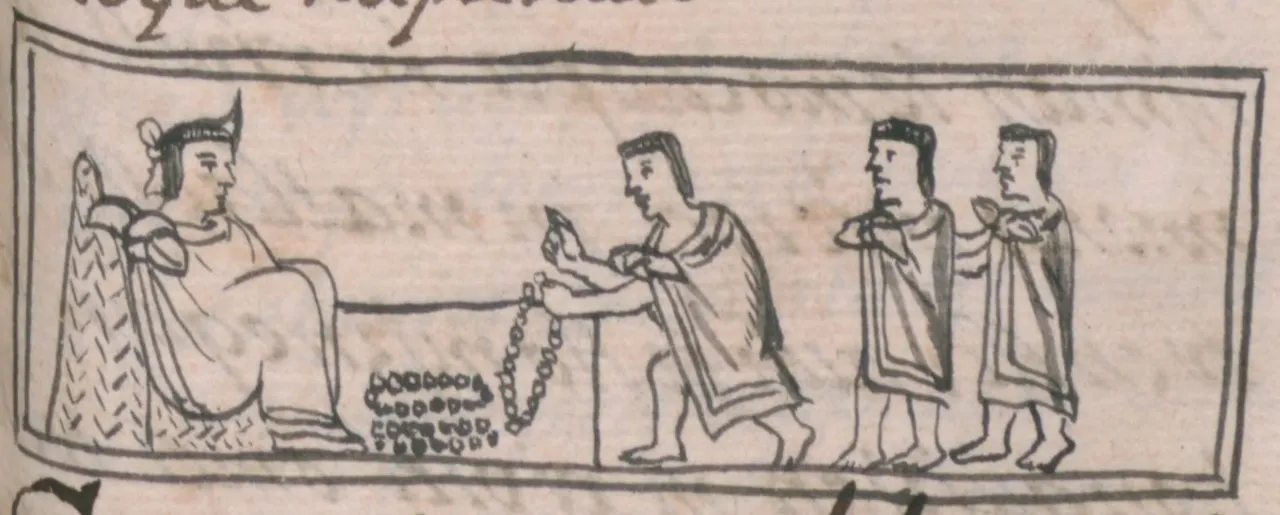 Moctezuma receives news of Grijalva’s Spaniards on the coast, Florentine Codex, Book XII, folio 5r, about 1577, Biblioteca Medicea Laurenziana, FlorenceWikimedia Commons, unknown artist, Public domain (Moctezuma siendo informado de la presencia de españoles de Grijalva, en el folio 5r del libro XII.png)
Sources
- Inga Clendinnen, Ambivalent Conquests: Maya and Spaniard in Yucatan, 1517 to 1570 (2nd ed. 2003), pp. 14 to 16.
- Robert J. Sharer and Loa P. Traxler, The Ancient Maya (6th ed. 2006), pp. 759 to 760.
- Diego de Landa, Relación de las cosas de Yucatán (c. 1566).
Prev: The retreat to the boatsNext: Cortés at Cozumel