c. AD 250 – 1500
Gods, temples and the ballgame
Kings are buried under pyramids: Pakal of Palenque in 683 under the Temple of the Inscriptions, Jasaw Chan K'awiil I of Tikal in 734 under Temple I. Families bury their dead beneath the floors of their houses, where the ancestors watch over the living, and the royal pyramids grow out of such ancestor shrines. The temple on top, a k'uh nah or "god's house", has one to three rooms under a tall roof comb.
The Maya see the world as thirteen layers of sky above and nine of underworld below, each of the four directions with its own colour, and the major gods have an aspect for each direction. Kings identify themselves with the young maize god, who dies and rises again like the crop. Chaak, god of rain, thunder and lightning, strikes the clouds with his axe, and K'awiil, the god of lightning with a serpent for one leg, is the sceptre in a king's hand.
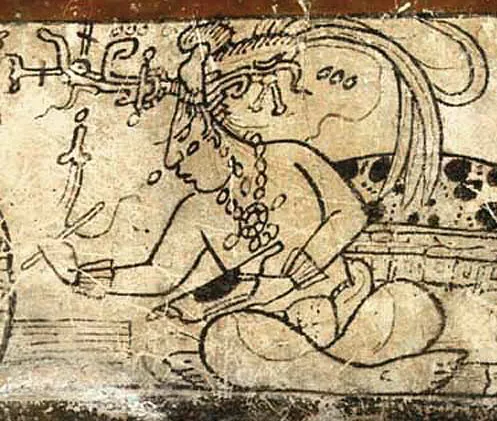 The tonsured maize god as a patron of scribes, painted on a Classic Maya vesselWikimedia Commons, unknown Maya artist, Public domain (Maya maize god.jpg)
Blood feeds the gods. Kings and queens draw their own with obsidian blades or stingray spines and burn it on bark paper at accessions, dedications and period endings, and a queen at El Perú is buried with a stingray spine. The greatest rites end with the sacrifice of a high ranking captive. Most large cities have a ballcourt, a long narrow alley where players strike a heavy rubber ball with their hips, and in the Popol Vuh the Hero Twins, Hunahpu and Xbalanque, defeat the lords of the underworld, Xibalba, in their ballcourt and rise as the sun and the moon.
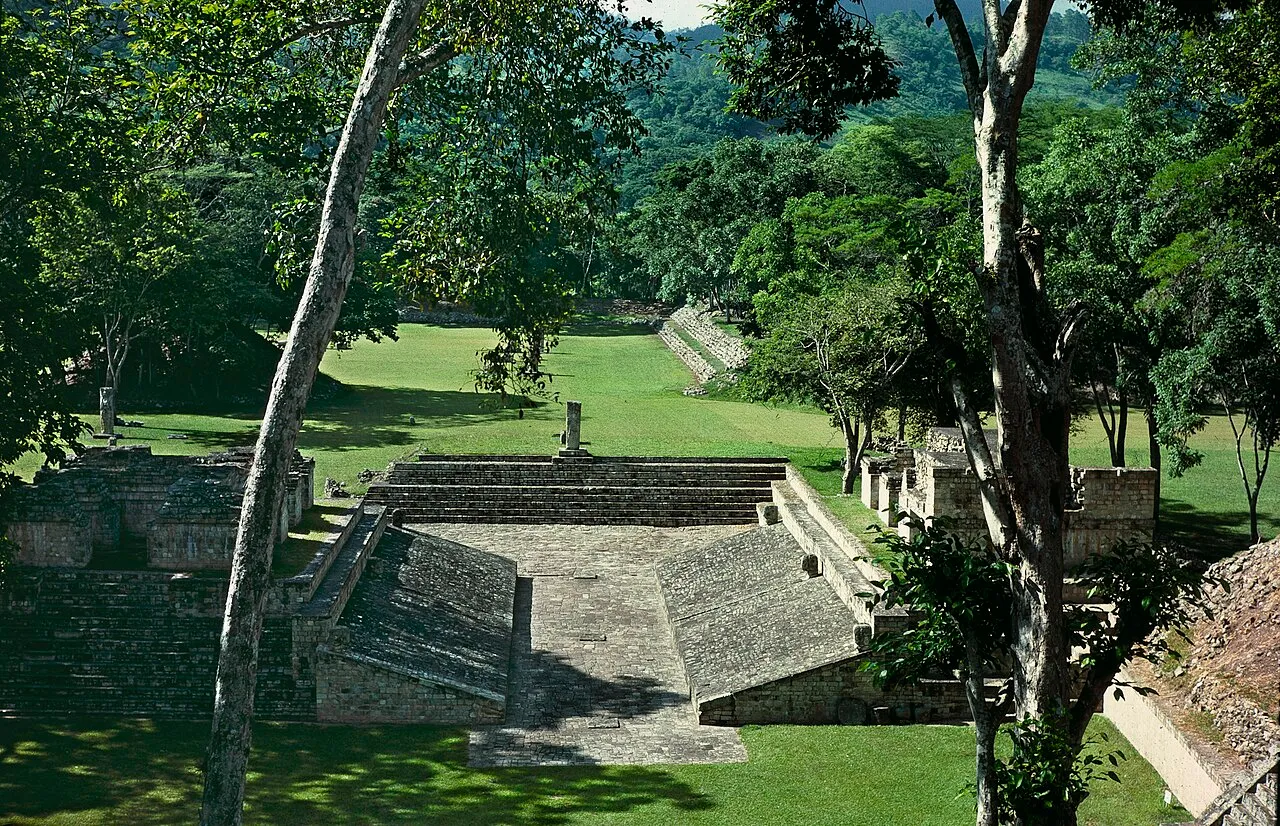 The ballcourt of Copán, dedicated in 738, with its sloping side wallsWikimedia Commons, HJPD, CC BY 3.0 (Copan JPelota1.jpg)
Northwestern Yucatán has no rivers, and its water lies in cenotes, sinkholes in the limestone, some of them held to lead to the underworld. In times of drought people and valuables are thrown into the Sacred Cenote at Chichen Itza as offerings to Chaak, as Diego de Landa records in 1566. From 1904 dredging and diving bring up thousands of objects of jade, gold, copper, copal, wood and cloth, and the bones of men, women and many children.
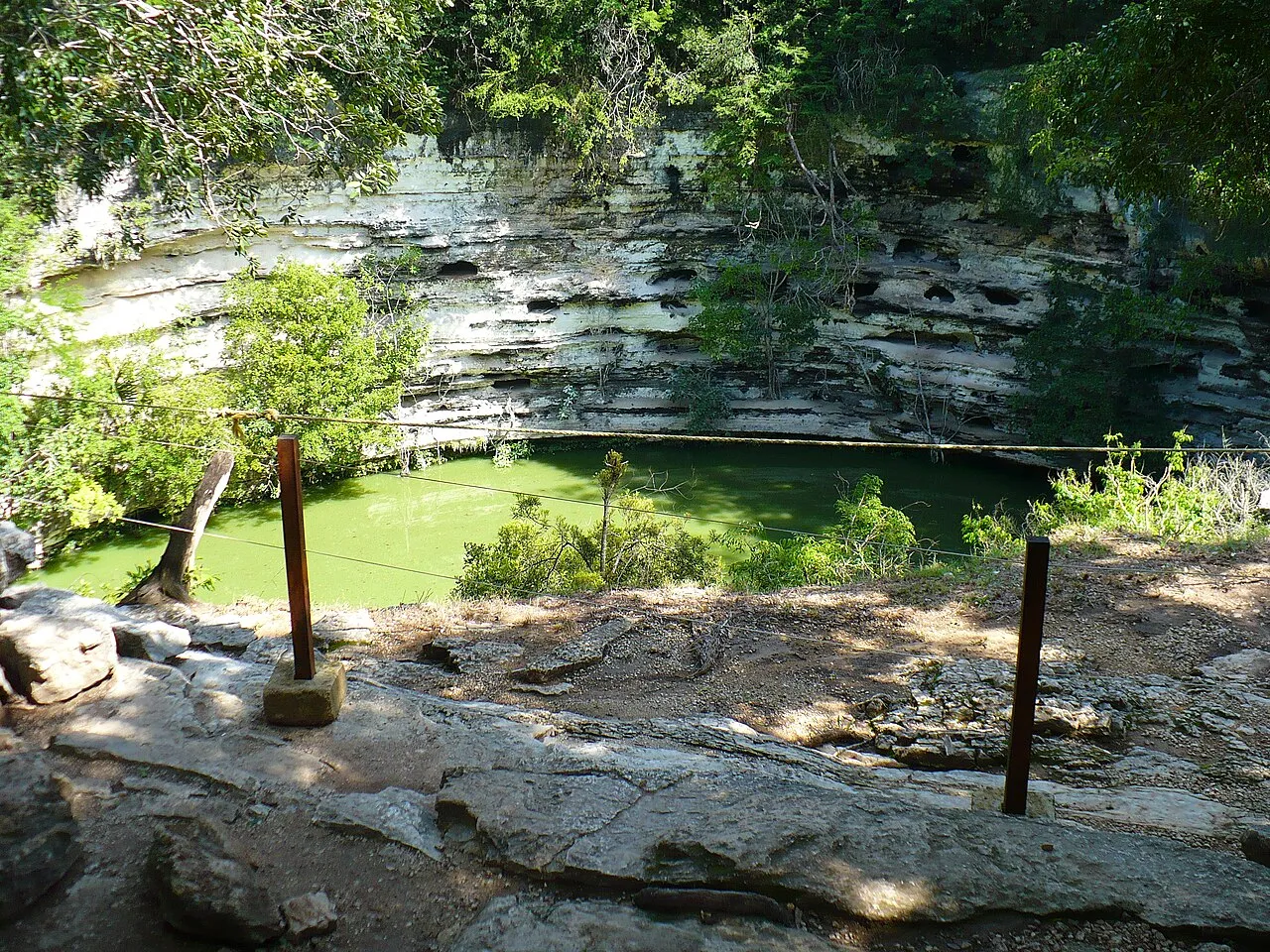 The Sacred Cenote at Chichen Itza, a sinkhole 60 m acrossWikimedia Commons, Altairisfar, Public domain (Sacred Cenote Chichen Itza.JPG)
Sources
- Mary Miller and Karl Taube, The Gods and Symbols of Ancient Mexico and the Maya (1993).
- Allen J. Christenson, Popol Vuh: The Sacred Book of the Maya (2007).
- Clemency Chase Coggins, Cenote of Sacrifice: Maya Treasures from the Sacred Well at Chichen Itza (1984), pp. 26 to 27.
Prev: The calendar and the booksNext: Farms, causeways and reservoirs