c. 1000 – 700 BC
The first villages and plazas
Between about 1000 and 800 BC people in Tabasco, near the San Pedro River, build Aguada Fénix, a platform of earth and clay 1,400 m long, 400 m wide and 10 to 15 m high. Its volume of 3.2 to 4.3 million m³ is greater than that of the Great Pyramid of Giza. It has no houses and no sculptures of rulers, and jade axes are buried at its centre. Its pottery is closer to that of the Maya lowlands than to Olmec wares. It is abandoned around 750 BC.
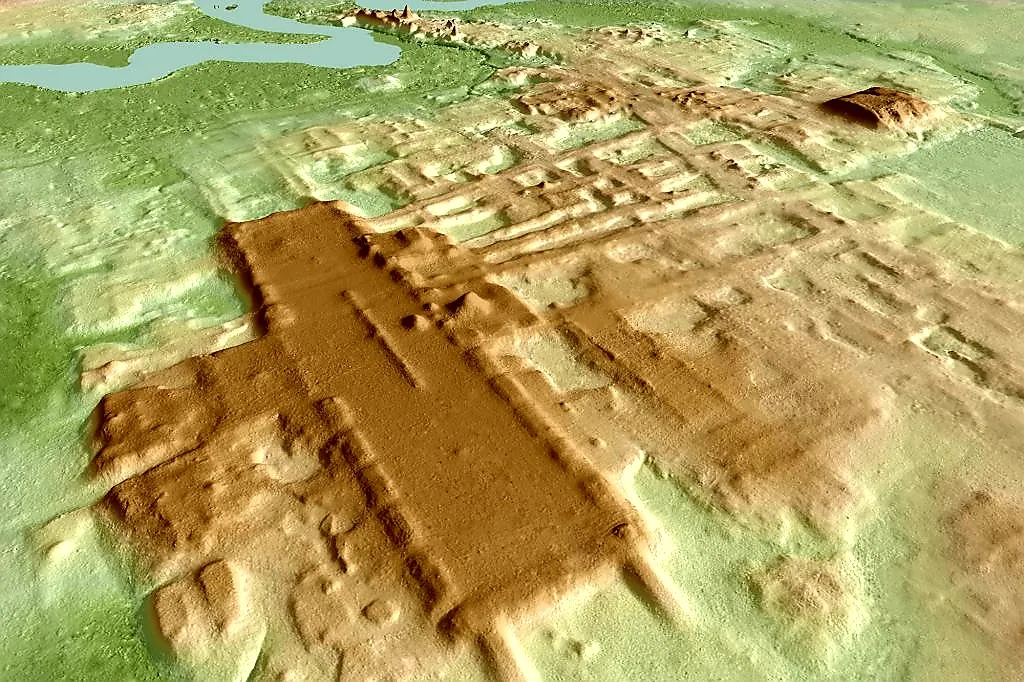 Aguada Fénix in a lidar image: the platform of about 1000 – 800 BC with the causeways and wings around itWikimedia Commons, Takeshi Inomata, CC BY-SA 4.0 (Aguada Fénix 1.jpg)
Seibal, on the Pasión River in Petén, is settled around 900 BC. An offering found there, jade axes laid out in a cross with a bloodletter, matches offerings of the Olmec heartland, and the pieces were probably made at La Venta. E Groups appear in the Preclassic: on a plaza a pyramid on the west side faces three small temples on the east, over which the sun rises at the solstices and equinoxes.
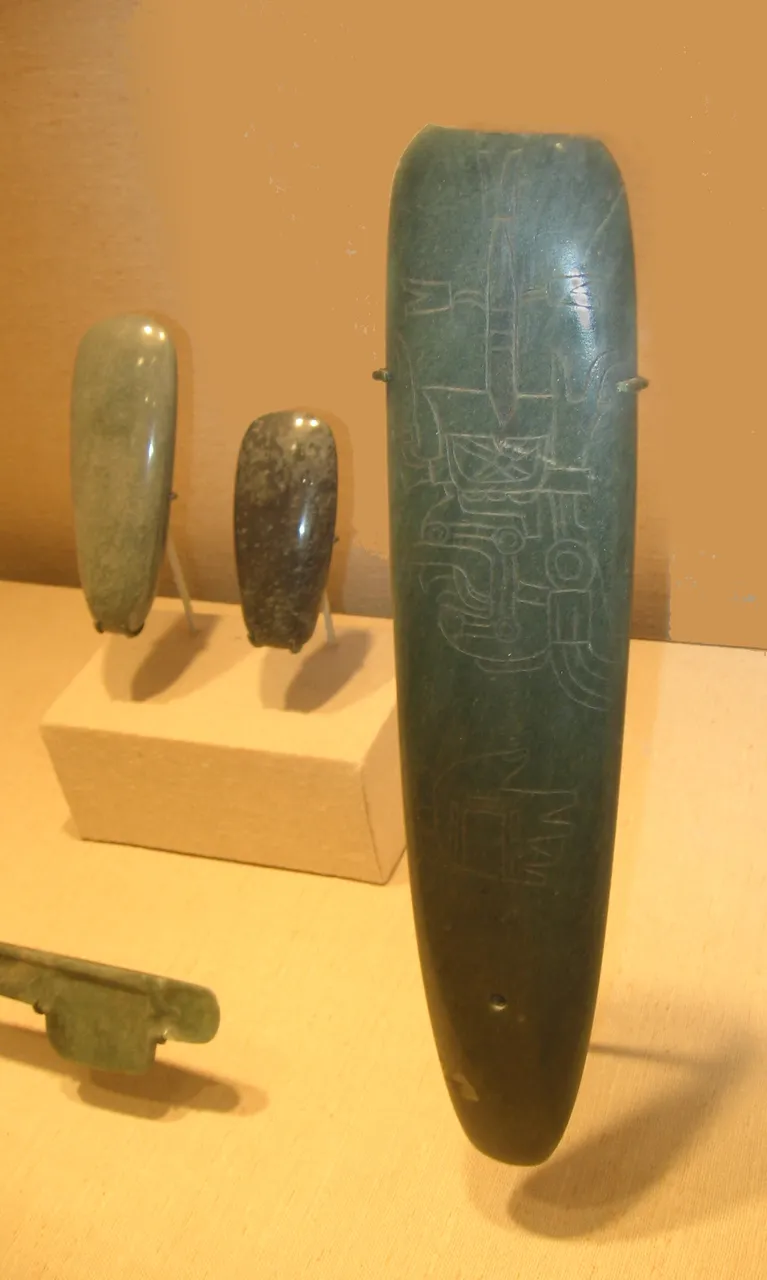 Olmec jade celts, axe blades for offerings, the largest engraved with an Olmec supernatural, Metropolitan Museum of ArtWikimedia Commons, Madman2001, CC BY 2.5 (Olmec celts from Met.jpg)
After San Lorenzo declines around 900 BC, La Venta is the leading Olmec centre until about 400 BC. Its Great Pyramid rises 34 m. The Olmec speak a Mixe–Zoquean language, and Mayan takes several words from it.
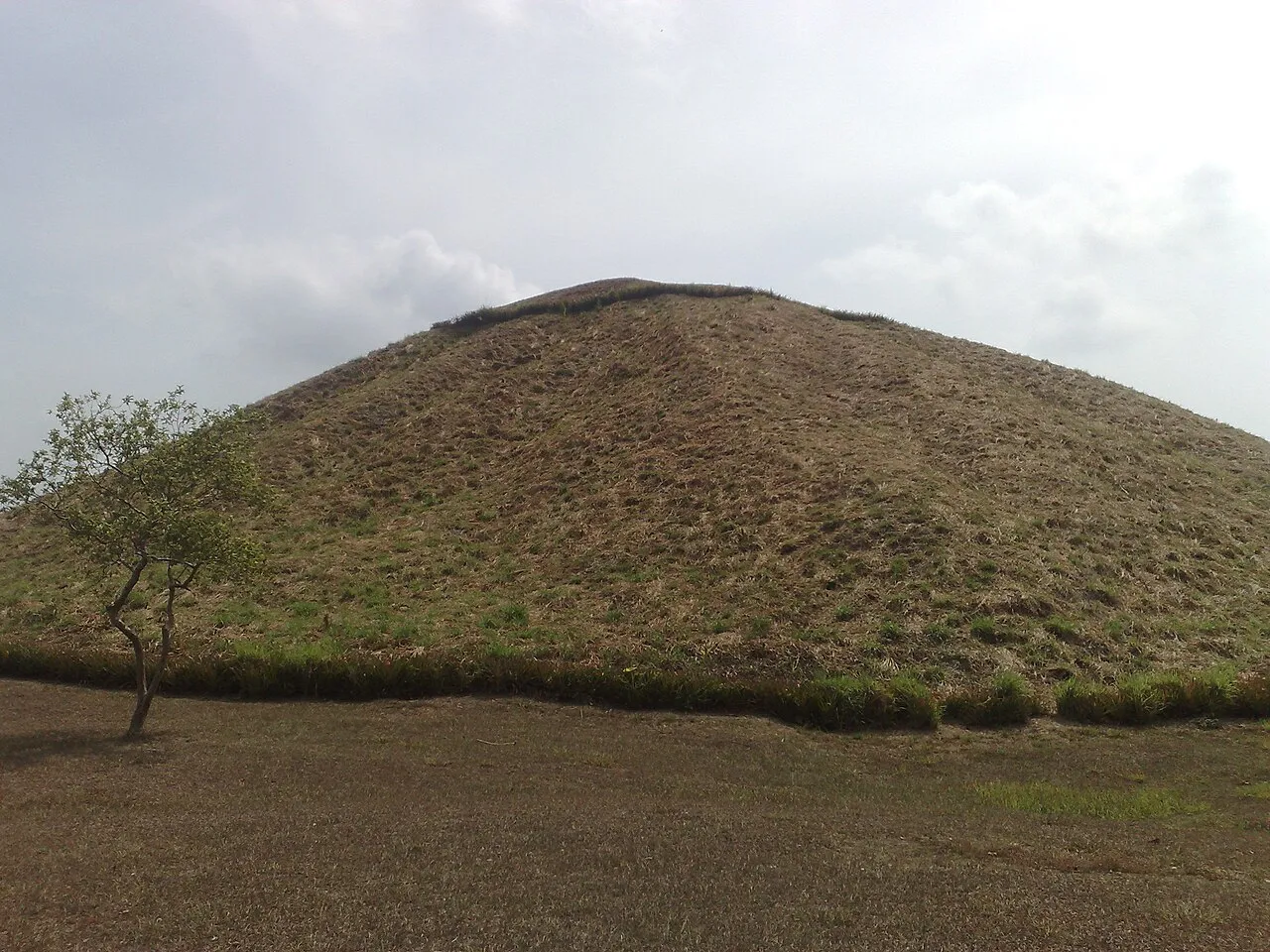 The south face of the Great Pyramid of La Venta, Tabasco, built of earth and clayWikimedia Commons, Alfonsobouchot, Public domain (La Venta Pirámide cara sur.jpg)
Cuello in northern Belize is a village of pole-and-thatch houses on low plastered platforms, grouped around patios. Its steam bath of about 900 BC is the oldest known in the lowlands. From 900 BC the dead are buried with pottery vessels, and from 800 BC obsidian arrives from the highlands.
Sources
- Takeshi Inomata et al., Monumental architecture at Aguada Fénix and the rise of Maya civilization, Nature 582 (2020), pp. 530 to 533.
- Robert J. Sharer and Loa P. Traxler, The Ancient Maya (6th ed. 2006), pp. 202 to 203.
- Richard A. Diehl, The Olmecs: America’s First Civilization (2004), p. 9.
Prev: The Maya areaNext: El Mirador