1952 – 2018
Reading the inscriptions
By the 1950s scholars can read the numbers, the calendar and the astronomical tables in Maya writing, but little else. The leading Mayanist, J. Eric S. Thompson, holds that the signs stand for ideas rather than sounds and that the inscriptions record time and religion rather than history. In 1952 the 30-year-old Soviet scholar Yuri Knorozov argues that the "alphabet" Diego de Landa recorded around 1566 is a list of syllables, and that the script joins word signs with syllabic signs. Thompson leads the rejection of his work.
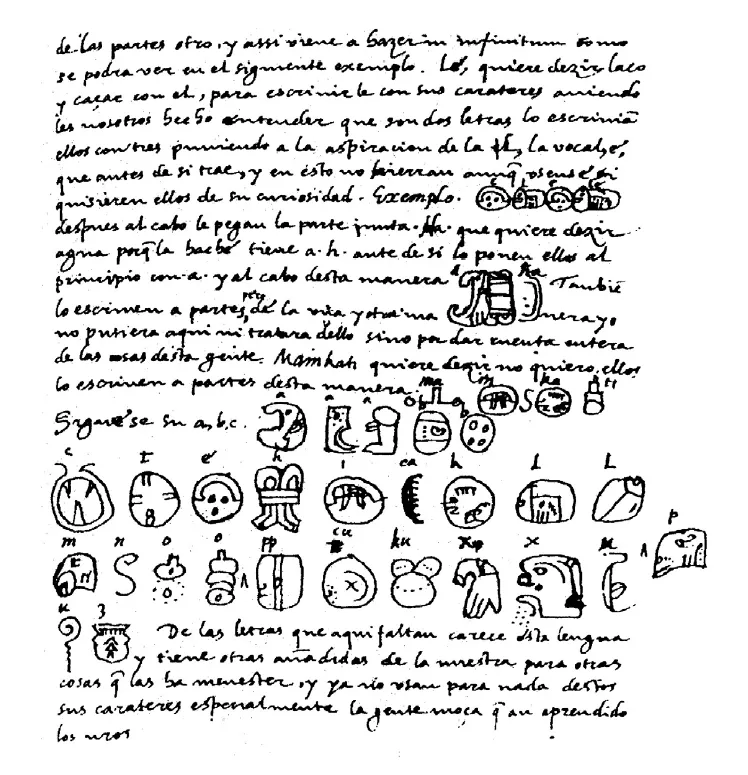 The page of Landa’s Relación de las cosas de Yucatán with his "alphabet" of Maya signs, in the copy of about 1660 in the Real Academia de la Historia, MadridWikimedia Commons, Not recorded, Public domain (De Landa alphabet.jpg)
In 1958 Heinrich Berlin identifies the emblem glyphs, royal titles built on a place name. In 1960 Tatiana Proskouriakoff, who had drawn Piedras Negras in 1936 – 1937, shows that the dates on its stelae mark the births, accessions and deaths of rulers, and traces seven kings over two hundred years. The inscriptions record dynastic history.
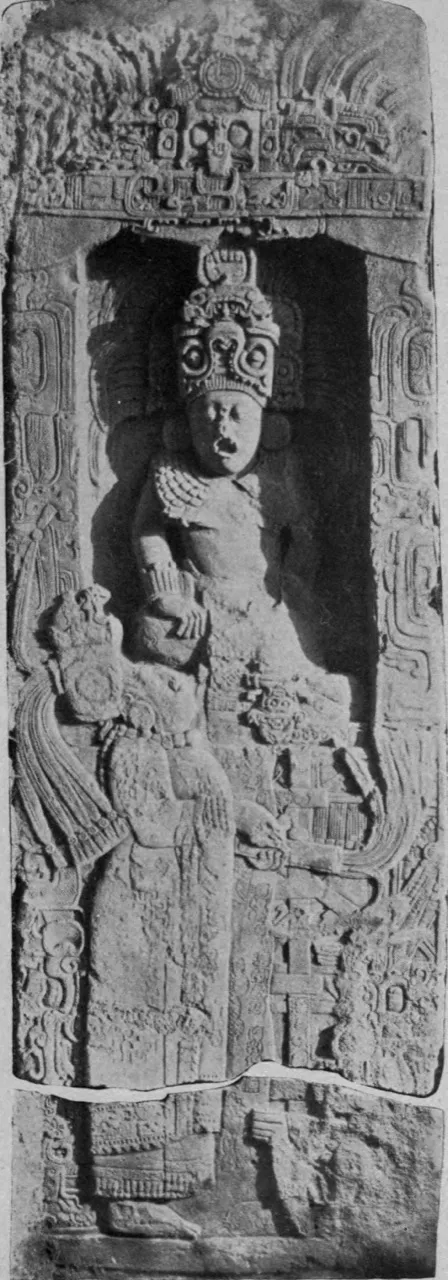 Stela 14 of Piedras Negras, a new king seated in a niche, the scene that marks an accession on its stelaeWikimedia Commons, Not recorded, Public domain (MA D285 Maya stela 14, Piedras Negras, Guatemala.jpg)
In December 1973, at the first Mesa Redonda de Palenque, Linda Schele, Floyd Lounsbury and Peter Mathews reconstruct most of the king list of Palenque in one afternoon. More than 90 percent of Maya texts can now be read. Knorozov first visits Guatemala in 1990 and sees Tikal, and Mérida raises a monument to him in 2018. In the same year an airborne laser survey of 2,100 km² of the Maya Biosphere Reserve maps more than 60,000 structures, among them houses, causeways and fortifications. Archaeologists estimate that 7 to 11 million people lived in northern Guatemala between AD 650 and 800.
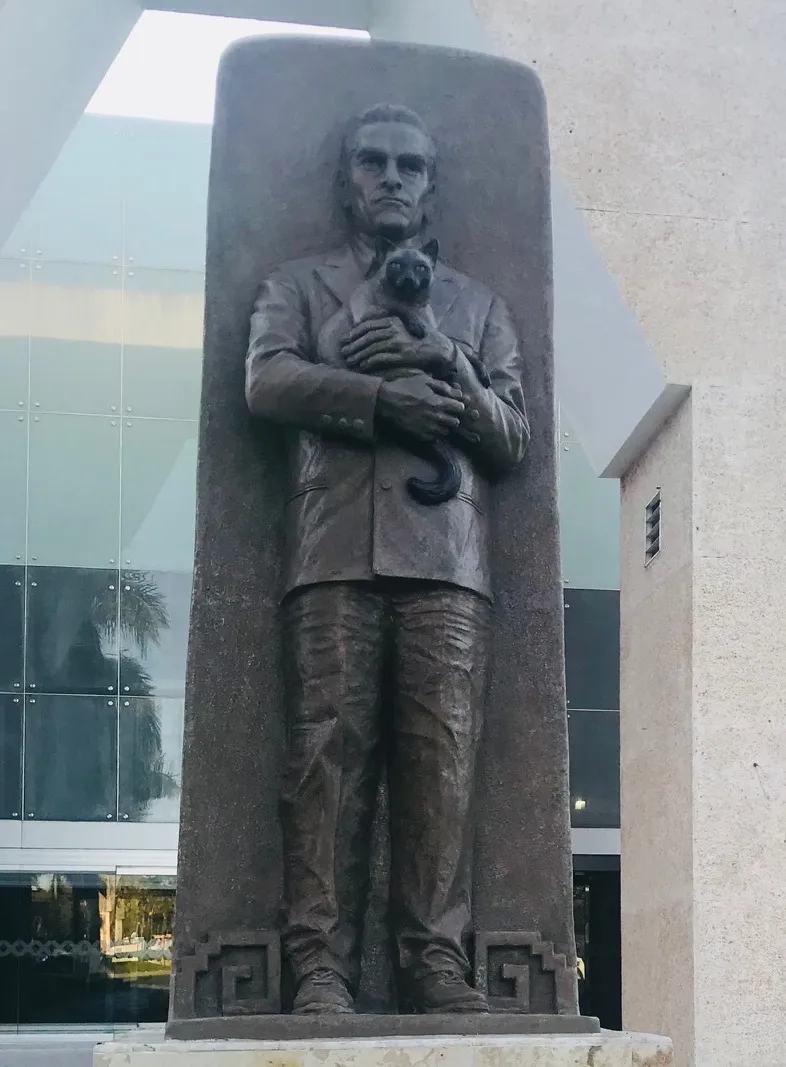 The monument to Yuri Knorozov with his cat Asya in Mérida, unveiled in 2018Wikimedia Commons, Yodigo, CC BY-SA 4.0 (Yuri Knorosov monument in Mérida, Yucatán (cropped).jpg)
Sources
- Michael D. Coe, Breaking the Maya Code (1992), pp. 145 to 205.
- Yuri Knorozov, Ancient Writing of Central America, Sovetskaya Etnografiya 3 (1952), pp. 100 to 118.
- Tatiana Proskouriakoff, Historical Implications of a Pattern of Dates at Piedras Negras, Guatemala, American Antiquity 25 (1960), pp. 454 to 475.
Prev: The Caste War of YucatánNext: The Maya today