c. AD 250 – 900
Holy lords and their courts
Between about AD 250 and 900 each lowland kingdom has a hereditary king, the ajaw, and the kings of the oldest dynasties call themselves k'uhul ajaw, "holy lord". The king holds the highest military, judicial and religious power and stands between his people and the gods. The throne usually passes to the eldest son, and the heir, the b'aah ch'ok or "head youth", must prove himself by taking captives in war. At his accession the new king sits on a jaguar skin cushion and receives a jade headband, a headdress of quetzal feathers and a sceptre in the form of the god K'awiil.
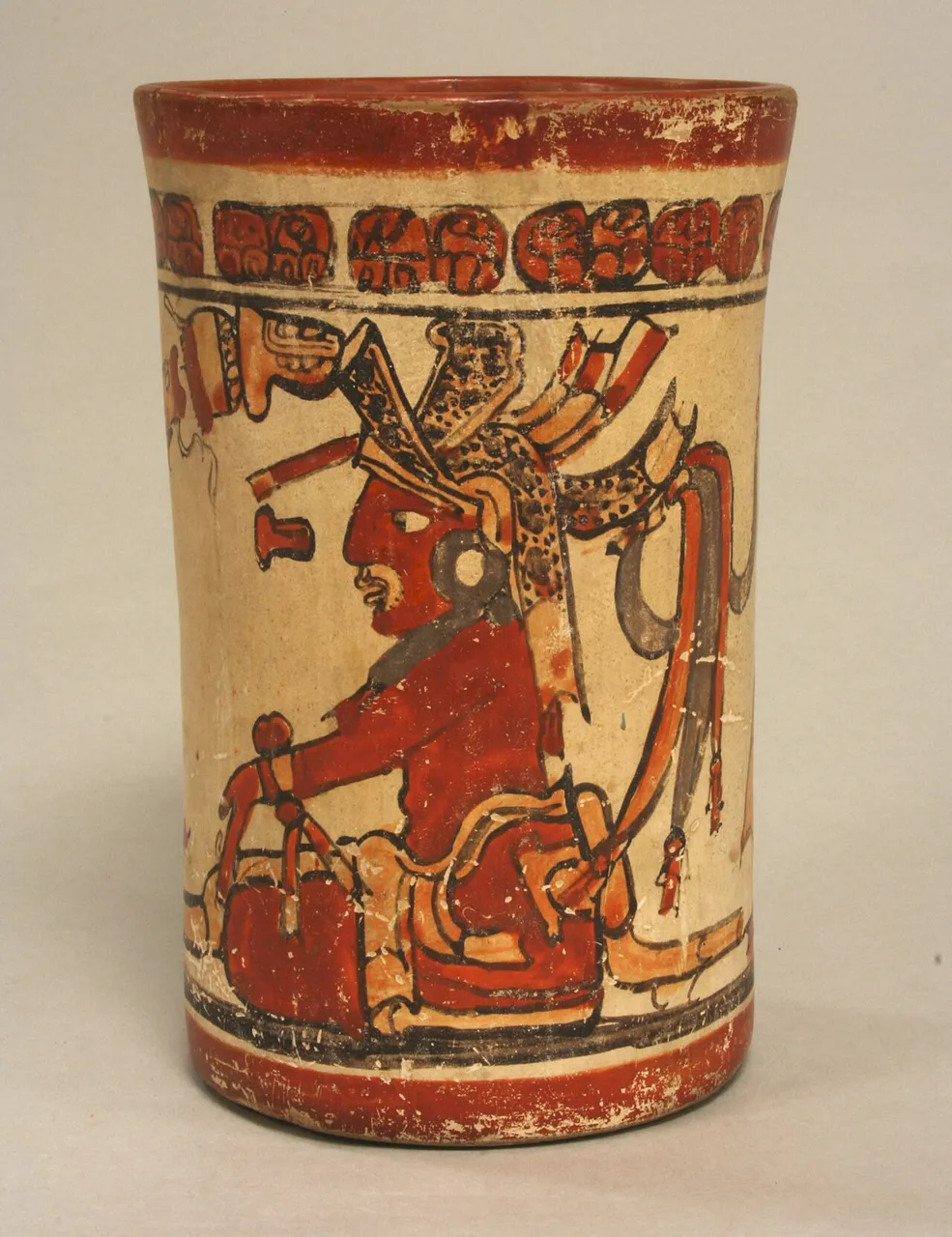 A lord seated on a throne, painted on a cylinder vessel of the 7th or 8th century, Metropolitan Museum of Art, New YorkWikimedia Commons, Metropolitan Museum of Art, CC0 (Vessel, Palace Scene MET 1978.412.202 a.jpeg)
A woman takes the throne when the dynasty would otherwise die out. Yohl Ik'nal rules Palenque from 583, and at Tikal a girl of six, known as the Lady of Tikal, is crowned in 511 and reigns beside a male co-ruler. Royal daughters also marry into other dynasties and tie kingdoms together, as Lady Eveningstar of Calakmul does at Yaxchilan.
Below the king rank the sajal, lords of lesser towns who often lead in war, and officials whose posts are granted by higher nobles. Scribes, aj tz'ib, come from noble and sometimes royal families. Jasaw Chan K'awiil I of Tikal is buried with his paint pot, a palace at Copán belongs to a lineage of scribes, and eight sculptors sign one stela at Piedras Negras. The court lives and meets in palaces beside the main plaza, ranges of rooms on platforms around courtyards, with stone benches, curtains across the doorways and throne rooms for audiences and accessions.
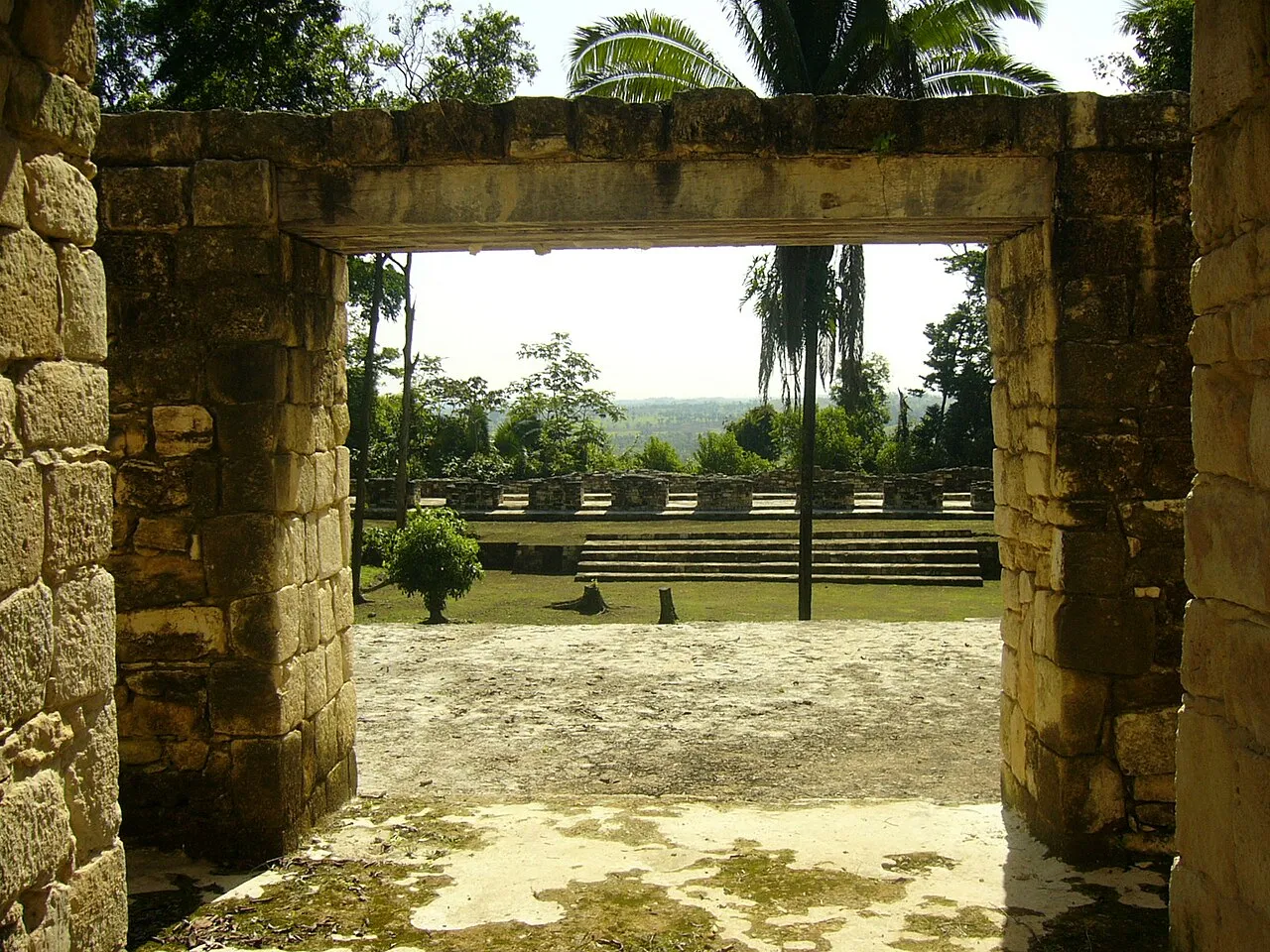 A plaza at Aguateca seen through a doorway of the palace, 2006Wikimedia Commons, Sébastian Homberger, Public domain (Aguateca.jpg)
When enemies burn Aguateca around 800, its nobles flee or are taken away and leave their houses with everything in them. The rooms show courtiers at work as scribes, weavers and artisans: central rooms for receiving visitors and for writing, grinding stones, bone needles and spindle whorls, mortars for pigments, and carvings of shell and bone. The royal family has emptied the palace before the attack.
Sources
- Simon Martin and Nikolai Grube, Chronicle of the Maya Kings and Queens (2000), pp. 14 to 17.
- Sarah E. Jackson, Politics of the Maya Court: Hierarchy and Change in the Late Classic Period (2013), pp. 12 to 15 and 65 to 77.
- Takeshi Inomata and others, “Domestic and Political Lives of Classic Maya Elites: The Excavation of Rapidly Abandoned Structures at Aguateca, Guatemala”, Latin American Antiquity 13 (2002), pp. 305 to 330.
Prev: The murals of BonampakNext: The calendar and the books