AD 426 – 437
Copán and Quiriguá
A text at Tikal from AD 406 names a lord called K'uk' Mo'. In September 426 he is enthroned as K'inich Yax K'uk' Mo' and takes the title "Lord of the West" that Siyaj K'ak' had borne. He comes to Copán, in a valley of western Honduras, and founds a new dynasty there, probably with the backing of Sihyaj Chan K'awiil II of Tikal. Three days after his enthronement he installs Tok Casper as the first known king of Quiriguá, on the Motagua River 48 km to the north. Quiriguá controls the river route and the trade in jade from the middle Motagua valley.
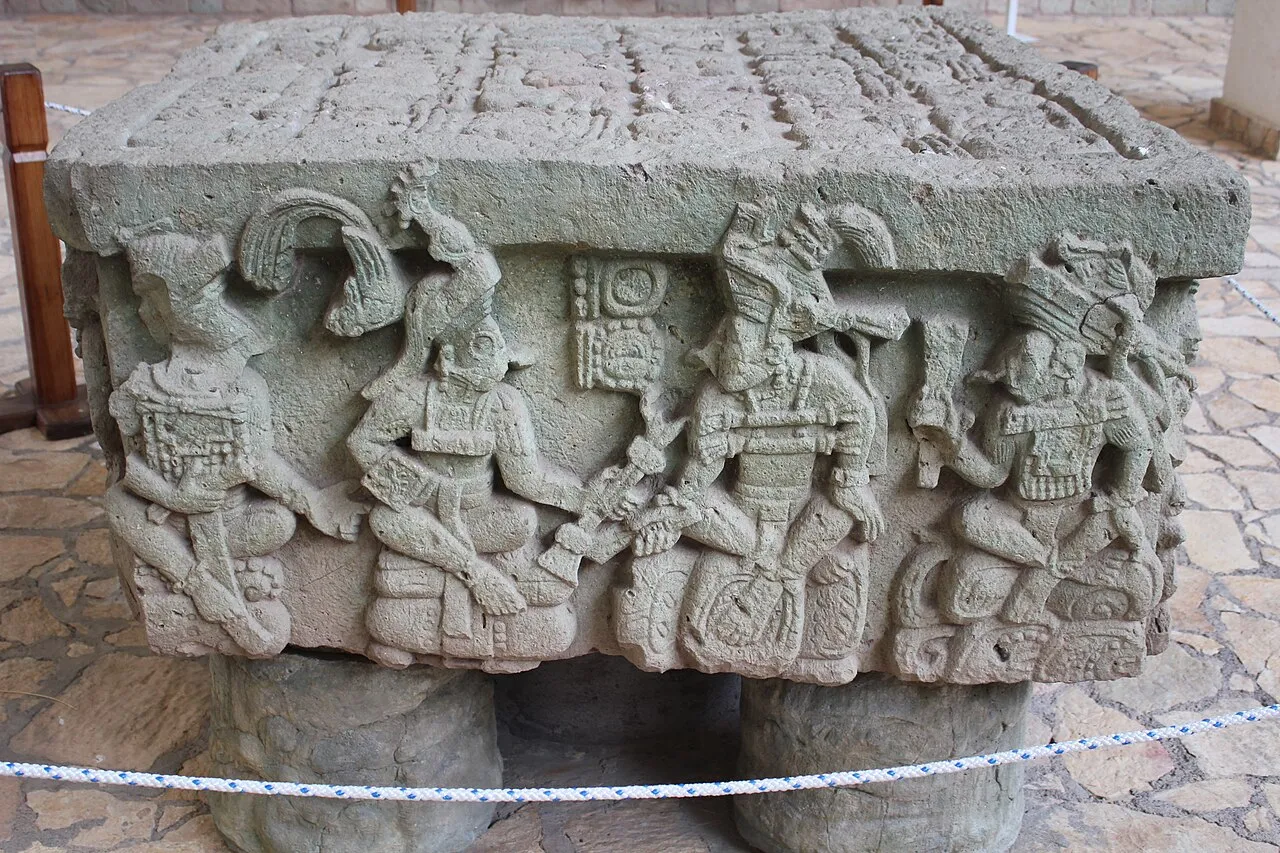 Altar Q at Copán, carved in the 8th century with the sixteen kings of the dynasty of K'inich Yax K'uk' Mo'Wikimedia Commons, Arian Zwegers, CC BY 2.0 (Copan Museum, Altar Q, dynastic rulers (15771343718).jpg)
At Copán K'inich Yax K'uk' Mo' builds one temple in the talud-tablero style of Teotihuacan and another in the style of Tikal. Later portraits show him in the goggles and war dress of Teotihuacan. He dies between 435 and 437 and is buried in the Hunal tomb under Temple 16. Analysis of his teeth shows he grew up in Petén. His son K'inich Popol Hol builds over the tomb and lays out the first ballcourt of the city. The dynasty rules Copán for four centuries.
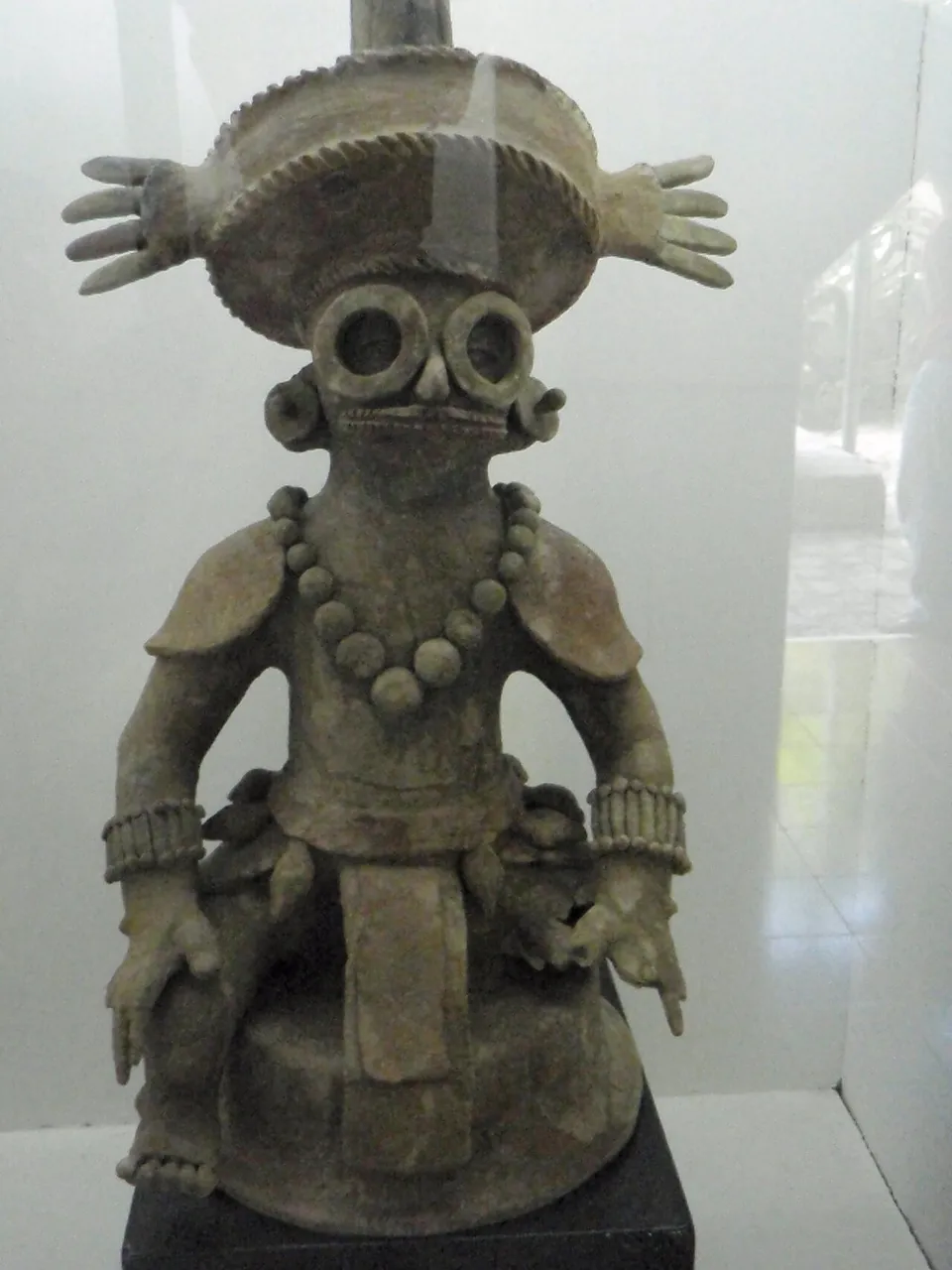 A 7th-century incense burner from Copán thought to show K'inich Yax K'uk' Mo' with the goggles of TeotihuacanWikimedia Commons, DuendeThumb, CC BY-SA 3.0 (Yax Kuk Mo.jpg)
Around this time the Ilopango volcano in El Salvador, 130 km south of Copán, erupts. It throws out 37 to 82 km³ of ash and rock, one of the largest eruptions of the last 7,000 years, and its pyroclastic flows devastate Maya settlements. Radiocarbon dates place it between 410 and 535, a study of ice cores published in 2020 in about 431.
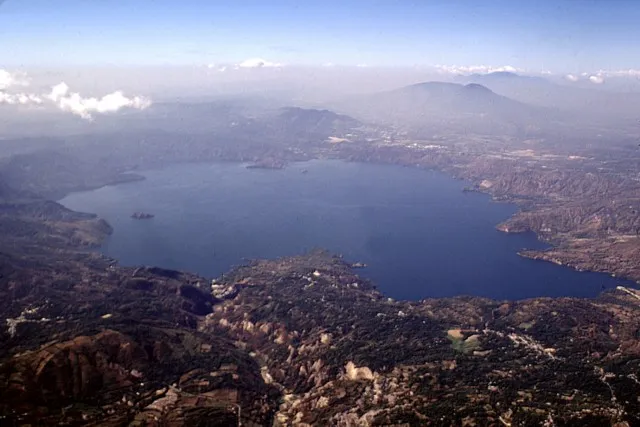 The Ilopango caldera, 8 by 11 km, with pale deposits of the great eruption in the foregroundWikimedia Commons, Lee Siebert (Smithsonian Institution), Public domain (Ilopango caldera.jpg)
Sources
- Robert J. Sharer and Loa P. Traxler, The Ancient Maya (6th ed. 2006), pp. 333 to 342.
- Simon Martin and Nikolai Grube, Chronicle of the Maya Kings and Queens (2000), pp. 192 to 196, 216.
- Victoria C. Smith et al., The magnitude and impact of the 431 CE Tierra Blanca Joven eruption of Ilopango, El Salvador, Proceedings of the National Academy of Sciences 117 (2020), pp. 26061 to 26068.
Prev: The arrival of Siyaj K'ak'Next: The Kaanul kingdom