AD 724 – 738
Quiriguá captures the king of Copán
Uaxaclajuun Ub'aah K'awiil (18 Rabbit), the 13th king of Copán, installs K'ak' Tiliw Chan Yopaat on the throne of Quiriguá as his vassal in AD 724. Quiriguá lies 48 km north of Copán on the Motagua River, the route for highland jade and for trade to the Caribbean. Copán is an old ally of Tikal, and its Stela A of 731 ranks Copán with Tikal, Calakmul and Palenque as the four great kingdoms.
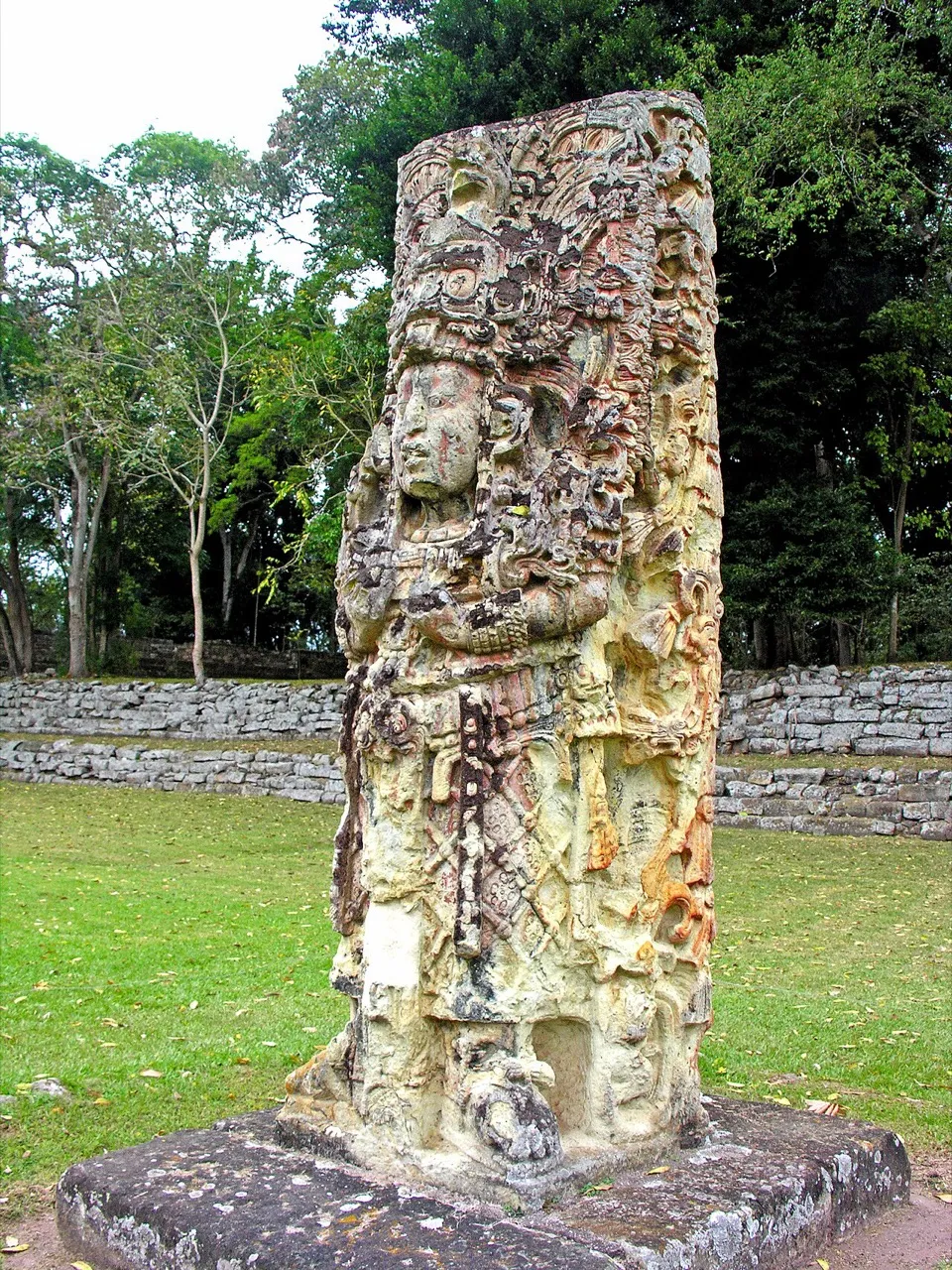 Stela H at Copán, raised in 730, with Uaxaclajuun Ub'aah K'awiil in the costume of the maize godWikimedia Commons, Dennis G. Jarvis, CC BY-SA 2.0 (Honduras-0290 (2213597895).jpg)
In 734 K'ak' Tiliw Chan Yopaat calls himself k'uhul ajaw, holy lord, and begins to use an emblem glyph of Quiriguá’s own. In 736 he receives a visit from Wamaw K'awiil, king of Calakmul, the great rival of Tikal. Copán dedicates its new ballcourt on 6 January 738.
An inscription at Quiriguá records that on 27 April 738 K'ak' Tiliw Chan Yopaat seizes Uaxaclajuun Ub'aah K'awiil and burns the wooden images of Copán’s patron gods. Neither city shows signs of an attack, and the capture probably takes place in an ambush away from both. On 3 May 738 the king of Copán is beheaded in a public ritual at Quiriguá.
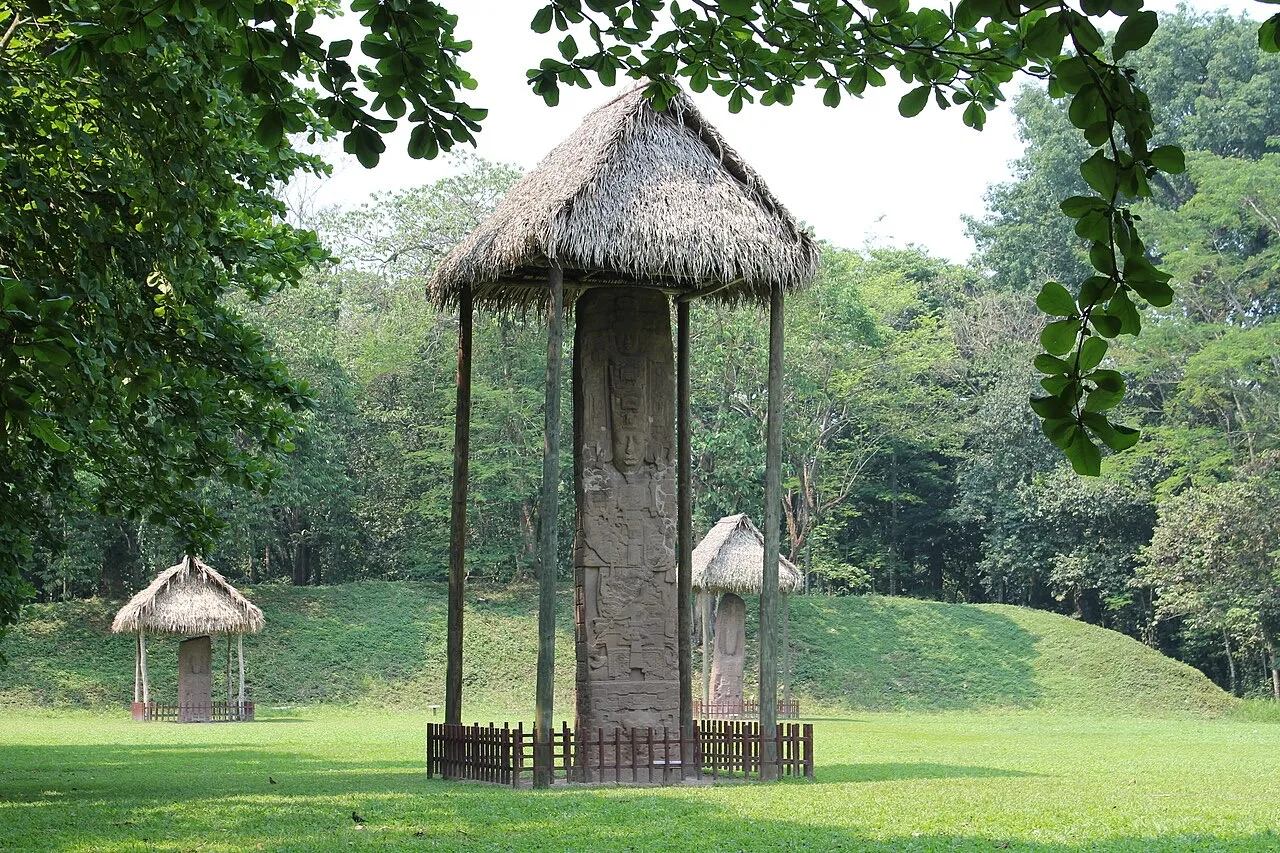 Stela E at Quiriguá, dedicated in 771, under its protective roof, 2014Wikimedia Commons, Arian Zwegers, CC BY 2.0 (Stela E, Quirigua, Guatemala, with protective roof, 2014.jpg)
K'ak' Joplaj Chan K'awiil becomes king of Copán on 7 June 738. Copán raises no new monuments for 17 years and loses the Motagua trade route to Quiriguá. In the following decades Quiriguá raises tall stelae and zoomorphs in the style of Copán, among them Stela E, 10.7 m high.
Sources
- Matthew G. Looper, Lightning Warrior: Maya Art and Kingship at Quirigua (2003), pp. 76 to 81.
- Simon Martin and Nikolai Grube, Chronicle of the Maya Kings and Queens (2000), pp. 203 to 207 and 216 to 221.
- Robert J. Sharer and Loa P. Traxler, The Ancient Maya (6th ed. 2006), p. 482.
Prev: Shield Jaguar and Bird JaguarNext: Tikal’s last victories