AD 832 – c. 1100
Chichen Itza
Chichen Itza stands on the dry limestone plain of northern Yucatán, beside four natural cenotes. The layout of its core takes shape between AD 750 and 900. The earliest hieroglyphic date found at the site corresponds to 832, and the last, in the Osario temple, to 998. The Itza, a Maya group of debated origin, begin to arrive in the region around 800.
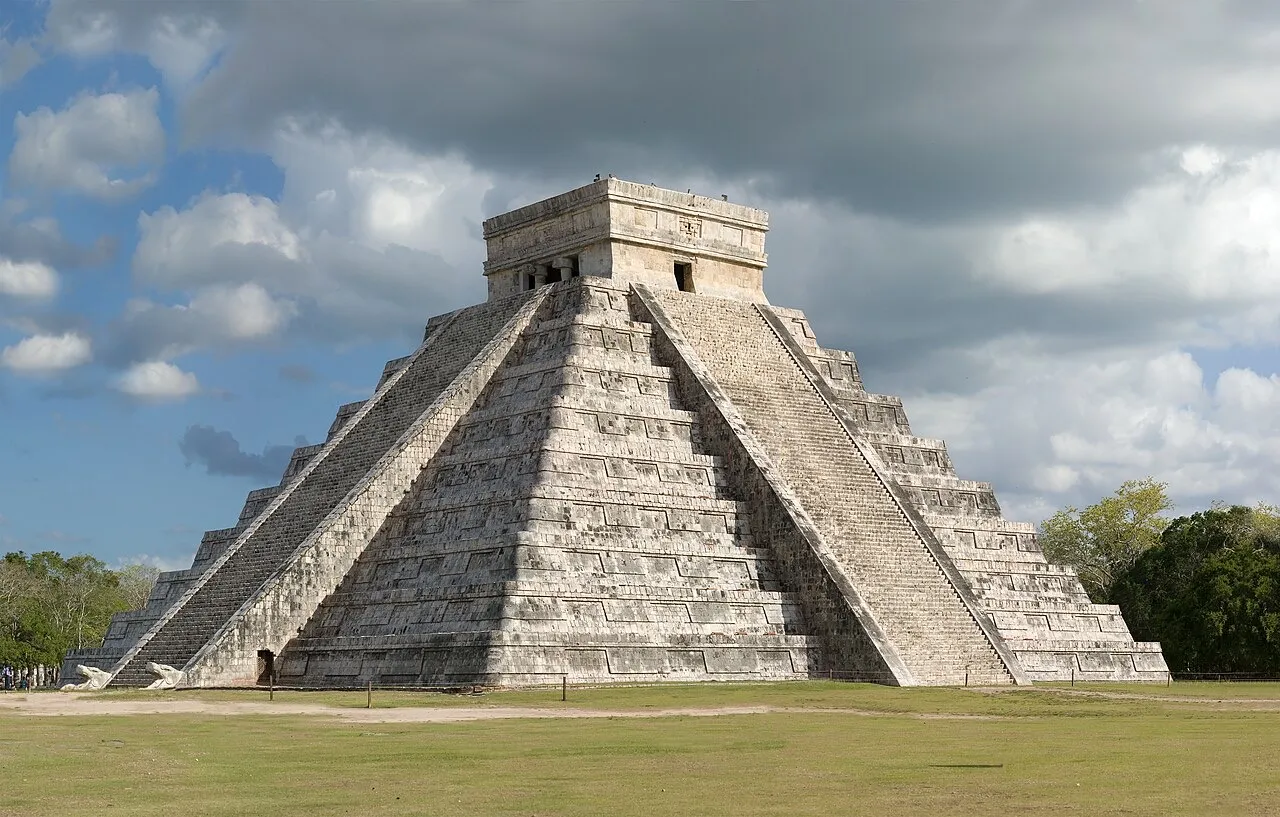 The Temple of Kukulcán, El Castillo, at Chichen ItzaWikimedia Commons, Fcb981, CC BY-SA 3.0 (El Castillo Stitch 2008 Edit 1.jpg)
Between 900 and 1050 Chichen Itza becomes a regional capital that controls the north and centre of the peninsula. Through its port on Isla Cerritos, on the north coast, it takes part in the sea trade round the peninsula and obtains obsidian from central Mexico and gold from southern Central America. Coba and its dependency Yaxuna decline in the 10th century, and Chichen Itza may have contributed to their fall.
The Temple of Kukulcán, called El Castillo by the Spanish, rises about 30 m in nine terraces, with a stairway on each side. The Great Ball Court, 168 by 70 m, is the largest in ancient Mesoamerica. The Temple of the Warriors, fronted by rows of carved columns, resembles Temple B at Tula, the Toltec capital in central Mexico. Offerings of gold, jade and pottery, and human remains with wounds of sacrifice, lie in the Sacred Cenote.
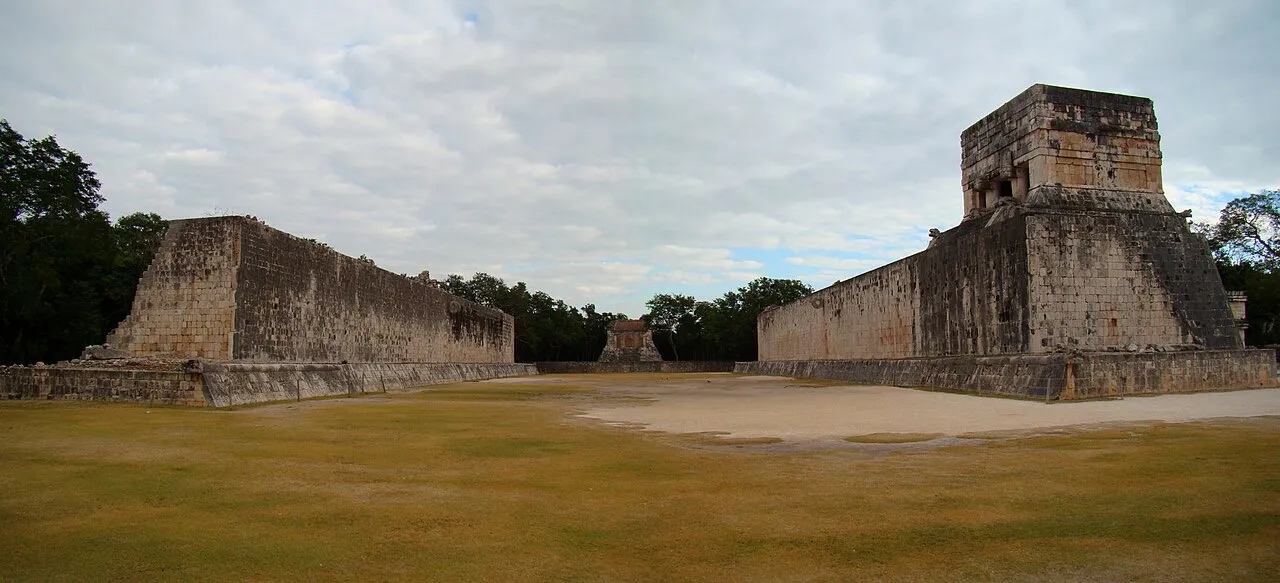 The Great Ball Court of Chichen Itza, 2010Wikimedia Commons, Bjørn Christian Tørrissen, CC BY-SA 3.0 (Chichen-Itza-Ballcourt-Panorama-2010.jpg)
Chichen Itza declines as a regional centre by 1100. Some colonial Maya chronicles say that Hunac Ceel of Mayapan conquers it, while archaeology places its decline before the rise of Mayapan.
Sources
- Rafael Cobos Palma, “Chichén Itzá: Settlement and Hegemony During the Terminal Classic Period”, in The Terminal Classic in the Maya Lowlands (2005), pp. 517 to 544.
- José Osorio León, “La presencia del Clásico Tardío en Chichen Itza (600–800/830 DC)”, XIX Simposio de Investigaciones Arqueológicas en Guatemala (2006), pp. 455 to 462.
- Robert J. Sharer and Loa P. Traxler, The Ancient Maya (6th ed. 2006), pp. 562 to 566.
Prev: Uxmal and the Puuc citiesNext: Mayapan