14 March 1519
Cortés’s horsemen
After about an hour Cortés and the horsemen come up behind the Chontal army. Caught between the horse and the foot, the warriors break and flee. The Chontal have never seen horses, and Bernal Díaz writes that they take horse and rider for a single creature.
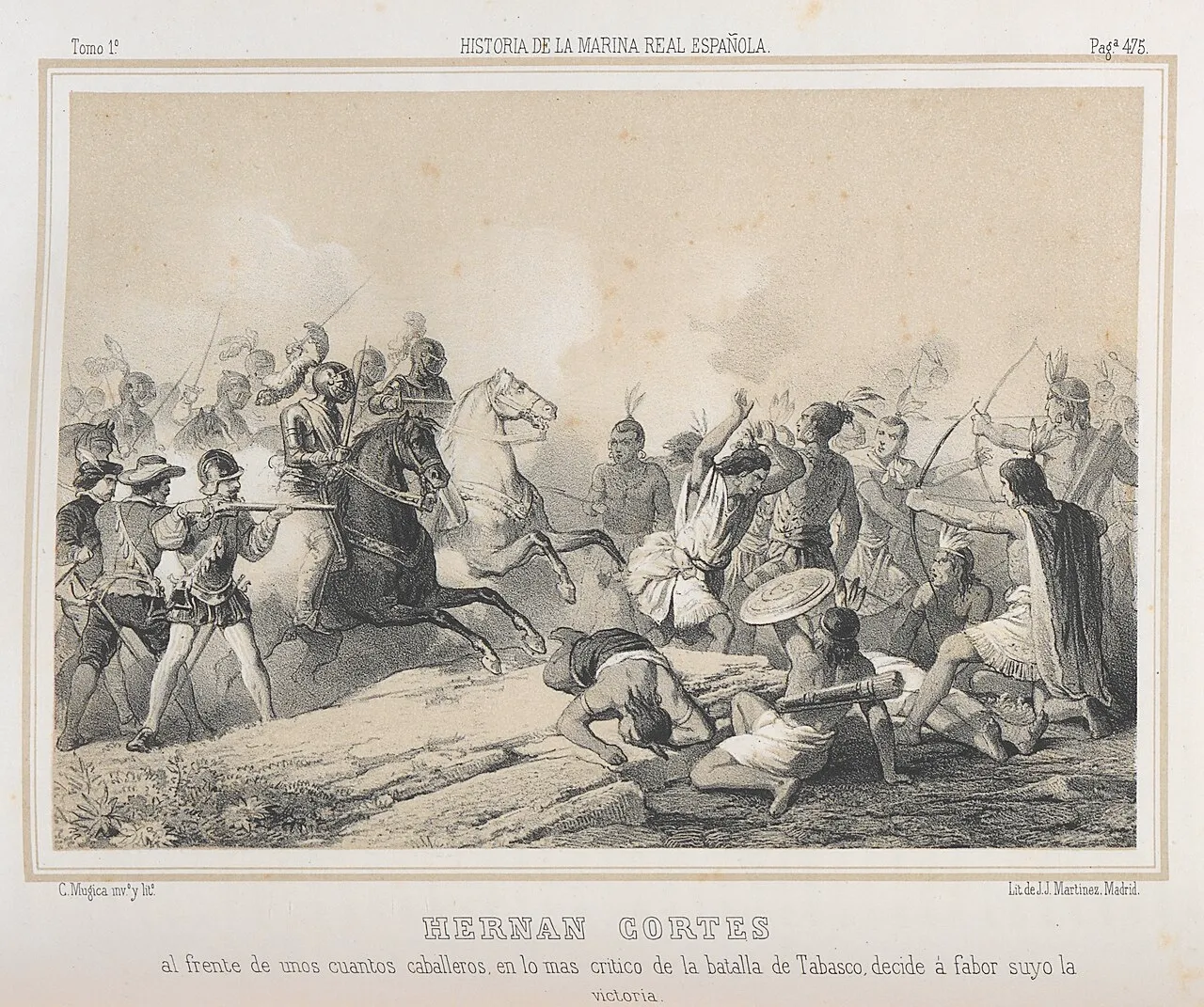 Cortés and a few horsemen decide the battle of Tabasco, lithograph by Carlos Múgica in the Historia de la Marina Real Española, Madrid, 1854Wikimedia Commons, Carlos Múgica y Pérez, Public domain (A055a160 0517.jpg)
Bernal Díaz counts more than 800 dead on the field. Two Spaniards are killed and about seventy wounded. The Spaniards bury their dead and sear the wounds of the men and the horses.
In the following days envoys of Tabscoob bring gold, jade, turquoise, feathers and food, and twenty young women. One of them is Malintzin, a Nahua woman sold to the Chontal as a slave, who speaks Nahuatl and Chontal Maya. Baptised Marina, she becomes Cortés’s interpreter together with Aguilar. On 25 March Cortés founds Santa María de la Victoria at Potonchán, the first Spanish town in Mexico, named for Our Lady and the victory. In April the fleet sails on to San Juan de Ulúa.
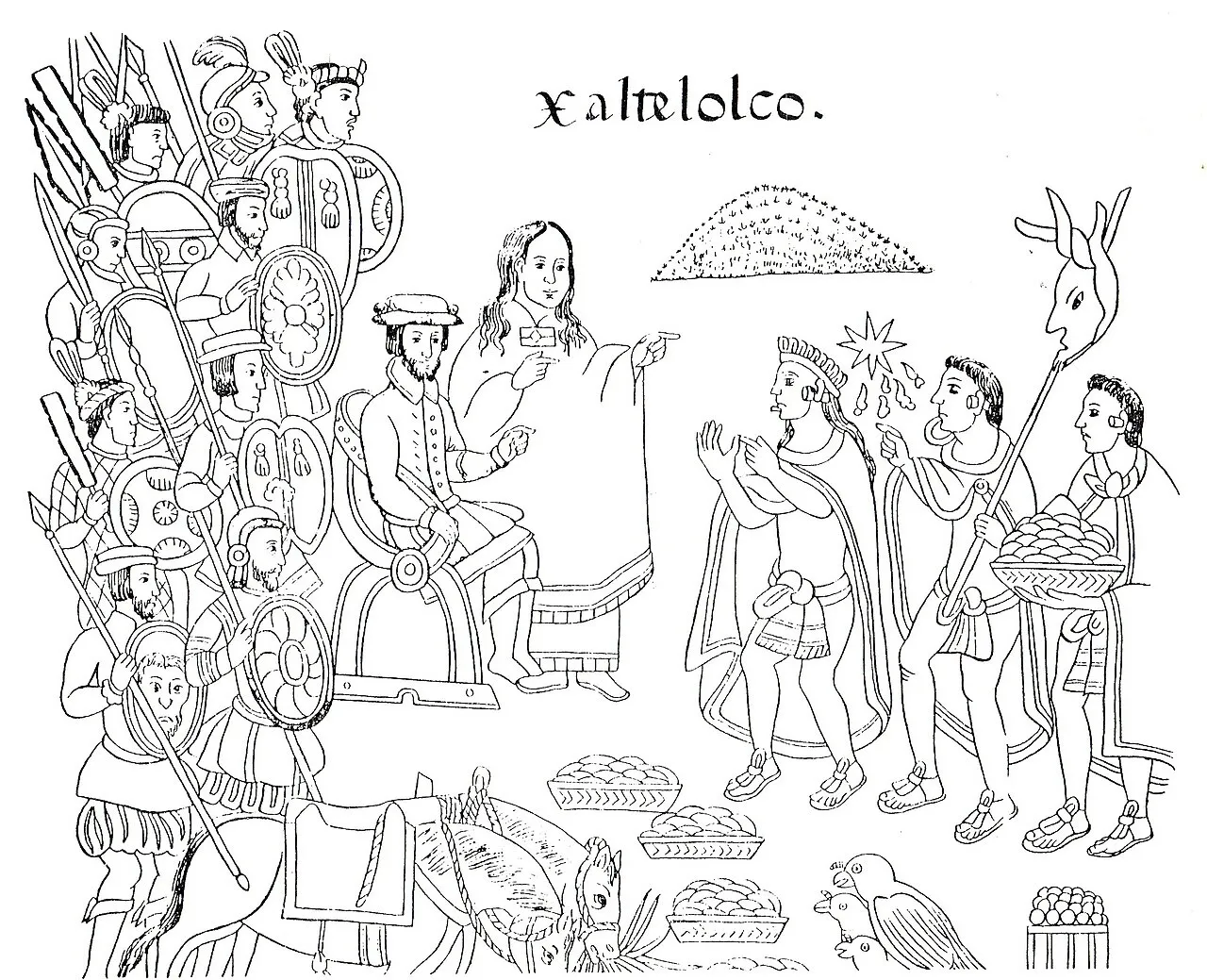 Malintzin interprets for Cortés as lords bring food at Xaltelolco, from a copy of the Lienzo de Tlaxcala of about 1550Wikimedia Commons, unknown artist, Public domain (Malinche Tlaxcala cropped.jpg)
Sources
- Bernal Díaz del Castillo, The Conquest of New Spain, tr. J. M. Cohen (1963), pp. 74 to 82.
- Cipriano Aurelio Cabrera Bernat, Viajeros en Tabasco: Textos (1987), p. 45.
- Camilla Townsend, Malintzin’s Choices (2006), pp. 35 to 36.
Prev: The foot on the plainNext: Alvarado marches into Guatemala