AD 292 – 909
The calendar and the books
From AD 292 the kings of the lowlands date their monuments in the Long Count, a count of days from the creation of the present world on a day in August 3114 BC. The count runs in units of 20 days, 360 days, 7,200 days, the k'atun of nearly 20 years, and 144,000 days, the b'ak'tun. The oldest known Long Count date, of 36 BC, is carved in the Epi-Olmec script on Stela 2 at Chiapa de Corzo, and the first Maya one on Stela 29 at Tikal.
Each date also names its day in two cycles that run side by side. The tzolk'in of 260 days joins the numbers 1 to 13 to twenty day names, and the haab' of 365 days has eighteen months of 20 days and five unlucky days, the wayeb. The same pair of names returns only after 52 years, the Calendar Round, and Stela C at Quiriguá, raised in 775, gives the day of creation as 4 Ajaw 8 Kumk'u.
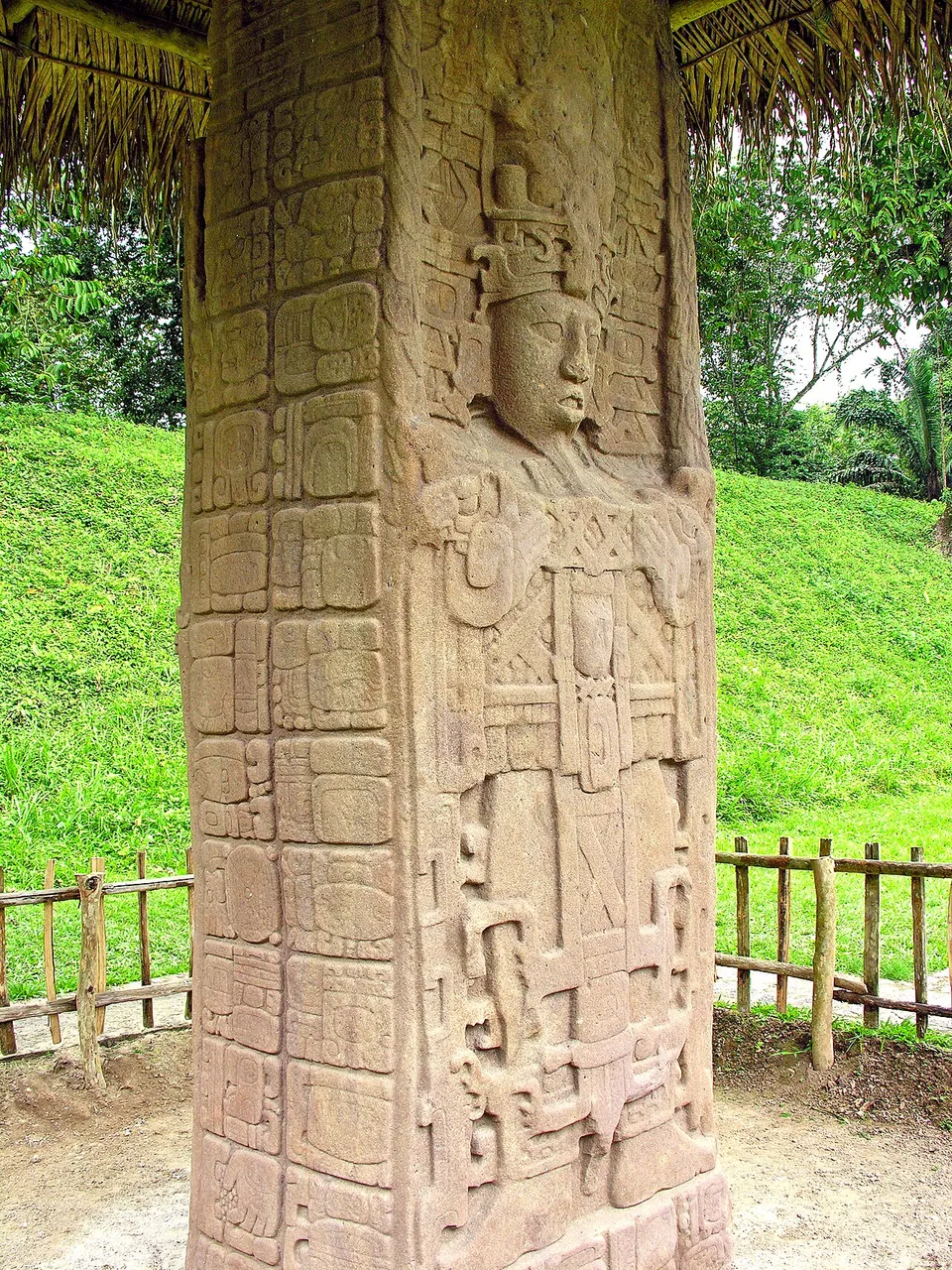 Stela C at Quiriguá, raised by K'ak' Tiliw Chan Yopaat in 775, whose text records the day of creation in 3114 BCWikimedia Commons, Dennis G. Jarvis, CC BY-SA 2.0 (Flickr - archer10 (Dennis) - Guatemala-0569.jpg)
From the late 5th century kings raise a stela at the end of each k'atun, and often at its half and quarter. The texts tell of the king dancing and letting his blood at these ceremonies, and the stela itself is bound in cloth. Tikal builds twin pyramid groups for the k'atun endings, and Calakmul raises at least 166 stelae, more than any other Maya city. The last Long Count date, a k'atun ending in January 909, is carved on Monument 101 at Toniná.
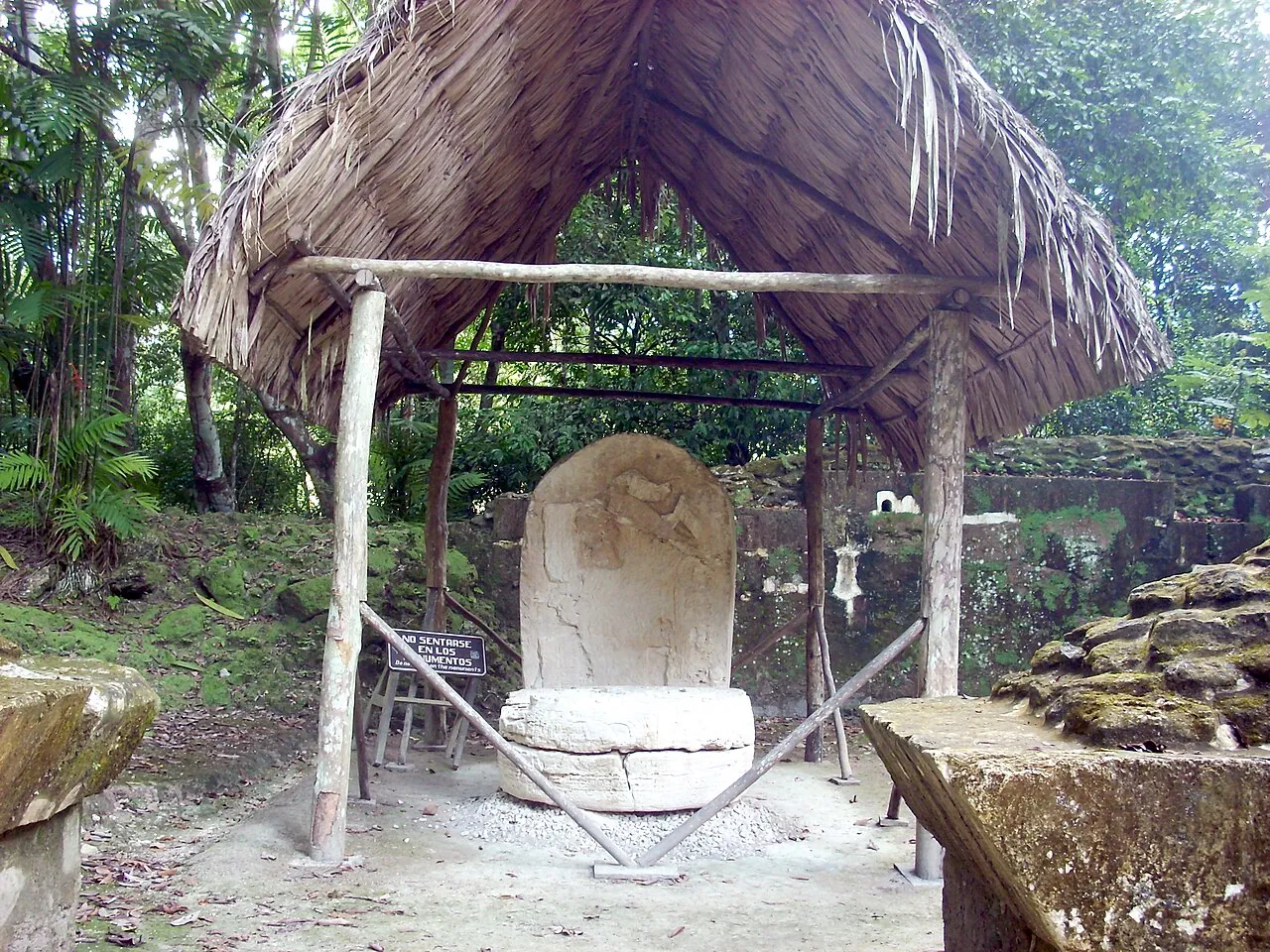 Stela 19 and Altar 6 in Group R, a twin pyramid group built at Tikal for the k'atun ending of 790Wikimedia Commons, Simon Burchell, CC BY-SA 3.0 (Tikal Stela 19 and Altar 6, Group R.jpg)
Scribes follow the cycles of the moon and the planets. In the 8th century they cover the walls of a room at Xultun with lunar tables and long spans of time, and one formula is signed by Sak Tahn Waax, the only Classic Maya astronomer known by name. They also write folding books on paper made from fig bark, most of which Spanish priests destroy after the conquest. Four survive: the Dresden Codex, with tables of eclipses and of the cycles of Venus and Mars, the Madrid Codex of almanacs for priests, the Paris Codex of prophecies for the k'atuns, and the fragmentary Maya Codex of Mexico, the only one still in the Americas.
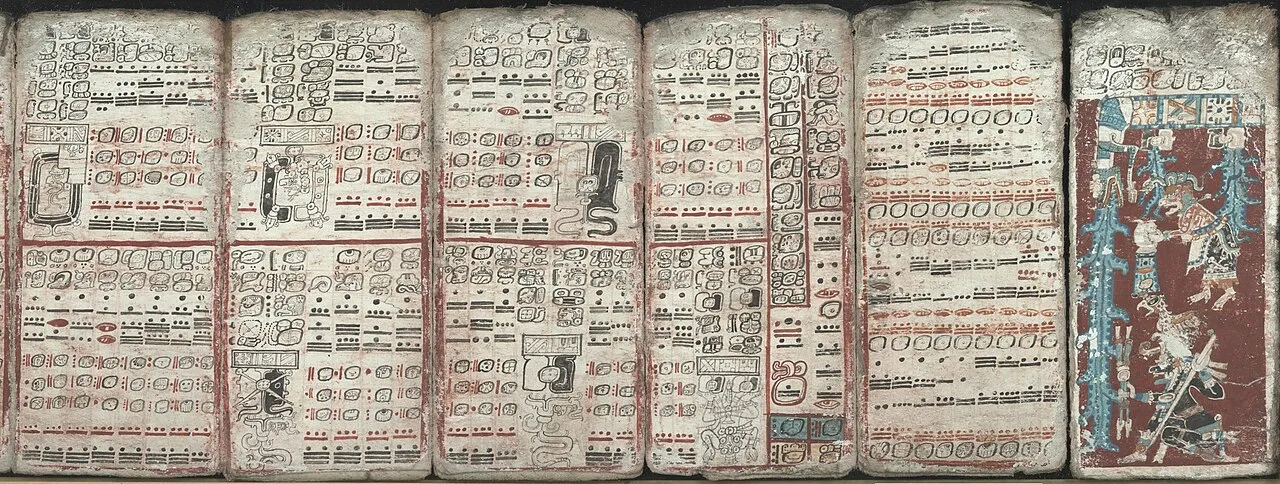 Six pages of the Dresden Codex, a Postclassic Maya book, with eclipse tables and a scene of the flood, Saxon State and University Library, DresdenWikimedia Commons, unknown artist, Public domain (Dresden Codex pp.58-62 78.jpg)
Sources
- Robert J. Sharer and Loa P. Traxler, The Ancient Maya (6th ed. 2006), pp. 101 to 115.
- David Stuart, “Kings of Stone: A Consideration of Stelae in Ancient Maya Ritual and Representation”, RES: Anthropology and Aesthetics 29/30 (1996), pp. 148 to 171.
- William A. Saturno, David Stuart, Anthony F. Aveni and Franco Rossi, “Ancient Maya Astronomical Tables from Xultun, Guatemala”, Science 336 (2012), pp. 714 to 717.
Prev: Holy lords and their courtsNext: Gods, temples and the ballgame