c. AD 790
The murals of Bonampak
Bonampak, a small city near a tributary of the Usumacinta, is a dependency of Yaxchilan in the late 8th century. Carved lintels over the three doors of its Structure 1 show captures by Aj Sak Teles in 780, by the Yaxchilan overlord on 4 January 787 and by the Bonampak ruler Yajaw Chan Muwaan on 12 January 787. Around AD 790 painters sent by the king of Yaxchilan cover the three rooms of Structure 1 with murals.
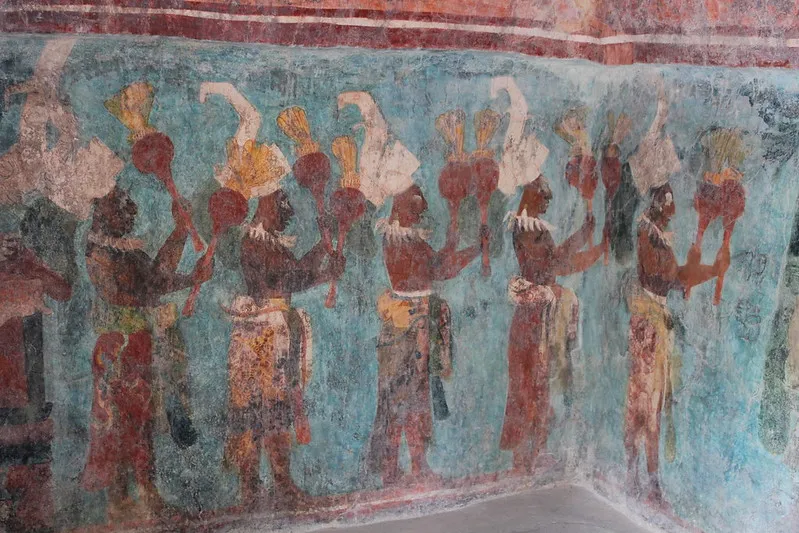 Musicians on the murals of Room 1 at BonampakWikimedia Commons, Arian Zwegers, CC BY 2.0 (Bonampak, Temple of the Murals, musicians.jpg)
The murals show some 281 figures, about a third of them named in captions. Room 1 shows the court, musicians and dancers, and the presentation of Chooj, son of Yajaw Chan Muwaan, as heir. Glyphs under the throne mark five bundles of tribute, which David Stuart’s reading puts at 40,000 cacao beans.
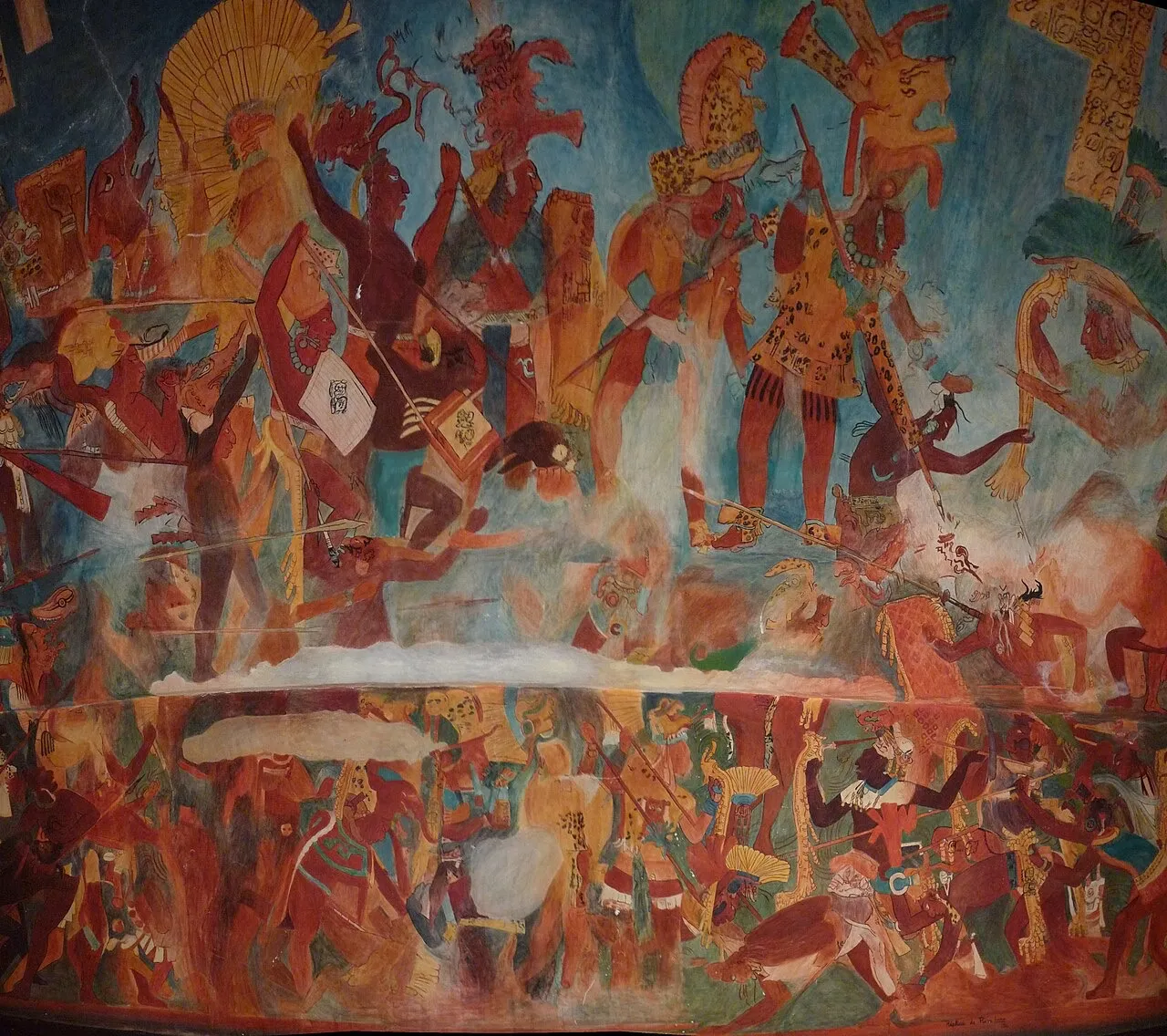 The battle on the walls of Room 2 at Bonampak, in the reproduction at the National Museum of Anthropology, Mexico CityWikimedia Commons, El Comandante, CC BY-SA 3.0 (Reproduction of Bonampak murals (center) 2.JPG)
Room 2, the largest, shows a battle. On its north wall stripped captives bleed from their torn fingernails before Yajaw Chan Muwaan in his jaguar costume. Room 3 shows costumed dancers and the noblewomen of the court drawing blood from their tongues with stingray spines.
Bonampak declines with Yaxchilan in the 9th century. Lacandon Maya still pray in its temples in 1946, when they lead outsiders to the ruins and show the photographer Giles Healey the paintings.
Sources
- Mary Miller and Claudia Brittenham, The Spectacle of the Late Maya Court: Reflections on the Murals of Bonampak (2013).
- Mary Miller, The Murals of Bonampak (1986).
- Stephen Houston, “The Good Prince: Transition, Texting and Moral Narrative in the Murals of Bonampak, Chiapas, Mexico”, Cambridge Archaeological Journal 22 (2012), pp. 153 to 175.
Prev: The Petexbatún warsNext: Holy lords and their courts