1419 – 1434
The wagon fort
The Hussite war wagon is a strong farm wagon with thick planks on its sides and a plank hung below between the wheels, which covers the men behind it. Each wagon carries a chain to fasten its wheels to the next wagon, and shovels, axes and hoes to clear a road or dig a ditch. Its crew is about 20: four to eight crossbowmen, two handgunners, six to eight men with flails or pikes, two pavise bearers and two drivers.
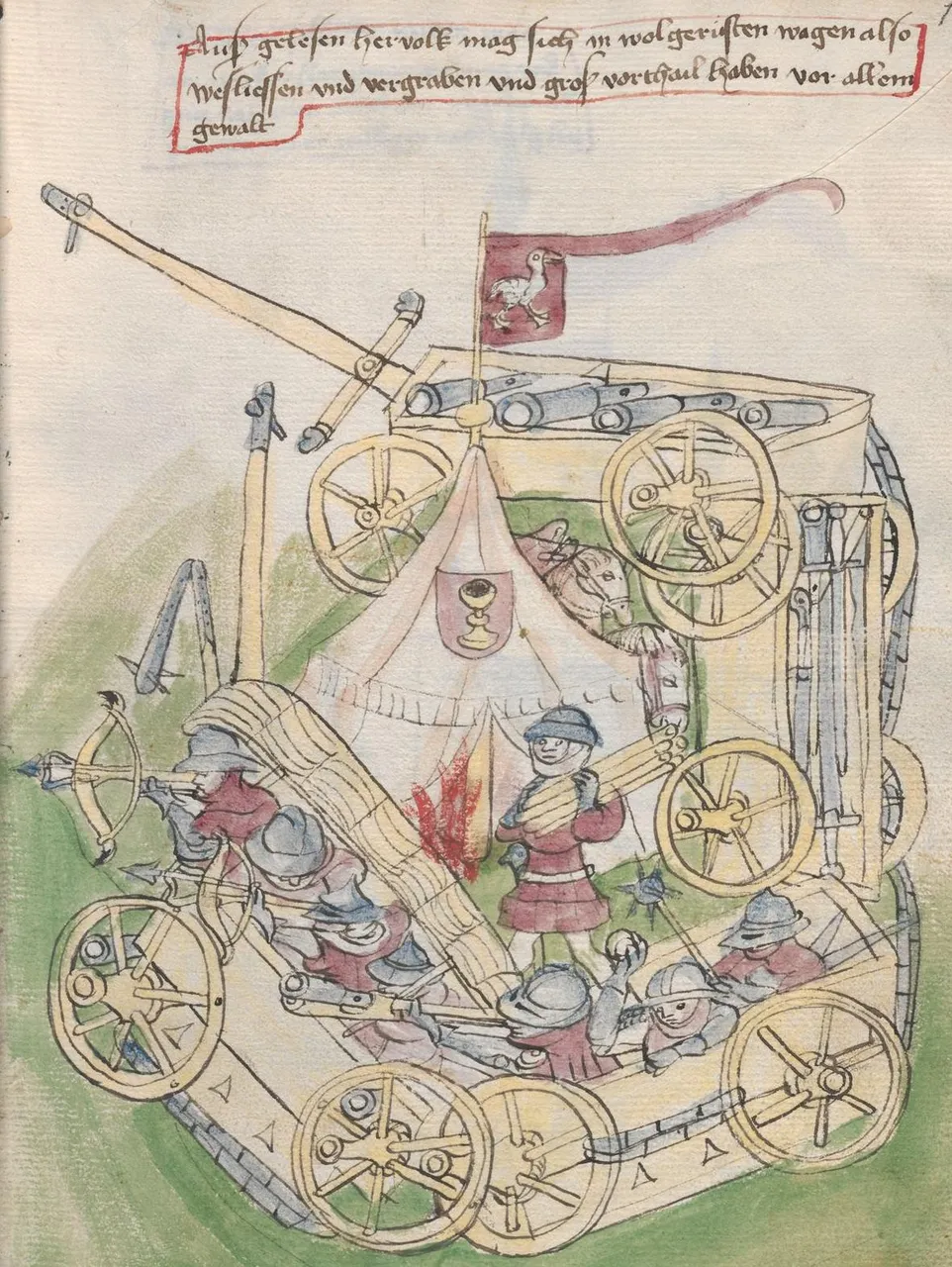 A Hussite war wagon with its crew, handguns and a gun, from a manuscript on the art of war of about 1437Wikimedia Commons, Johannes Wienner, Public domain (War Wagon - Manuscript on the Art of War.jpg)
For battle the wagons are chained into a ring or a square, and the camp followers dig a ditch in front. Horsemen cannot ride through the ring, and the shooters aim first at the horses. The Czechs call the handgun píšťala, a pipe, and the light gun houfnice, the words that became pistol and howitzer. When the attack has worn itself out, gaps open in the ring, and men with flails and the few horsemen go out against the flanks of the enemy.
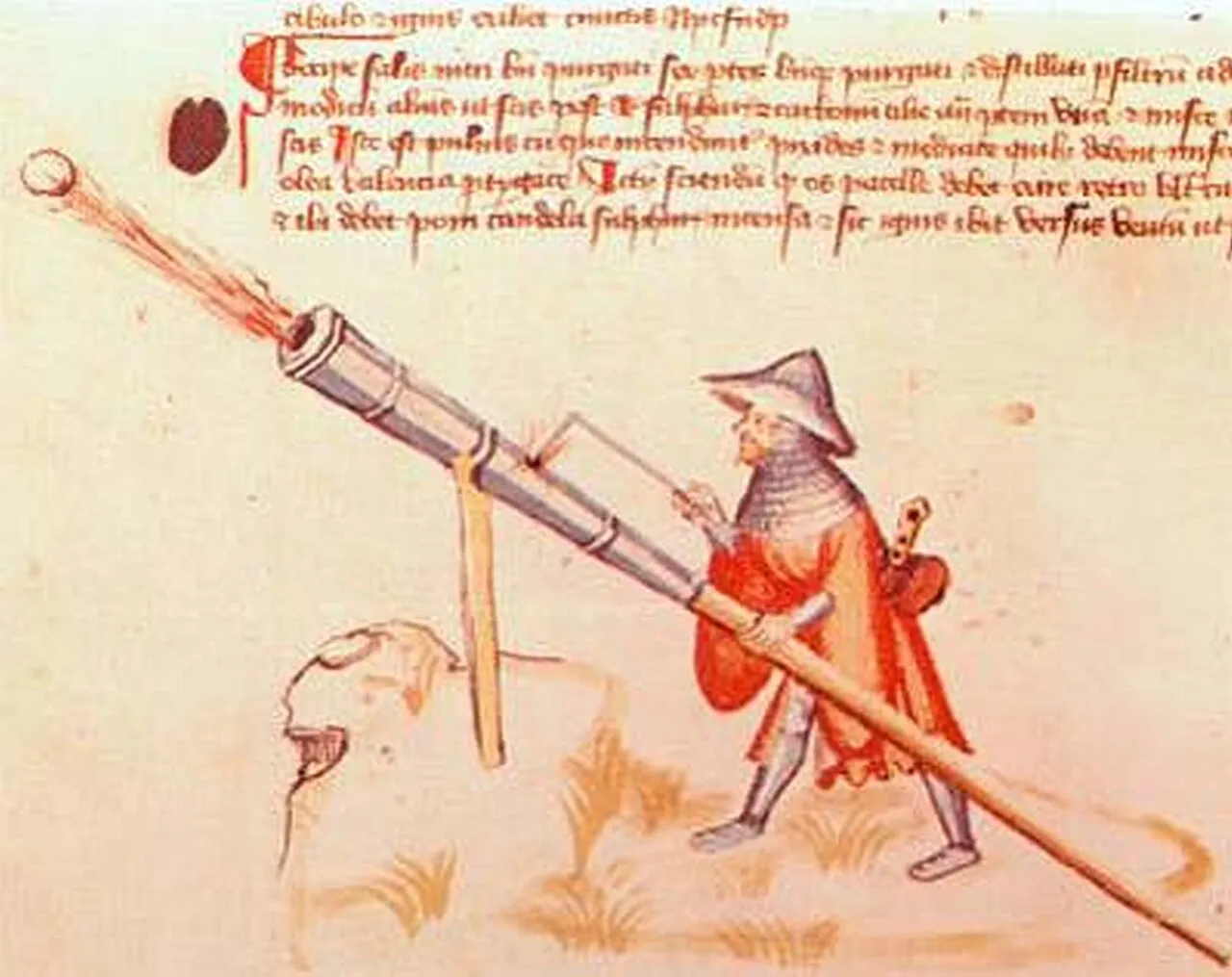 A handgun fired from a rest, in Konrad Kyeser’s Bellifortis, about 1405Wikimedia Commons, Konrad Kyeser, Public domain (Hand-cannon-being-fired-from-a-stand-belli-fortis-manuscript-by-konrad-kyeser-1400.jpg)
Žižka uses seven wagons at Nekmíř and twelve at Sudoměř, and the field armies of the later years take the field with hundreds. The wagons march in up to four columns that close into a fort in a short time, and at Kutná Hora in 1421 the fort fires as it moves. Žižka’s military ordinance of 1423 sets the rules of the march and the camp: every man stays under his own banner, booty goes to one pile to be shared, and fights, gambling and drunkenness are punished.
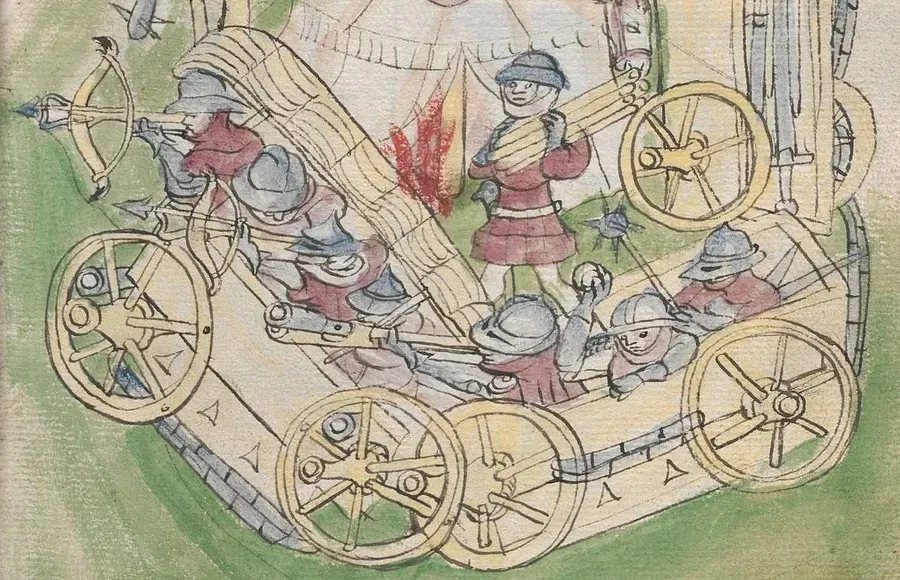 A Hussite wagon fort, a 15th-century sketchWikimedia Commons, unknown author, Public domain (Wagenburg.jpg)
Sources
- Jan Durdík, Husitské vojenství (1953).
- Stephen Turnbull, The Hussite Wars 1419–36 (2004).
- Žižka’s military ordinance of 1423, in a copy of the 16th century.
Prev: Sunset at SudoměřNext: Sigismund’s crusade, 1420