May – 15 June 1426
The siege of Ústí and the Saxon relief
On 16 June 1426 the Hussite unions, about 11,000 men by the estimate of Petr Čornej and Pavel Bělina, meet a Saxon relief army of about 13,000 west of Ústí nad Labem. The chroniclers give far larger numbers on both sides, up to five Germans for every Czech. The Hussites wait for the attack in a wagon fort of some 500 wagons in two lines, and the second line decides the battle: it stops the knights after they break through the first.
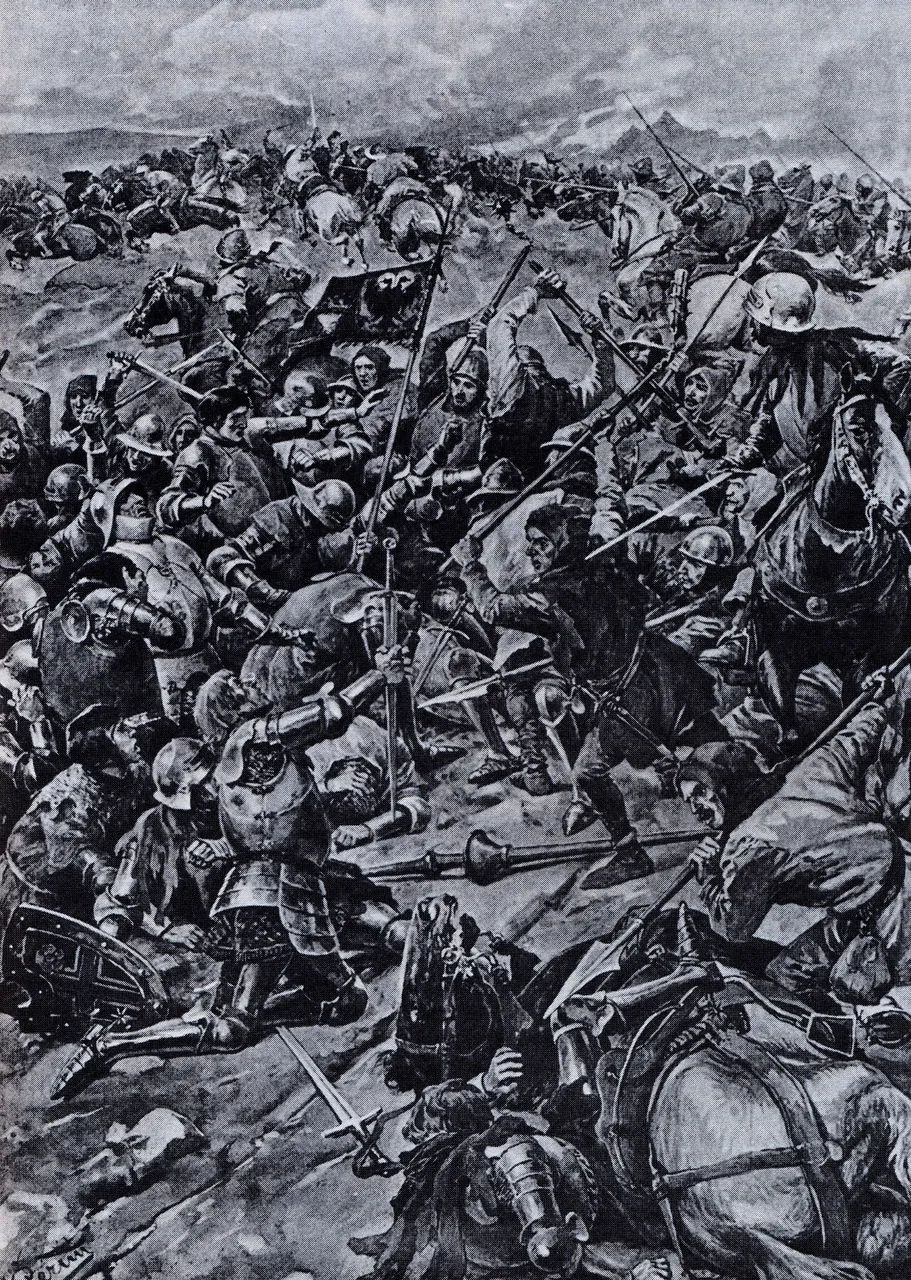 The battle of Ústí nad Labem, drawing by Věnceslav ČernýWikimedia Commons, Věnceslav Černý, Public domain (Bitva u Ústí nad Labem.jpg)
Sigismund has given Ústí and Most to Frederick, margrave of Meissen, who becomes elector of Saxony in 1425, and Ústí holds a Meissen garrison. In spring 1426 all the Hussite unions and the Utraquist lords take the field together. After a council of the captains at Mladá Boleslav on 5 May, the Orphans under Jan Roháč of Dubá burn Mimoň and take Česká Lípa on 19 May, and the joined army takes Třebenice, Teplice and Krupka. From 26 May three Hussite camps and a ring of wagons surround Ústí, and on 6 June the garrison beats off an assault on the walls.
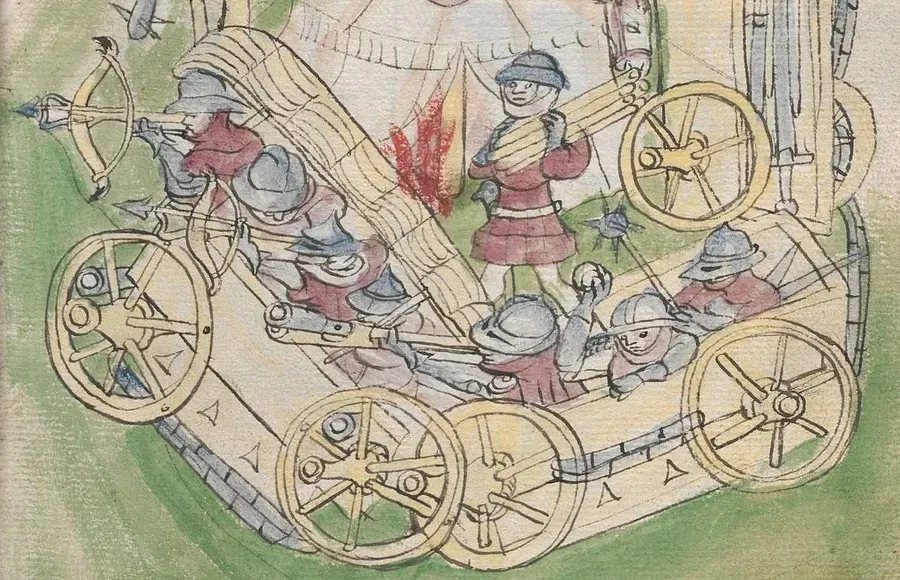 A Hussite wagon fort, a 15th-century sketchWikimedia Commons, unknown author, Public domain (Wagenburg.jpg)
Frederick is at the imperial diet, and his wife Catherine raises the relief army at Freiberg from Meissen, Saxony, Thuringia, Upper Lusatia and Hesse, under the Meissen governor Boso of Vitzthum. It crosses the Ore Mountains on 14 June in three columns, by the Janov road past Most, by Osek, and by Krupka and Teplice, and the hungry columns meet at Chabařovice the next day. On 15 June the Hussites lift the siege and draw up on Běhání, a low hill between Hrbovice and Předlice about 5 km west of the town.
Sources
- Petr Čornej and Pavel Bělina, Slavné bitvy naší historie (1993), pp. 68 to 74.
- František Šmahel, Husitská revoluce, vol. 3, Kronika válečných let (1996), pp. 178 to 181.
- Jan Durdík, Husitské vojenství (1953), pp. 153 to 156.
Prev: Prokop and the field armies, 1425–1426Next: The wagon fort on Běhání hill