16 June 1426, morning
The wagon fort on Běhání hill
On the morning of 16 June, a Sunday, the Hussite captains propose to the Saxon commanders that both sides take prisoners and that the battle wait until Monday. Both proposals are refused. The relief army forms up in the valley of the Ždírnický brook north of the hill and on the road from Chabařovice, in a heat that grows through the morning.
The Hussites stand in three bodies, as they camped before Ústí. Sigismund Korybut commands the Praguers with the Lithuanian and Polish volunteers and the Czech and Moravian lords, Prokop the Great is the priest of the Taborite field army, and Jan Roháč of Dubá and Kuneš of Bělovice lead the Orphans.
The wagons stand chained wheel to wheel round the top of the hill, and with some 500 of them the Hussites set a second line behind the first. Howitzers and light field guns stand in the gaps, with men behind them under large shields whose pointed ends are driven into the ground. Handgunners and crossbowmen fire from the wagons, and the foot with flails and halberds and a few hundred horse wait inside the ring.
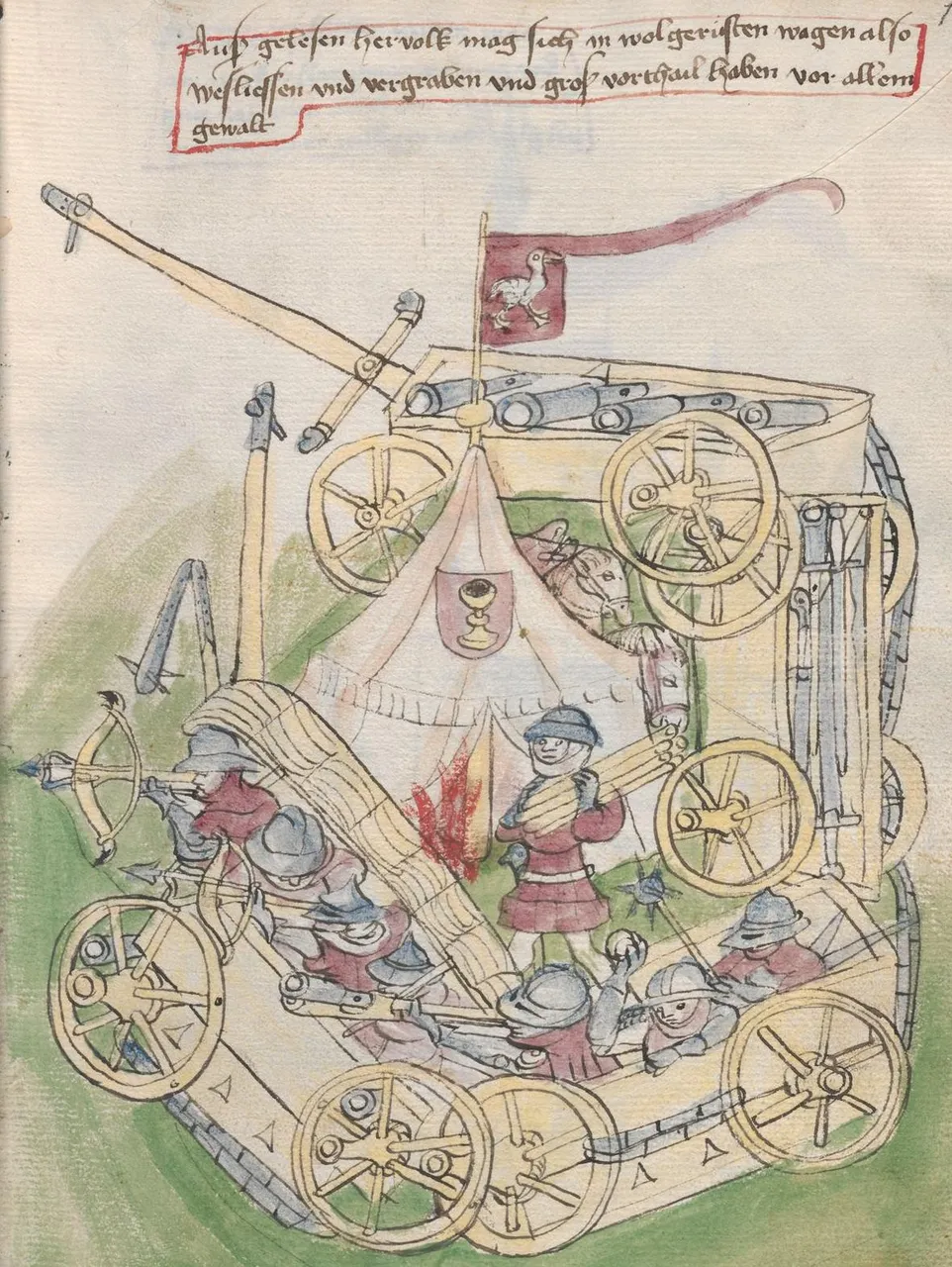 A Hussite war wagon with its crew, handguns and a gun, from a manuscript on the art of war of about 1437Wikimedia Commons, Johannes Wienner, Public domain (War Wagon - Manuscript on the Art of War.jpg)
Sources
- Petr Čornej and Pavel Bělina, Slavné bitvy naší historie (1993), pp. 68 to 74.
- František Šmahel, Husitská revoluce, vol. 3, Kronika válečných let (1996), pp. 178 to 181.
- Count Lützow, The Hussite Wars (1914), ch. 5.
Prev: The siege of Ústí and the Saxon reliefNext: The knights break the chain