14th century
Prague and Kutná Hora
Charles IV, King of Bohemia from 1346 and Holy Roman Emperor from 1355, makes Prague his residence. In 1344 Prague becomes an archbishopric and work begins on St Vitus Cathedral at the castle. In 1348 Charles founds the New Town, three times the size of the Old Town, and the university, the first in Central Europe. In 1357 work begins on a stone bridge over the Vltava, and the castle of Karlštejn, founded in 1348, keeps the imperial regalia and the Bohemian crown jewels.
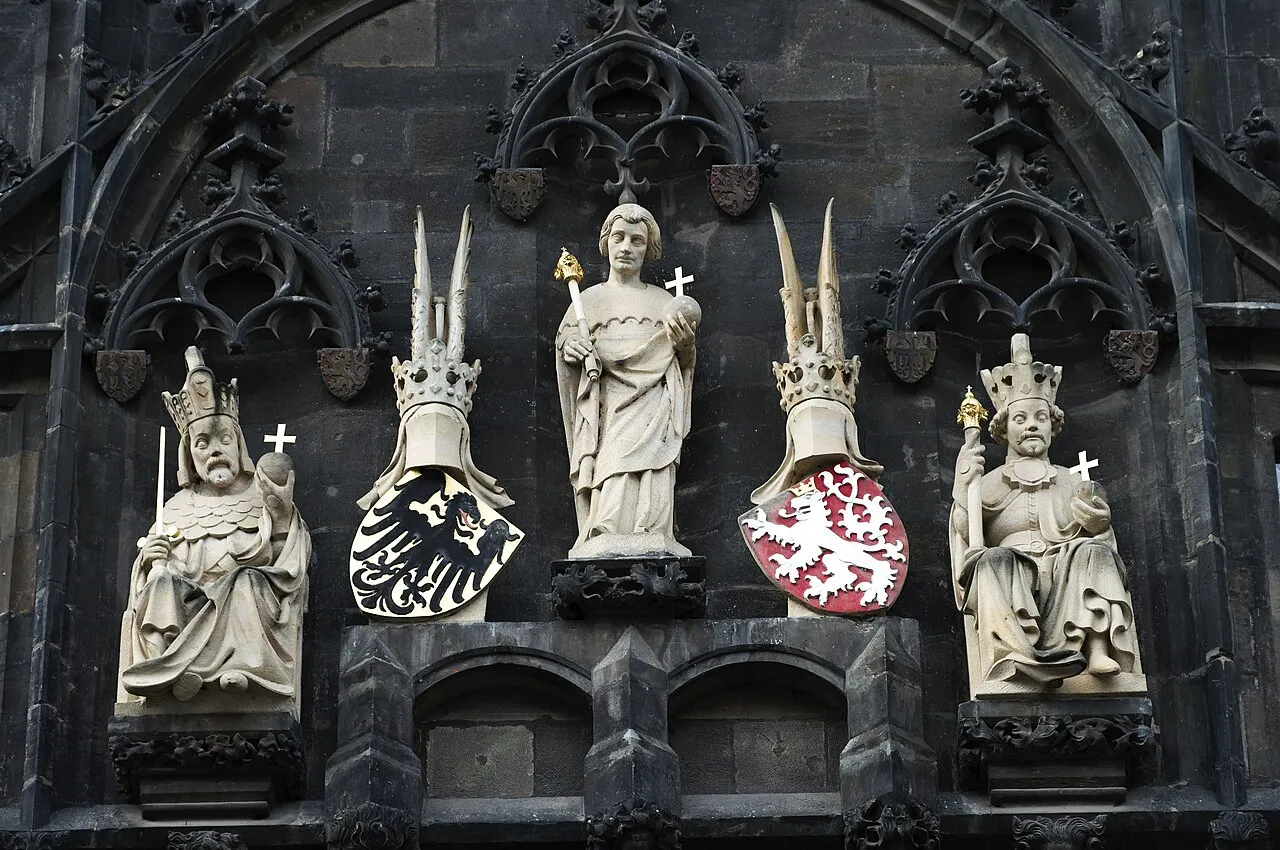 Charles IV, St Vitus and Wenceslas IV on the Old Town Bridge Tower in Prague, built by Peter Parler’s workshop by about 1380Wikimedia Commons, Bjørn Erik Pedersen, CC BY 3.0 (Statues on Old Town Bridge Tower.jpg)
Prague’s four towns, the Old Town, the New Town, the Lesser Town below the castle and Hradčany, have about 40,000 people around 1370, and by some estimates up to twice as many. Charles moves the noisy and dirty trades to the New Town, which fills with poorer Czech craftsmen. Most craftsmen of the Old Town are German or Jewish.
Kutná Hora, about 60 km east of Prague, grows on the silver mines opened about 1260 near the Cistercian abbey of Sedlec. In 1300 King Wenceslas II issues a mining code and makes the town the seat of the royal mint, which strikes the Prague groschen. Kutná Hora becomes the second town of the kingdom and its financial centre, and most of its burghers speak German.
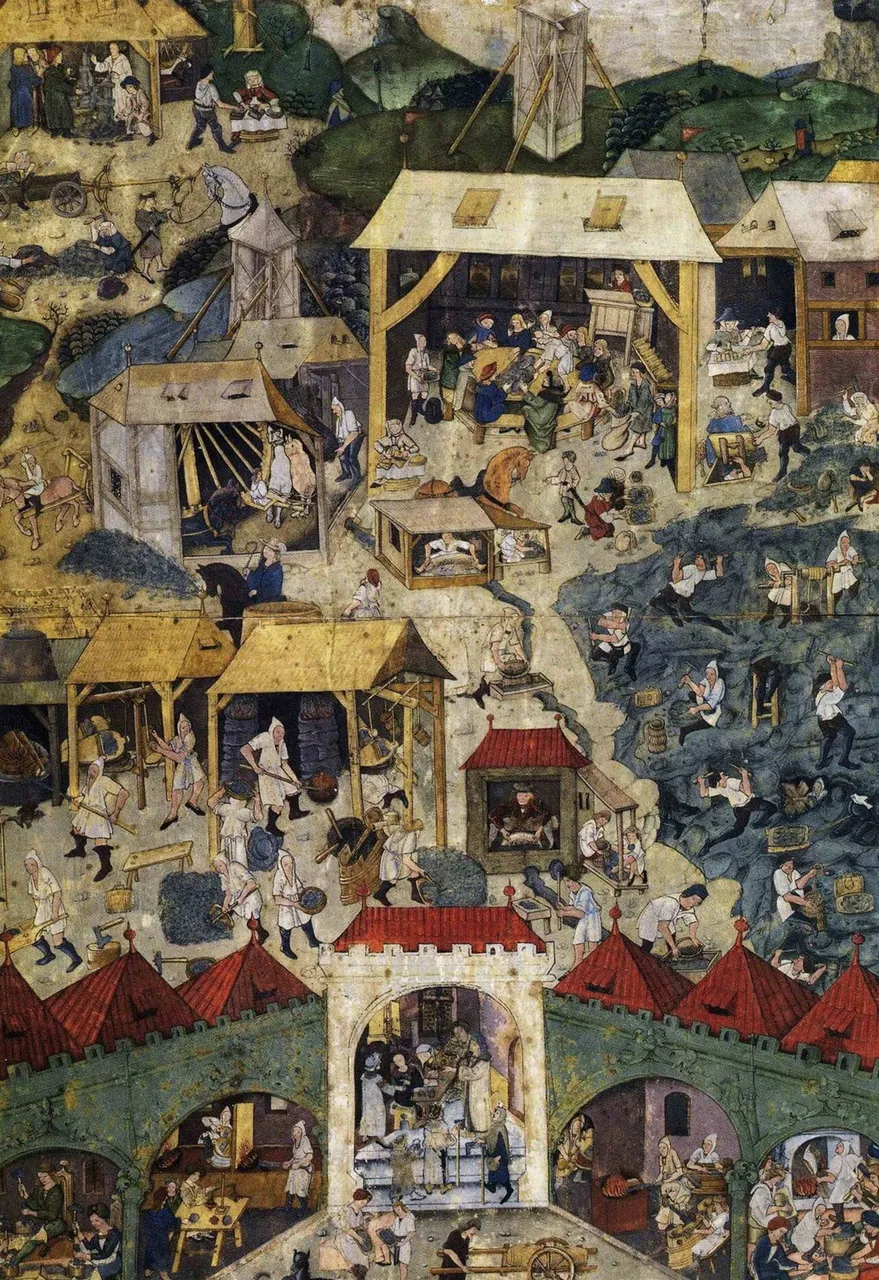 Silver mining at Kutná Hora, from the frontispiece of the Kutná Hora Gradual, 1490sWikimedia Commons, unknown illuminator, Public domain (Silver mining in Kutná Hora 1490s.jpg)
Sources
- Peter Demetz, Prague in Black and Gold (1997).
- František Šmahel, Die Hussitische Revolution (2002), vol. 1.
- Howard Kaminsky, A History of the Hussite Revolution (1967).
Prev: The lands of the Bohemian Crown around 1400Next: Jan Žižka of Trocnov, c. 1360–1409